
ⓘ Affiliate Disclosure: This article may contain affiliate links. If you purchase through one of these links, BerneseMountainLover.com may earn a commission at no additional cost to you. Recommendations are included to help readers compare suitable options for Bernese Mountain Dogs. Read our full disclosure.
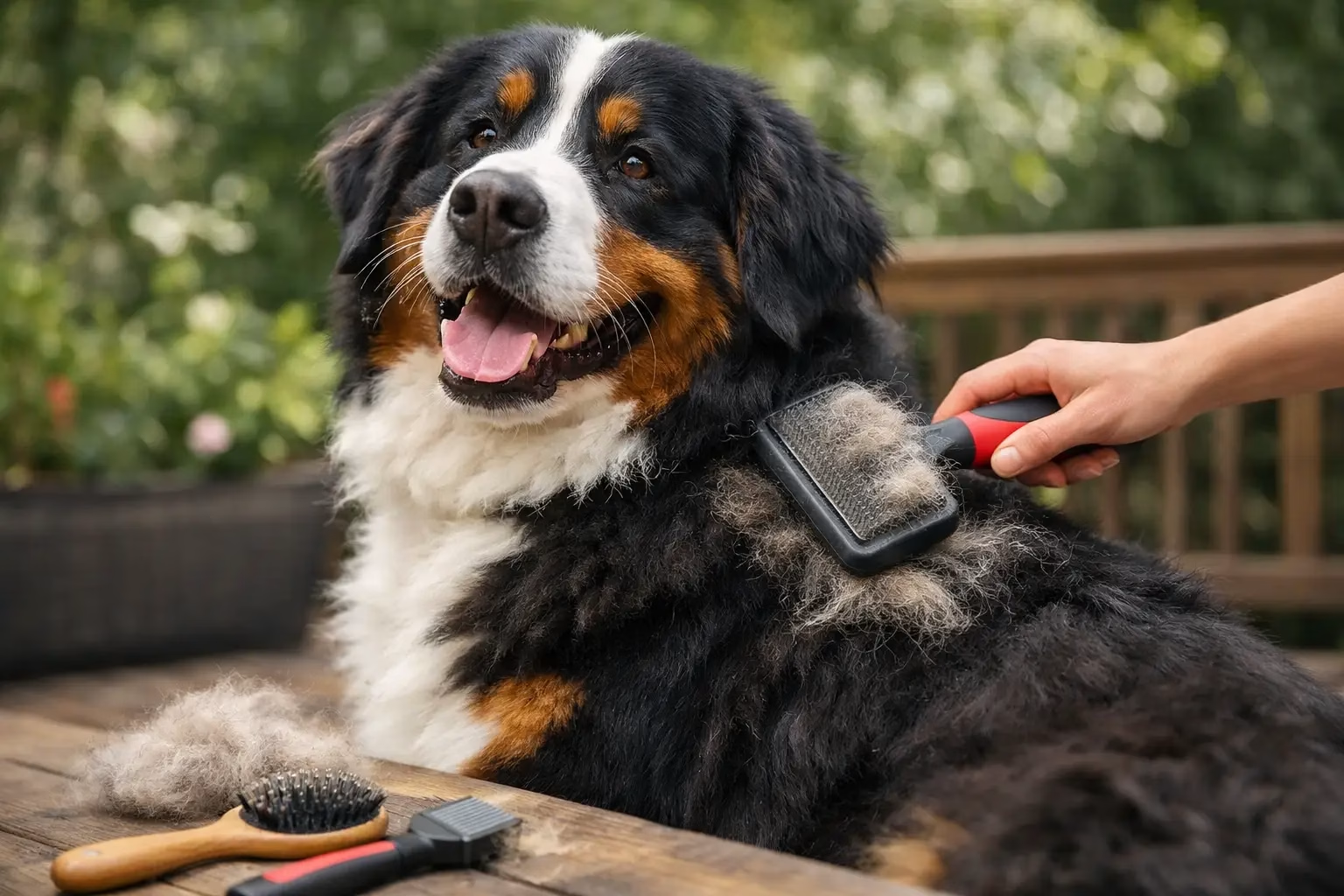
If you live with a Berner, you already know the fur is not a seasonal inconvenience. It is part of daily life. Finding the best brush for Bernese mountain dog shedding matters because the wrong tool can waste your time, miss the undercoat, or worse, damage that beautiful double coat you are trying to protect.
Bernese Mountain Dogs are heavy shedders with a thick, weather-resistant double coat. Their topcoat is longer and slightly coarse, while the undercoat is dense and soft. That combination is exactly why generic grooming advice often falls short. A brush that works well on a short-haired Lab or even a Golden may not be the right fit for a Berner, especially during spring and fall coat blowouts.
For most Bernese owners, the best single brush type is a long-pin slicker brush paired with an undercoat rake. If you want just one place to start, start with the slicker. If you want the most effective setup for real shedding control, you need both.
What makes the best brush for Bernese mountain dog shedding?
A Bernese coat needs more than surface brushing. You are not just removing loose hair from the top layer. You are trying to reach through a thick outer coat, lift dead undercoat, prevent mats behind the ears and legs, and do it without scraping the skin.
That means the best brush for this breed should do three things well. First, it needs enough pin length to get through the outer coat. Second, it has to remove loose fur efficiently without cutting healthy hair. Third, it should be comfortable enough that your dog tolerates regular sessions.
This is where many owners get frustrated. A brush can look effective because it fills with hair quickly, but that does not always mean it is doing the right job. Some de-shedding tools with blades can remove coat fast, but if used too often or too aggressively, they can thin the topcoat and leave the coat looking rough or uneven.
The brush types that actually work on Berners
A long-pin slicker brush is usually the workhorse. It helps separate the coat, remove loose hair, and work through feathering on the chest, legs, and tail. On a Bernese Mountain Dog, shorter slicker pins often stay too close to the surface. Longer pins do a better job reaching into the coat without forcing you to brush the same area over and over.
An undercoat rake is the other tool most Berner homes need. This tool is especially useful during seasonal shedding, when your dog seems to drop half a second dog around the house every week. A good undercoat rake loosens the dead woolly undercoat that a slicker may not fully pull out on its own.
A stainless steel comb is not the main shedding tool, but it is an excellent finishing tool. It helps you check your work and catch hidden tangles in the pants, tail, armpits, and behind the ears. If the comb cannot pass through easily, the coat is not fully brushed.
A pin brush can be helpful for light maintenance and fluffing, but for serious shedding control, it is usually not enough by itself. Rubber curry brushes are great on short-coated breeds, but they do very little for a dense Berner undercoat.
Best overall choice: a long-pin slicker brush
If you want the best all-around answer for the best brush for Bernese mountain dog shedding, choose a high-quality long-pin slicker brush. It is the most versatile option for routine maintenance, moderate shedding, and detangling without over-stripping the coat.
This matters because Berners need frequent brushing, not occasional rescue sessions. A slicker brush fits that rhythm better than a harsh de-shedding blade. You can use it several times a week, and during heavy shed periods, even daily on problem areas.
Look for a slicker with flexible pins, a cushioned pad, and enough surface area to cover a large dog efficiently. Since Bernese Mountain Dogs are big, a tiny brush head can turn grooming into a long project. At the same time, extremely stiff pins can be uncomfortable, especially on sensitive areas like the belly and rear legs.
The trade-off is that a slicker brush alone may not fully handle major coat blowouts. It is your best everyday tool, but not always your fastest heavy-shed solution.

Wooden handle, flexible long pins, cushioned pad – ideal for Bernese Mountain Dogs and other large double-coated breeds.
Check Price on Amazon »
Best tool for coat blowout: an undercoat rake
When spring or fall shedding hits, an undercoat rake often becomes the hero. This is the tool that helps pull out the dead undercoat that seems to keep coming no matter how much you brush.
Used correctly, an undercoat rake can dramatically reduce the amount of loose fur left on your floors and furniture. It also helps air circulate through the coat, which is especially helpful for a heavy-coated breed that can overheat more easily in warm weather.
But there is a clear caution here. Not every rake is gentle, and not every owner uses one gently. You want a rake designed to loosen undercoat, not yank through tangles or scrape at the skin. Slow, light passes work better than aggressive digging. If your dog’s coat is matted, forcing a rake through it is uncomfortable and can make your dog resist grooming the next time.

Wide-tooth steel undercoat rake with anti-slip grip – designed for pulling loose undercoat from thick-coated breeds like Berners.
Check Price on Amazon »
Brushes and tools to use carefully
Some popular de-shedding tools remove a shocking amount of fur fast. That can feel satisfying in the moment, but speed is not the only goal. On a Bernese, overusing blade-style de-shedding tools can remove too much healthy coat and disturb the natural texture and protection of the outer coat.
That does not mean these tools are always wrong. It means they should not be your default brush for regular grooming. If used at all, they should be used sparingly, with a light hand, and usually during heavy seasonal shed rather than every week.
The same goes for very firm slicker brushes marketed for dematting. Berners can get tangles, but a brush that is too harsh can turn grooming into something they dread. For a breed this large and this hairy, your dog’s cooperation matters.
How often should you brush a Bernese Mountain Dog?
Most Bernese Mountain Dogs do well with brushing three to four times a week. During shedding season, daily brushing is often the difference between manageable fur and fur everywhere.
Puppies may need shorter, gentler sessions so they learn grooming is normal and safe. Adults with full coats need more thorough line brushing, especially in feathered areas and anywhere friction causes mats, like under the collar, behind the ears, in the armpits, and around the hindquarters.
Bathing can also help loosen dead coat, but brushing before and after the bath matters. A wet tangled coat only gets harder to manage.
How to brush a Berner without missing the undercoat
The biggest mistake owners make is brushing the top layer until it looks smooth and assuming the job is done. On a Bernese, the outer coat can look beautiful while the undercoat underneath is still packed with loose hair.
Line brushing works better. Part the coat with your hand and brush in sections, starting low on the body and moving upward. This lets you reach the undercoat instead of skating across the surface. Work from the neck and shoulders down through the chest, sides, rear, tail, and feathering.
Go slowly in sensitive areas. If you hit resistance, do not rip through it. Use your fingers or comb to isolate the tangle first, then gently work it apart. A calm ten-minute session done regularly is usually more effective than a once-a-week marathon.
Signs your current brush is the wrong one
If brushing takes forever and still leaves hair falling out in clumps, your tool may not be reaching deep enough. If your dog flinches, avoids you, or gets red skin after grooming, the brush may be too harsh. If the coat starts to look choppy, frizzy, or thinned out, you may be overusing a de-shedding blade.
A good brush leaves the coat cleaner, lighter, and smoother without making it look stripped. Your Berner should also be more comfortable after grooming, not irritated.
The best setup for most Bernese owners
If you want a practical answer, not a complicated grooming arsenal, here is what usually works best: a long-pin slicker brush for regular brushing, an undercoat rake for heavy shedding periods, and a steel comb for finishing and spot checks. That combination covers routine maintenance, seasonal blowouts, and tangle prevention without overcomplicating the job.

Professional-grade stainless steel finishing comb – use after brushing to check for hidden tangles and mats.
Check Price on Amazon »
For first-time Berner owners, this is usually the smartest place to start. You do not need every grooming gadget on the market. You need tools that respect the structure of a Bernese coat and a routine you can stick with. For a full coat-care routine, see our Bernese Mountain Dog grooming guide and our guide to shedding solutions.
The right brush will not stop shedding. Nothing will. But it can make the shedding manageable, keep your dog more comfortable, and protect the coat that makes this breed so unmistakable. With Bernese Mountain Dogs, that is the real win.
Love spoiling your Berner? Grooming tools are just the start – browse our collection of Bernese Mountain Dog gifts, from mugs and shirts to hoodies, stickers, and personalized Berner designs.
