

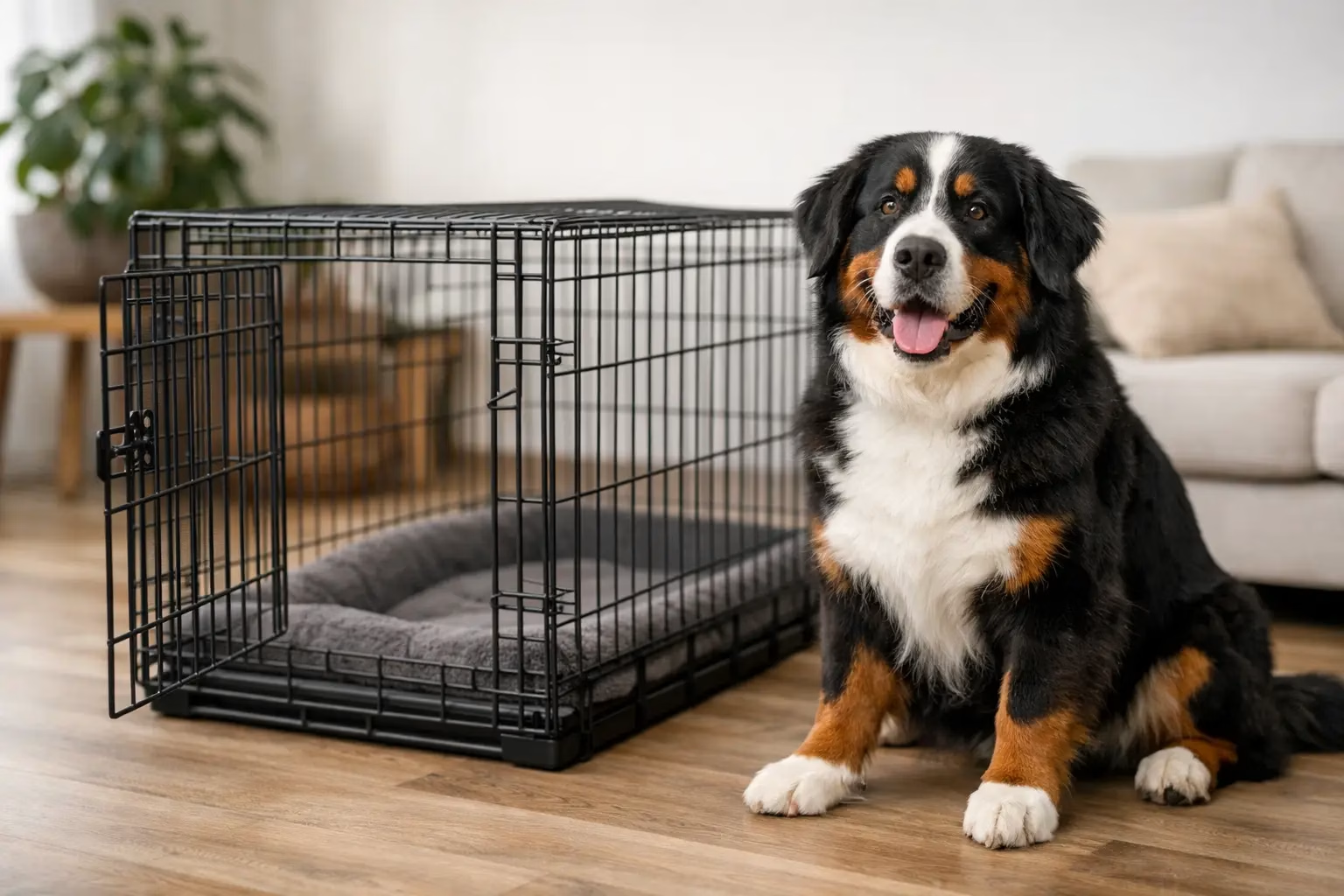
A Bernese puppy can look manageable at eight weeks, then suddenly seem twice as big a month later. The growth spurts they go through makes choosing the right crate size important to think about. It takes a bit more thought than just grabbing the biggest crate on the shelf. You need enough room for comfort and safety, but not so much space that crate training becomes harder or the crate overwhelms your home.
Pictured below: Scarlett at 9, and Indy as a young pup.

For most adult Bernese Mountain Dogs, a 48-inch crate is the right starting point. But, getting your dog to the size of that full crate takes up to 12 months and can leave you wondering what to do. This is why I would always recommend purchasing an adjustable crate, and checking the size each week to see if it needs to go bigger or smaller. In many cases, it is the best fit. But as with most things in this breed, the real answer depends on your dog’s build, age, and how you plan to use the crate. I always used the crate for crate training – and to make a “safe space of rest” for the dog. That meant, no sending the dog to the crate as a punishment. the crate was always used as a place of rest for the dog, which can be very helpful (for instance if you need to run to get groceries and do not want to leave the pup unsupervised).
What size crate does a Bernese Mountain Dog need?
Most full-grown Bernese Mountain Dogs do well in a 48-inch adjustable crate, commonly measuring about 48 inches long, 30 inches wide, and 32–33 inches high. For many adult Berners, this provides enough room to stand comfortably, turn around, and lie down without being cramped.
Not every Bernese Mountain Dog will fit the same crate equally well. Males are often larger and broader than females, and some adult Berners are especially tall or heavy through the chest. Before choosing a crate, check the interior height and width as well as the listed length. Your dog should be able to stand naturally without hunching, turn around comfortably, and rest in a normal lying position. I found it helps to take measurements of the parents of your puppy for approximate future size and use them as a reference guide for crate size. If you end up taking the largest of the litter; and the parents are very large (120+lb) you may find you have to step up to a larger crate size. It’s better to be prepared than to have to buy a larger crate down the road!
For a Bernese puppy, do not buy a smaller crate that will quickly be outgrown. If you have a smaller crate around and can use it that is likely fine, but just know you will have to still be prepared to buy a larger one. A better option is a 48-inch crate with a divider panel. Adjust the divider so your puppy has enough space to stand, turn around, and lie down comfortably, then increase the usable space as they grow.
Also its good to note that giving a puppy far more space than needed during house training is not a good thing. If the crate is oversized, some puppies may sleep at one end and have accidents at the other which can delay house training. The goal is not to make the crate tight, but to keep it appropriately sized, comfortable, and secure.
A crate should always be a safe resting space, never a place of punishment. I have never personally placed a cover overtop of the crate; but some of my friends/family have had good success with that. I think it makes the crate feel more like “home” for the dog.
Bernese mountain dog crate size by age
The ideal bernese mountain dog crate size changes dramatically during puppyhood. Berners grow fast, and what works at nine weeks may be too small by four or five months. This is once again why we need to be prepared and have an adjustable divider for our crate, of which we monitor and check every week. The divider can be used to expand the space as your favorite new puppy grows. If you go too big too soon, you will inevitably have messes if using the crate for crate training (ask me how I know, I for sure came home to a few messes because of this one).
Bernese puppies
For young puppies, many owners start with a 42-inch or 48-inch crate that includes a divider panel. This is usually the smartest approach. Instead of buying multiple crates as your puppy grows, you can adjust the usable space over time.
The divider lets you create a sleeping area that is large enough for your puppy to stand up, turn around, and lie down comfortably, but not so big that potty training gets sloppy. As your puppy gets taller and longer, you move the divider back.
If you already know your puppy will likely reach 80 to 115 pounds as an adult (once again, helpful to have an idea on how big the pup will be based on the parent’s size), buying a small crate first often becomes an unnecessary expense. A properly divided larger crate is usually more practical.
Adolescent Bernese Mountain Dogs
This stage can be awkward. Your dog may be too large for a puppy setup but still not fully filled out. Between about six and twelve months, many Berners need more length and more headroom, even if they are still lean. I found that my puppies always seemed to get to their final height by 1-2 years of age. It’s also funny to see the growth patterns – one week the front end is taller than the rear, the next its the opposite 😂. I always enjoy (and honestly miss that stage) of watching your puppy grow into a dog.
If your adolescent Berner seems cramped when sitting upright or has to curl too tightly just to rest, it is time to enlarge the crate space. Growth during this phase can sneak up on owners, especially in a breed that matures more slowly than many people expect.
Adult Bernese Mountain Dogs
Once your dog is fully grown, a 48-inch adjustable crate is still the standard choice for most homes. Some extra-large dogs may need a roomier heavy-duty model with generous height and width, but that is the exception, not the rule. What matters most is fit. Your adult Berner should be able to enter easily, turn without bumping the sides, and settle in without looking folded in half.
I always found that most of my dogs were fully filled out by 3-4 years of age. The only exception so far was Indy (pictured below), who took 4-5 years of age to fill out properly. Life for us at 3-4 years of age was not so good, which could have added to the time to fill out; or it could have been due to the fact that she was one of the smaller ones of the litter that I chose. I chose her because she was a sweet-but-cautious girl, and am very grateful to have her in my life.

How to measure your adult dog for the right fit
If you want to be confident, measure your adult dog instead of relying only on breed averages. Bernese Mountain Dogs and breeding vary enough that this matters.
Measure your dog from the tip of the nose to the base of the tail, then add 2 to 4 inches for crate length. For height, measure from the floor to the top of the head or ears when your dog is standing naturally, then add 2 to 4 inches. That gives you a more realistic target than a generic breed chart.
Pay attention to sleeping style too. Some Berners curl up tightly, while others like to sprawl on their side with legs extended. If your dog is a stretcher, width becomes especially important.
TIP: If you are purchasing a crate for your FUTURE Bernese puppy; measuring full size will not be possible. Instead, ask to measure the parents (if possible), on the pickup date of your puppy. As long as the crate will fit the larger of the parents; this should be close enough for you to purchase a crate.
Why a divider matters for Bernese puppies
For a giant-breed puppy, a divider is not just a convenience. It is one of the easiest ways to make crate training smoother.
Puppies naturally avoid soiling the area where they sleep, but that instinct weakens when the crate is oversized. A divider helps preserve that den-like feeling without forcing you to replace the crate every few months.
It also helps your puppy feel more secure. A huge open crate can feel less comforting to a small puppy, especially during the first nights away from littermates. I found it was always helpful to have something that smelled like the parents and or littermates in the crate with the new puppy. A correctly sized section often encourages better settling and less restless pacing.
Wire, plastic, or heavy-duty crate?
For most Bernese families, a sturdy wire crate is the most practical choice. It offers ventilation, visibility, and flexibility, especially if it comes with a divider. It also tends to work well for home crate training because your Berner can still see the household around them.
Plastic crates can be useful for travel or dogs that settle better in a more enclosed space, but they can feel tight for a large adult Berner. You also need to be very careful with ventilation and actual interior dimensions.
Heavy-duty crates are sometimes worth considering for a powerful dog that bends standard wire or panics when confined. That is not every Bernese Mountain Dog by any means. Many are gentle and calm in a regular crate. But if your dog is a determined escape artist or has severe separation distress, durability matters. I always went with the wire crates; and I still have one to this date. They are easy to clean, easy to find dog beds for, and are immensely helpful in the training stages.
Common crate sizing mistakes
The most common mistake is buying a crate based only on weight. Two Bernese Mountain Dogs can weigh roughly the same but have different height, chest width, and body length. Weight helps, but measurements tell the real story. For instance, Scarlett and Reba weighed close to the same. Scar was thicker and wider; Reba was taller.
Another mistake is choosing the largest crate possible for a young puppy without using a divider. It sounds generous, but it can create setbacks with house training and make the crate feel less secure.
Some owners also underestimate how much room a Bernese needs to lie down comfortably. This breed is large, deep-chested, and fluffy. Thick coat does not change the skeletal size, but it does affect how cramped a crate can feel in daily use.
Finally, do not confuse a crate for rest with a place to spend long, isolated hours every day. Berners are deeply people-oriented. Even the right crate size will not make extended confinement emotionally healthy.
Where to place the crate in your home
Crate size is only part of the equation. Placement changes how your dog feels about using it.
A Bernese Mountain Dog usually does best when the crate is in a family area, especially during training. I have yet to meet a Bernese Mountain Dog that does not attach to their family, and that does not want to be around you all day. Kitchens, living rooms, or nearby open spaces often work better than a remote basement or closed spare room. This breed generally wants to be near its people and in my experience, is at peace being around its family. If you remove the family; separation anxiety can kick in and your dog may bark and or panic.
At night, many owners keep the crate in the bedroom or close by during the puppy stage. That can make nighttime potty trips easier and help reduce anxiety. Later, some dogs transition well to another area of the house, while others rest better when they still feel included. I always found in the first few weeks the puppies liked being in the room with me, on a crate that was elevated and pointed at me so they could see me. If they could not see me during this stage; I found I would not get adequate sleep as the puppy would whine lots.
Do Bernese Mountain Dogs like crates?
Many do, if the crate is introduced thoughtfully and sized correctly. A well-trained Berner often sees the crate as a calm place to sleep, decompress, or retreat from household noise. Having a crate trained Berner can be exceptionally helpful down the road as life situations changes as well!
But liking a crate is not automatic. If the crate is too small, used mainly for punishment, or associated with stress, your dog may resist it. Berners are sensitive dogs. They respond best when the crate is introduced with patience, consistency, a sense of safety and mostly importantly – positivity! I always had good luck with my dogs as I would give them a small treat each time they would have to go into the kennel. I would coax them into the kennel with the dog treat, and reward them after they entered the kennel. The treats I would use would be classified as the “training dog treats” – basically small mini bits of chicken, beef, etc.
If your dog is not a chewer, soft bedding also helps. A predictable routine and enough exercise before crate time helps as well. A bored Berner in a crate is much more likely to whine, paw, or struggle to settle. You may find it helpful to keep the same routine for training. An example might be a night time walk, then a training keyword (such as “Hey Indy, it’s crate time”. If you can be routine with this, these are VERY smart dogs. If you say “Hey Indy, it’s crate time” each time before she gets rewarded with a mini training treat, then gets to settle down in her kennel; this can be very positive for training.
The best crate size for most Bernese homes
If you want the simple answer, buy a quality 48-inch crate with a divider for a Bernese puppy, and expect that same crate to suit most adults. It is the option that fits the widest range of dogs in this breed and usually offers the best balance between comfort, training success, and long-term value. For where to get your crate, I would honestly recommend checking out your local Pet store for good options. Alternatively, if buying used, Marketplace,Craigslist, etc can be helpful too.
Still, trust your eyes as much as the label. If your Bernese looks cramped, measures larger than average, or sleeps in a way that clearly demands more room, adjust accordingly. Breed guidelines are helpful, but your individual dog matters more.
A crate should support your Berner’s sense of security, not just contain a large body. When the size is right, it becomes one more way to give this gentle giant the comfort and structure they deserve.
I hope this helps!!
