
I’ve lived with Bernese Mountain Dogs since 2011. Scarlett and Reba were my first two, and Indy is with me now. If there’s one thing all three taught me about exercise, it’s that a Berner does best with steady, sensible activity, not big bursts of hard effort. These are large, heavy dogs, and what keeps a Lab or a Border Collie happy will quickly wear out a Berner or stress their joints.
Figuring out the right amount of exercise takes a little real-world experience. You have to learn your own dog. Some days Indy is ready for a long sniff walk and a play session in the yard, and some days she’d rather take it slow. The goal isn’t to hit a number every day. It’s to keep your Berner fit, keep their joints moving, burn a little energy, and pay attention to what your dog is telling you. This guide walks through how much exercise Bernese Mountain Dogs usually need, how that changes with age, what to avoid, and how to build a routine you can actually stick with.
A quick note before we start: this is owner-to-owner guidance, not veterinary advice. Talk with your vet before starting any intense exercise, especially with a puppy, a senior, an overweight dog, or a dog with joint or health concerns.
How Much Exercise Does a Bernese Mountain Dog Need?
For most healthy adult Berners, somewhere around 60 to 90 minutes of activity a day is a good target, split into two or more sessions rather than one long push. That can be a mix of walks, easy play, sniffing time, and a bit of training. It doesn’t all have to be brisk walking.
The important thing to understand is the kind of exercise. Berners are not lazy, but they are not built like endurance dogs either. They were bred to work at a steady pace in the cool Swiss mountains, carting and moving alongside people, not running long miles or doing repetitive high-impact work. Steady and moderate suits them. Two relaxed-to-brisk walks plus some yard time and a little mental work will keep most adult Berners in good shape without grinding on their hips and elbows.
With my own dogs, I’ve found consistency matters more than intensity. A predictable daily rhythm of a morning walk and an evening walk does far more good than an occasional big outing that leaves them sore the next day. Exercise also keeps weight in check, and weight management is a big deal for this breed. Extra pounds put real stress on joints that are already prone to trouble, so daily movement plus regular weigh-ins at the vet is your simplest defense.
Still deciding on the details? Two other guides cover the questions that come up most often before a Berner comes home: whether to get a male or female Bernese — the temperament differences are real but smaller than most people expect — and what size crate a Bernese actually needs, which is the one purchase people most often get wrong on the first try.
Bernese Mountain Dog Puppies Need Controlled Exercise
Puppy exercise is the part owners get wrong most often, usually with good intentions. A Bernese Mountain Dog puppy’s growth plates don’t fully close until around 18 to 24 months. Until then, repetitive impact, like long runs on pavement, jumping on and off furniture, or hard fetch on a slick floor, can damage developing joints in ways that show up years later as arthritis or worse.
A common guideline many owners use is about five minutes of structured exercise per month of age, twice a day. So a four-month-old puppy gets roughly 20 minutes of walk or structured play, twice daily. It’s a rule of thumb, not a law, but it keeps you from overdoing it.
What “controlled” means in practice:
- Short, frequent walks where the puppy is allowed to stop and sniff freely, on soft grass or dirt when you can.
- Gentle play on soft surfaces, not slippery floors.
- Basic obedience and socialization, which tire a puppy out mentally without touching the joints.
- Shallow wading or supervised swimming, which is low impact.
What to avoid while the joints are still developing: forced running or jogging, repeated jumping, long hikes, stairs, and play on hard or slick surfaces. A no-pull harness and a long leash help here. A long line lets a puppy explore and move naturally while you still keep control, and a good no-pull harness keeps a strong, growing puppy from hauling on their neck. For more on starting a Berner pup off right, see our guide to bringing home a Bernese Mountain Dog puppy.
Adult Bernese Mountain Dog Exercise Routine
Once a Berner is past two years old and fully grown, you can settle into a real routine. Here’s a practical adult day that’s worked well for me:
- Morning: A 30-minute walk at an easy-to-brisk pace. Let them sniff. Sniffing is genuine mental work, not wasted time.
- Midday or afternoon: Some yard time, a little gentle play, or a short training refresher. Ten or fifteen minutes is plenty.
- Evening: A second walk, 20 to 30 minutes, plus a puzzle toy or a stuffed Kong while you make dinner.
That lands around 60 to 90 minutes total without ever being hard on the body. On cooler days you can add a hike or a longer walk. On hot days you scale back and move things earlier or later (more on heat below). A good travel water bottle is worth keeping by the door so you always have water on a walk.
Senior Bernese Mountain Dog Exercise Needs
Berners tend to slow down sooner than smaller breeds, and many start showing stiffness in their middle years. As they age, the goal shifts from fitness to comfort and mobility. You still want to keep them moving, because stopping entirely leads to muscle loss and stiffer joints, but everything gets gentler.
For a senior, think 30 to 45 minutes of easy activity a day, broken into shorter sessions, on flat and forgiving ground. Slow walks, gentle play, and wading or swimming if your dog enjoys water are all good. Watch the weather, since cold, damp days stiffen older joints. Let your senior set the pace and turn back before they’re tired rather than after.
Comfort at home matters just as much as the walk. A good orthopedic, joint-friendly bed makes a real difference for an older Berner’s rest and recovery. For help choosing one, see our roundup of the best dog beds for Bernese Mountain Dogs. Always loop in your vet on a senior’s routine, especially if you see arthritis signs, so the plan fits your individual dog.
Best Exercises for Bernese Mountain Dogs
A good routine mixes a few different things rather than the same walk every day:
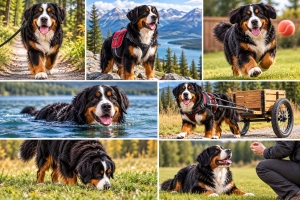
- Daily walks. The backbone of it all. Two moderate walks beat one long forced march. Let them sniff.
- Hiking. Their heritage shows on a trail. Stick to soft dirt paths, pack water, and take breaks. One of my favorite memories is a short hike with Indy at Abraham Lake in 2024, the kind of steady outing Berners love.
- Yard play. Easy fetch on grass, gentle chase, or just pottering around. Low pressure, low impact.
- Swimming, if your dog likes it. It builds muscle and conditions the heart with zero joint impact. Honestly, none of my three Berners have been real swimmers. They like to wade on a warm day. Indy will go in, but mostly only up to where her hind legs meet her body. If your dog enjoys water, it’s one of the best forms of exercise there is.
- Light pulling or carting. A nod to what the breed was built for, but only once the dog is fully mature and properly trained, with the right fitted gear.
- Sniff walks and scent games. A walk where the whole point is to let them use their nose is surprisingly tiring in a good way.
- Training games and gentle play. Short, fun, and good for your bond.
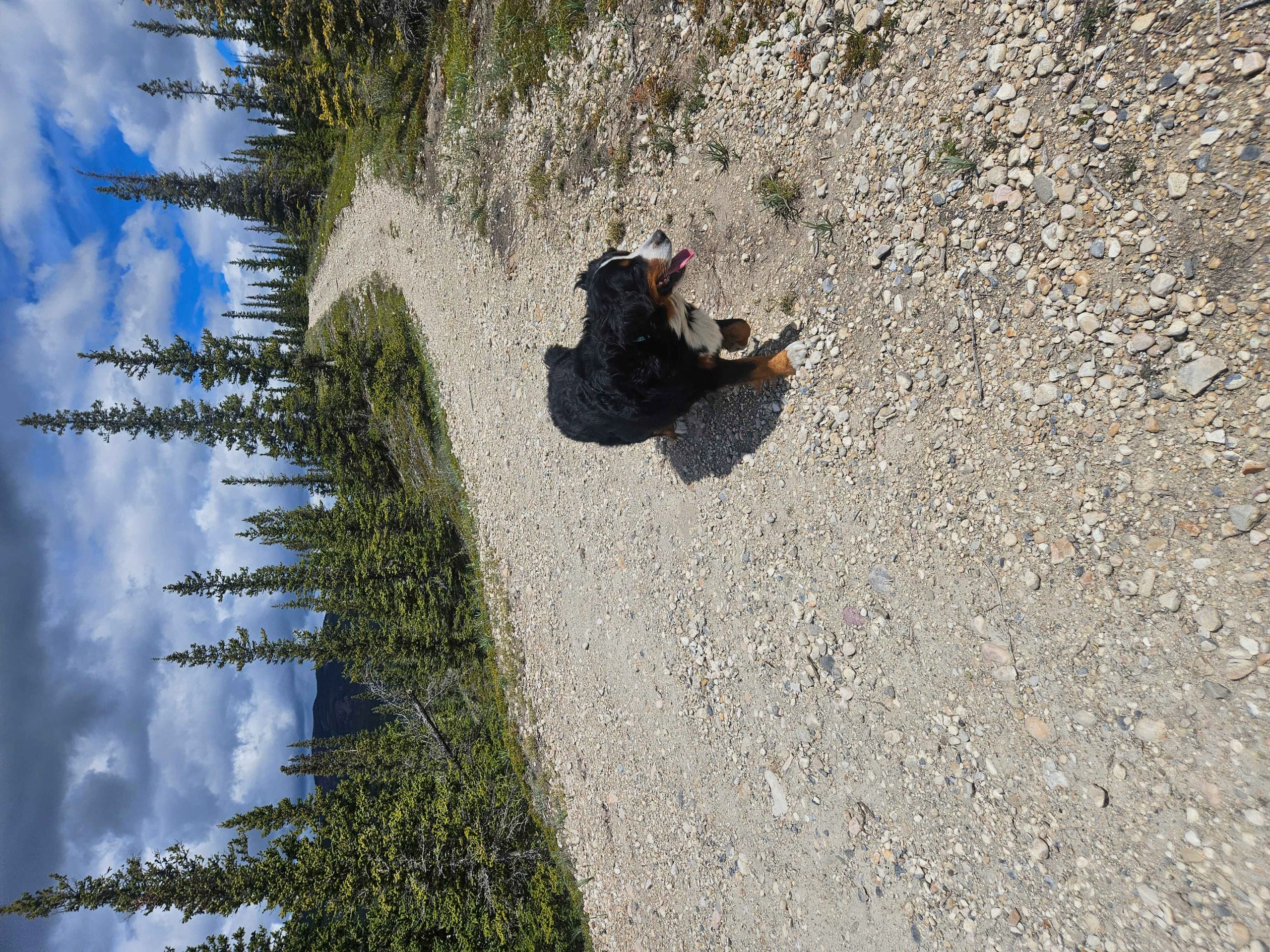
Indy and I at Abraham Lake on a quick hike in 2024.
Exercises and Activities to Avoid
Some activities do more harm than good for this breed, especially repeated over time:
- Long-distance running or forced jogging. Berners can jog a little once grown, but sustained running isn’t their natural mode and it pounds the joints.
- Long runs on pavement or other hard surfaces.
- Repetitive jumping, on and off furniture, in and out of the car, or hard fetch with lots of leaping.
- Hard or repeated stair work, particularly for puppies and seniors.
- Anything strenuous in the heat (covered next).
- Rough, repetitive high-impact play that keeps stressing the same joints.
None of this means your Berner has to live in bubble wrap. It just means choosing steady movement over pounding. For more on what tends to go wrong with this breed’s joints, see our guide to Bernese Mountain Dog health problems.
Hot Weather Warning for Bernese Mountain Dogs
This is the one I’d underline twice. Bernese Mountain Dogs are cold-weather dogs. That thick double coat that’s so beautiful in winter is a serious liability in summer, and Berners overheat fast, faster than you’d expect, even on a day that feels only mildly warm to you.
What’s worked for me over the years: I’d walk the dogs before work in the morning while it was still cool, and again in the evening, and in summer I’d push that evening walk until after the sun went down. A few practical rules:
- Exercise in the early morning or late evening during warm months, not midday.
- Check the pavement with your hand. If it’s too hot for your hand, it’s too hot for their paws.
- Always bring water and offer it often. Watch the tongue. Heavy panting is your sign to stop and let them cool and drink.
- Keep cooling options at home. A cooling mat gives them a place to lie down and shed heat. A shaded kiddie pool in the yard also works well.
- On truly hot days, move exercise indoors and lean on mental work instead.
If you see heavy panting that won’t settle, bright red gums, drooling, wobbliness, or confusion, stop everything, cool your dog down, and contact your vet. Heat stress is a real emergency in this breed.
Signs Your Bernese Mountain Dog Needs More Exercise
A bored or under-exercised Berner usually tells you, just not in words. Watch for:
- Restlessness and an inability to settle in the evening.
- Chewing, digging, or getting into things. Indy digs when she’s left in the yard alone with nothing to do, and that’s almost always a sign she needs more engagement.
- Barking or pacing.
- Attention-seeking and general pestering.
- Gradual weight gain.
These usually mean your dog needs more activity, more mental work, or both. Often the fix is enrichment as much as miles.
Signs Your Bernese Mountain Dog Is Getting Too Much Exercise
You can also overdo it, and the signs point the other way:
- Limping or favoring a leg during or after activity.
- Lagging behind or lying down on a walk they’d normally finish easily.
- Heavy, prolonged panting that doesn’t settle with rest.
- Reluctance to start a walk they usually enjoy.
- Stiffness or soreness, especially morning stiffness that doesn’t loosen up within 15 or 20 minutes of moving.
- Sleeping much more than usual after exercise.
- Any heat-stress signs, like the panting and distress described above.
If you see these, ease off and give your dog a few quieter days. If stiffness, limping, or reluctance keeps showing up, that’s a conversation to have with your vet rather than something to push through.
Mental Exercise Matters Too
Physical activity is only half of it. A Berner that’s been mentally worked is a calm, satisfied Berner, and mental work is a lifesaver on hot or rainy days when you can’t get outside much. Some easy options:
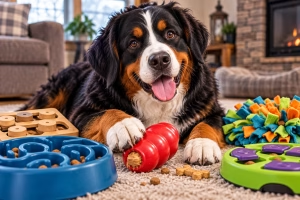
- Puzzle toys and slow feeders. Making them work for their food drains energy. A stuffed Kong is my go-to. I always had good luck packing them with peanut butter and a little cereal and freezing them. A frozen one can keep a dog busy for the better part of an hour. The KONG Classic is the one I always reach for.
- Scent games and hide-and-seek. Hide treats around a room or the yard and let them find them. You can hide yourself and call them, too.
- Basic obedience and training refreshers. Ten minutes of practicing known commands or teaching something new is real mental exercise.
- Slow feeders for meals. A simple way to turn dinner into a small puzzle and slow down a fast eater.
Rainy day and cold-snap ideas: indoor training sessions, a hallway game of find-it, puzzle feeders, and gentle indoor play. A senior or an adult can stay perfectly content on a bad-weather day with nothing but mental work and a short potty walk.

My Realistic Exercise Routine for a Bernese Mountain Dog
I want this to sound like real life, not a perfect plan nobody actually follows. Here’s roughly how it goes with Indy.
Morning, before the day heats up, we do a 30-minute walk and I let her sniff as much as she wants. After work, if it’s not too hot, we do a second walk, usually 20 to 30 minutes. In summer I just wait until evening when the sun’s down. Somewhere in the day she gets a stuffed Kong or a little training, and on weekends we might do an easy hike on a soft trail if the weather’s good and cool.
Some days that all happens. Some days it doesn’t, and that’s fine. If it’s blazing hot, we skip the long walk and do puzzle toys and a short potty trip instead. If she seems stiff or just off, we take it easy. The routine bends around the weather and around how she’s doing, and that flexibility is the whole point. Steady most days beats perfect some days and nothing the rest.
Quick Reference: Exercise by Age
| Age | Exercise Goal | Example Routine | What to Avoid |
| Puppy (under 18 mo) | ~5 min per month of age, twice daily | Short sniff walks on grass, gentle play, training, shallow wading | Running, jumping, stairs, long hikes, hard surfaces |
| Adult (2–7 yrs) | 60–90 min total, split up | Two walks, yard play, hikes on soft trails, swimming, puzzle work | Peak-heat exercise, pavement runs, repetitive high-impact play |
| Senior (7+ yrs) | 30–45 gentle min | Short flat walks, gentle play, swimming/wading, scent games | Long distances, jumping, cold-damp exertion |
Frequently Asked Questions
How much exercise does a Bernese Mountain Dog need each day?
Most healthy adult Berners do well with about 60 to 90 minutes a day, split into two or more easy-to-brisk sessions rather than one hard push. Puppies and seniors need less, and the right amount always depends on your individual dog’s age, weight, and health.
Can I take my Bernese Mountain Dog jogging?
Only once they’re fully grown, around 18 months or older, on soft surfaces, in cool temperatures, and after your vet has cleared their joints. Berners aren’t built for sustained running, so keep it short, mix in walking, and don’t push it.
How much exercise is right for a Bernese Mountain Dog puppy?
A common guideline is about five minutes per month of age, twice a day, on soft ground. Avoid forced running, repeated jumping, and stairs until the growth plates close around 18 to 24 months. Free play and sniffing time are fine; it’s repetitive impact you want to limit.
Is it safe to exercise my Berner in summer?
Only in the early morning or late evening. Bernese Mountain Dogs are cold-weather dogs and overheat fast. Check the pavement with your hand, always carry water, and move activity indoors on hot days. Heavy panting that won’t settle is your sign to stop.
How do I know if I’m over-exercising my Bernese Mountain Dog?
Watch for limping, lagging behind, lingering stiffness, reluctance to start a walk they usually enjoy, or heavy panting that doesn’t settle. Ease off for a few days, and check with your vet if any of it keeps showing up.
Final Thoughts
Bernese Mountain Dogs need consistent, moderate exercise. Not forced workouts, not endurance miles, just steady daily activity matched to their age and personality. Protect those joints, especially while a puppy is growing and as a senior slows down. Respect the heat, because this is a cold-weather breed that overheats quickly. And learn your own dog, because the best routine is the one that fits the Berner in front of you.
Do that, and you’ll have a fit, content companion who’s a pleasure to live with. After living with these dogs since 2011, that steady middle path is the thing I’d most want a new Berner owner to take away.
This article is owner-to-owner guidance, not veterinary advice. Please talk with your vet before starting any intense exercise program, especially for puppies, seniors, overweight dogs, or dogs with joint or health concerns. As an Amazon Associate, this site earns from qualifying purchases.
Related reading: Bernese Mountain Dog shedding and grooming · Bernese Mountain Dog health problems
Owner-written, not veterinary advice. This article is written by a Bernese Mountain Dog owner, not a veterinarian. It is general information gathered from veterinary and breed-club sources — not a diagnosis or a treatment plan. Every dog is different. If your dog is unwell or showing any sign described here, call your own vet. In an emergency, go straight in.
