

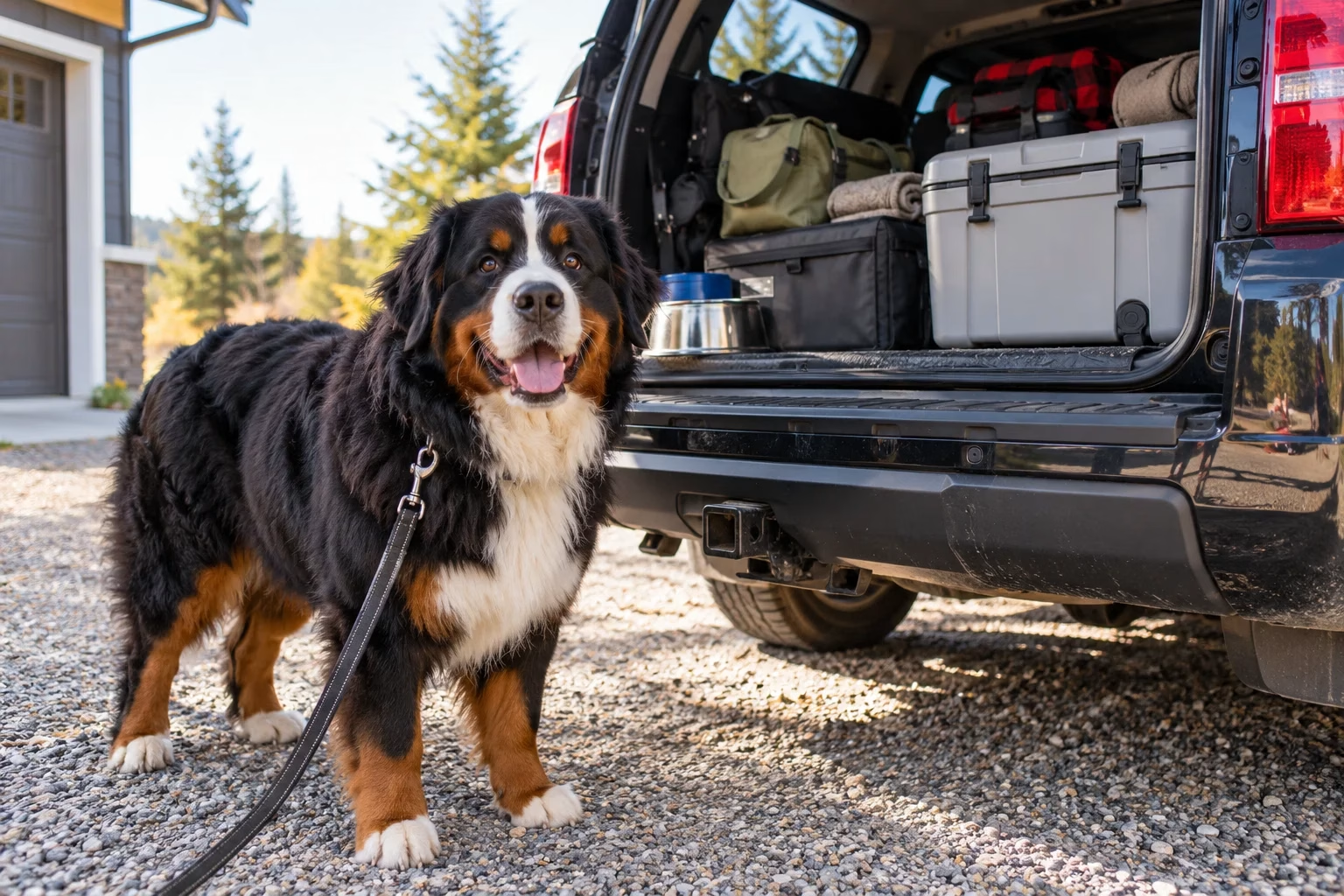
Two things to know before you plan anything.
Every dog entering or returning to the United States must be at least six months old. That’s a CDC requirement, along with a microchip, appearing healthy, and travelling with a CDC Dog Import Form receipt. Which means you cannot bring an eight-week-old puppy into the US from another country. If you’re an American buyer looking at a Canadian or European Berner breeder, that reshapes the whole plan.
And an adult Berner cannot fly in a cabin. At 70 to 115 pounds, your dog travels as cargo or doesn’t fly. Options for large dogs have narrowed considerably, and for most Berner owners most of the time, the honest answer is to drive.
Rules change. This article describes the requirements as of publication, and border regulations are revised without much warning. Confirm current requirements directly with the CDC and with your airline before you book anything — not before you travel, before you book.
This is general information, not legal, veterinary or immigration advice.
Crossing into the US: what’s required
For a dog that has been only in rabies-free or low-risk countries — which includes Canada — the requirements are:
- At least 6 months old
- Microchipped with an ISO-compliant chip
- Appears healthy on arrival
- A CDC Dog Import Form receipt, which can be printed or shown on a phone
The CDC states that dogs coming from rabies-free or low-risk countries do not require any other documents, provided those conditions are met.
A useful detail: the receipt for a low-risk-country dog is valid for multiple entries over six months from the date it’s issued. If you cross the border regularly, you’re not filling in a new form every trip.
If your dog has been in a high-risk country in the previous six months, the requirements are substantially more involved — additional documentation, possible rabies titre testing, entry restricted to specific airports, and possible quarantine. The classification follows your dog’s six-month travel history, not its last departure point, so routing through a low-risk country doesn’t reset it. Start at the CDC’s own pages well in advance if this applies to you.
One sequencing trap worth knowing generally: where rabies documentation is required, the rabies vaccination must have been given after the microchip was implanted. If it was done the other way round, the paperwork doesn’t satisfy the requirement, and that can’t be fixed retroactively.
Why the six-month rule matters so much for this breed
Berner breeding is unevenly distributed. Serious breeders with thorough health testing are concentrated in particular regions, waitlists are long, and American buyers regularly look north or across the Atlantic to find a well-bred litter.
The age requirement makes the usual arrangement impossible. You cannot collect a puppy at eight or ten weeks and fly it home. Your options become:
- Buy domestically. For most people this is the answer.
- Leave the puppy with the breeder until six months. Some breeders will do this; many won’t, and it’s a significant ask. It also means the puppy does its critical early socialisation somewhere other than your home, which is a real consideration rather than a technicality.
- Drive, if the border is drivable. Road entry is still subject to the same CDC requirements, including the age rule — driving doesn’t exempt you.
Discuss this with any breeder before money changes hands, and be sceptical of one who waves it away. Our breeder guide covers the wider conversation.
Flying: the reality for a 100-pound dog
Cabin travel is out. In-cabin allowances are built around a carrier that fits under a seat. A Berner puppy might briefly qualify by weight; an adult never will.
So it’s the cargo hold, and that comes with constraints that stack up fast:
- Not every airline carries large dogs, and policies have tightened over the years. Some carriers have withdrawn from pet cargo entirely, some accept animals only through a separate cargo service rather than as checked baggage, and some restrict it to specific routes.
- Temperature embargoes. Airlines restrict animal transport when temperatures at any point on the route — including a connection you’re not thinking about — fall outside a set range. For a double-coated alpine breed, summer restrictions are the binding constraint. Our heat safety article covers why this breed has less thermal margin than most.
- Crate specifications. Air transport crates follow IATA Live Animals Regulations, which govern size, ventilation, construction and fastenings. The crate must be large enough for the dog to stand fully upright, turn around and lie down naturally. For a Berner that’s a very large crate, and the crate’s dimensions drive the price.
- Cost. Shipping a large dog internationally runs into four figures. Crate size, route, connections and documentation all move the number.
Because airline policies change frequently and vary by route, this article deliberately names no carriers. Confirm directly with the airline, for your specific route and dates, before booking anything else.
Should you fly your Berner at all?
For a holiday, almost certainly not. The cargo hold is stressful, the constraints are considerable, and there isn’t a trip worth it for a dog who’d rather be at home with a sitter.
For a permanent relocation where driving isn’t possible, it’s a legitimate option and plenty of large dogs travel safely. What makes the difference is preparation rather than luck:
- Crate-condition for months, not days. The crate needs to be a familiar, comfortable place long before travel day. This is the single biggest factor in how a dog copes.
- Book direct flights where they exist. Connections mean handling, waiting and temperature exposure.
- Fly at the mildest times — early morning or late evening in summer.
- Don’t sedate unless your vet specifically advises it. Sedation can affect breathing and temperature regulation at altitude, and many carriers won’t accept sedated animals.
- Consider a professional pet relocation service for an international move. They handle documentation and logistics, and documentation failures are the expensive kind of mistake.
Driving is usually the answer
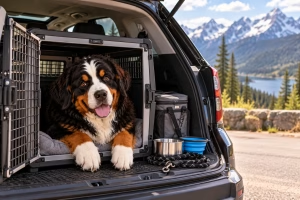
For most Berner owners, most of the time, the car wins — and not by a small margin. You control the temperature, you control the stops, and the dog is with you rather than in a hold.
Our car safety article covers the part that matters most, which is restraint. In short: a walking harness is not a crash restraint, certification for pet car restraints largely tops out around 75 pounds, and a secured crash-tested crate is the strongest option for a dog this size.
Driving across the border is still a border crossing. The CDC requirements apply the same way — age, microchip, health, form receipt. Have the receipt accessible on your phone, and don’t assume a land crossing is more relaxed than an airport.
Practical points for a long drive: stops every two to three hours, leashed before the door opens every single time, water offered at each stop, and a light stomach rather than a large meal before setting off — this breed carries real bloat risk.
A checklist worth working through
Three months out
- Confirm current CDC requirements at the source
- Confirm your dog’s microchip is ISO-compliant and the number is readable
- If flying: confirm your airline carries dogs of this size on your route
- If flying: buy the IATA-compliant crate and start crate conditioning
One month out
- Book the dog’s travel
- Vet check, and confirm all paperwork matches — especially that the microchip number is identical on every document
- Verify the CDC requirements again, in case anything has changed
Week of travel
- Complete the CDC Dog Import Form and save the receipt to your phone and print a copy
- Confirm the airline booking for the dog specifically, not just your own
- Check forecast temperatures along the whole route for embargo risk
The most common failure point is a microchip number that doesn’t match across documents. Check it character by character. Border decisions tend to be final, and correcting paperwork at the port of entry is not an option.
FAQ
Can I fly with my Bernese Mountain Dog in the cabin? No. In-cabin allowances are built around carriers that fit under a seat, and an adult Berner is far too large. Air travel for a dog this size means the cargo hold.
What does my dog need to enter the United States? For a dog that’s been only in rabies-free or low-risk countries, including Canada: it must be at least six months old, microchipped, appear healthy, and travel with a CDC Dog Import Form receipt. The CDC states no other documents are required for dogs from low-risk countries, provided those conditions are met. Dogs that have been in high-risk countries face substantially more requirements. Confirm current rules with the CDC before travelling.
Can I bring a Berner puppy into the US from Canada or Europe? Not at the usual age. The CDC requires dogs entering the US to be at least six months old, which rules out collecting an eight- or ten-week-old puppy from a foreign breeder. Your realistic options are buying domestically, arranging for the breeder to keep the puppy until six months, or accepting that the plan doesn’t work.
Does my dog need a microchip to cross the border? Yes. A microchip is one of the CDC’s requirements for dogs entering or returning to the US. Where rabies documentation is also required, the rabies vaccination must have been administered after the microchip was implanted — a sequence that can’t be corrected retroactively.
How long is a CDC Dog Import Form receipt valid? For a dog that’s been only in rabies-free or low-risk countries, the receipt is valid for multiple entries over six months from the date of issuance — useful if you cross regularly.
Is flying safe for a large dog? Plenty of large dogs travel safely, but it’s stressful and the constraints are significant: temperature embargoes, IATA crate specifications, limited airline options and substantial cost. For a holiday it’s rarely worth it. For a permanent move where driving isn’t possible it’s a legitimate option, and months of crate conditioning beforehand matters more than anything else.
Should I sedate my dog for a flight? Not unless your veterinarian specifically advises it. Sedation can affect breathing and temperature regulation at altitude, and many carriers won’t accept sedated animals.
Is driving across the border easier than flying? The journey is, but the requirements aren’t. The same CDC rules apply at a land crossing — age, microchip, health and the form receipt. Driving is usually the better option for this breed, but it doesn’t exempt you from anything.
