
ⓘ Affiliate Disclosure: This post contains affiliate links. As an Amazon Associate, we earn from qualifying purchases at no extra cost to you. Read our full disclosure.
The Bernese Mountain Dog’s thick tricolor double coat is one of the breed’s most recognizable features, and keeping it healthy takes a steady routine rather than the occasional big effort. This guide covers how the coat works, how often to brush and bathe, the tools that actually matter, and the grooming mistakes that cause the most trouble for Berners specifically.
From my own experience: the first coat blow that really caught me off guard was Scarlett’s first spring, when she was a full-grown one-year-old — the undercoat let go in clumps and, honestly, the hair got everywhere for a couple of weeks. The tool I reach for first now is an undercoat/grooming rake to pull the loose undercoat, then a slicker brush to finish and smooth the coat. I’ve used a FURminator-style deshedding tool too; it does work, but I find it a bit rough, so I use it sparingly and never press hard against the skin.
How the Bernese double coat works
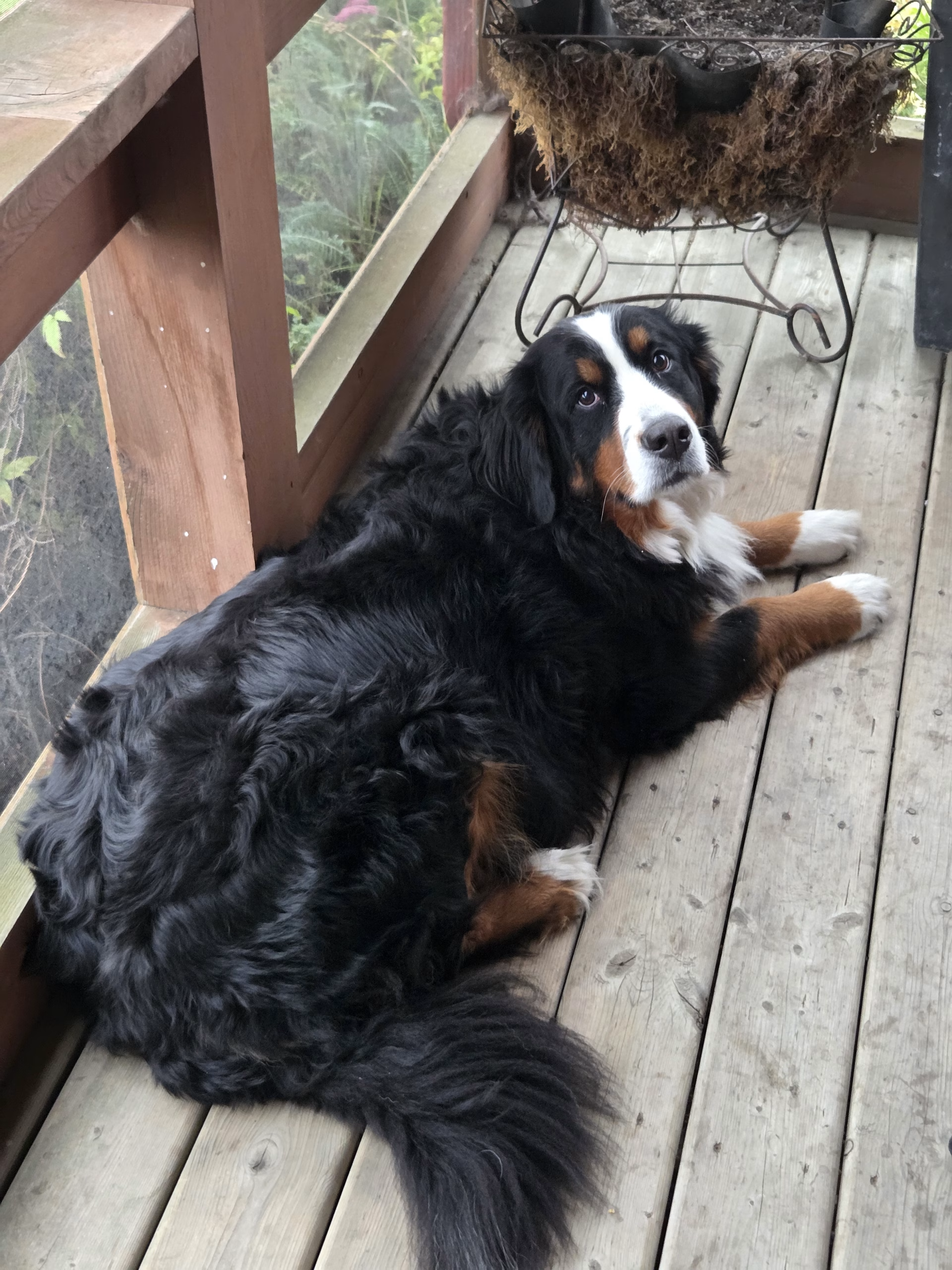
A Berner has a true double coat: a longer, weather-resistant outer coat of guard hairs and a dense, woolly undercoat for insulation. It evolved for cold Swiss mountain weather and does real work regulating temperature. The undercoat drives the heavy seasonal shedding — it “blows” twice a year, usually in spring and fall — while the guard coat sheds less but mats easily in the longer areas: the mane, behind the ears, the “armpits,” the groin, and between the rear legs.
Never shave a Bernese Mountain Dog
The most damaging mistake owners make is shaving the coat to manage heat or shedding. The double coat is self-regulating and helps keep a Berner cooler in summer as well as warmer in winter. Shaving removes the guard hairs that protect against sun and insects, and the coat often grows back patchy or with an altered texture that mats more easily. Groomers experienced with northern breeds advise against shaving except for a specific medical reason.
How often to brush
During the normal season, brushing three to four times a week keeps the coat mat-free. During the twice-yearly coat blow (roughly April–June and September–November), you’ll need to brush daily, sometimes twice a day. Once-a-week brushing isn’t enough for this breed — expect matting and a harder job overall if that’s all the coat gets.
Brushing technique that reaches the undercoat
Most owners brush only the top layer and miss the undercoat where mats form. Work in sections: part the coat with your free hand and brush from the skin outward, in the direction of hair growth, with a slicker or pin brush. A typical full-groom tool sequence is an undercoat rake or deshedding tool first, then a slicker brush, then a wide-toothed comb run root to tip — if the comb passes freely, the coat is truly mat-free.
For mats, don’t pull. Apply a detangler, then work the mat apart from the outside edges with your fingers and a dematting comb. Mats tight to the skin may need to be cut out carefully with blunt-nosed scissors held parallel to the skin.
Bathing
Bathe roughly every six to eight weeks, with spot-cleaning in between. Over-bathing strips natural oils and dries the skin; under-bathing lets oils and dirt build up in the undercoat. Always brush and de-mat fully before a bath — water tightens mats and makes them far worse.
Use a pH-balanced dog shampoo made for double-coated or sensitive skin (human shampoo disrupts a dog’s skin barrier); oatmeal or hypoallergenic formulas suit Berners prone to skin allergies. Then rinse far longer than you think you need to — a thick undercoat holds shampoo, and residue causes itching and irritation. A conditioner reduces tangling as the coat dries.
Drying matters
Don’t let a Berner air-dry. The dense undercoat can hold moisture for many hours, creating the warm, damp conditions that lead to hot spots. Use a high-velocity dog dryer (or a regular dryer on low heat for smaller sections), and brush as you dry so the coat doesn’t set in tangles.
Nails, ears, and teeth
- Nails: trim every three to four weeks. Overlong nails change a dog’s gait and stress the joints — a real concern in a breed prone to hip and elbow issues. If you hear clicking on hard floors, they’re too long. Trim dark nails a little at a time to avoid the quick, and keep styptic powder on hand.
- Ears: a Berner’s heavy, floppy ears trap moisture. Check weekly for redness, odor, or dark discharge, and clean monthly with a vet-recommended solution. Never insert anything past the visible part of the canal.
- Teeth: brush several times a week with dog-specific toothpaste; dental chews carrying the VOHC seal help between brushings.
Professional grooming vs. at-home
Many owners combine a full professional groom every 8–12 weeks with at-home brushing in between. A full groom for a large double-coated dog typically runs $80–150. If you groom at home, good tools — a high-velocity dryer, an undercoat rake, a stainless slicker, and a steel comb — pay for themselves quickly.
Making grooming a positive routine
Start young, keep sessions short, use high-value treats, and stay calm — a dog that associates grooming with a good experience is far easier to maintain for life. If your dog resists, build up a few strokes at a time rather than forcing a long session, and split the work across days (brush one day, nails the next).
Frequently asked questions
Is it normal for a Berner to shed year-round? Yes. Berners shed moderately all year, with two heavy seasonal coat blows. Year-round shedding is normal for the breed and is a housekeeping issue, not a health one.
My Berner hates being brushed — what can I do? Introduce grooming in short, positive sessions with high-value treats. For an adult who resists, start with just a few strokes and build up. A grooming glove is often accepted as petting. Never restrain a struggling dog forcefully; that makes grooming aversion worse.
Can I use a deshedding tool like a FURminator on my Berner? Yes, during the coat blow — no more than once a week, without pressing hard against the skin. It removes loose undercoat but doesn’t replace regular brushing.
When does a Berner puppy get its full adult coat? The soft puppy coat transitions to the full adult double coat between roughly 12 and 24 months, with noticeably more undercoat developing around 8–12 months. Start brushing early to build the habit before the full coat arrives.
Related reading: best brush for Bernese Mountain Dog shedding · Bernese Mountain Dog health problems
As an Amazon Associate, this site earns from qualifying purchases.
Owner-written, not veterinary advice. This article is written by a Bernese Mountain Dog owner, not a veterinarian. It is general information gathered from veterinary and breed-club sources — not a diagnosis or a treatment plan. Every dog is different. If your dog is unwell or showing any sign described here, call your own vet. In an emergency, go straight in.
