
Of all the breeds studied for fragmented medial coronoid process, the Bernese Mountain Dog carries the greatest predisposition. Not one of several at-risk breeds. The most affected.
And unlike hip dysplasia, which usually declares itself later, this one arrives while your dog is still a puppy — most often between five and ten months old, in the middle of the fastest growth a dog will ever do. Which is exactly when an owner is most likely to look at an awkward, gangly, rapidly changing animal and conclude it’s just a phase.
This is owner education, not veterinary advice, and nothing here diagnoses an individual dog. If your puppy is lame or moving oddly, that’s a vet appointment, not a search result.
What it actually is
“Elbow dysplasia” is an umbrella term covering several developmental problems that lead to a malformed elbow joint and early arthritis. The main ones are fragmented medial coronoid process, ununited anconeal process, osteochondrosis of the humeral condyle, and incongruity between the radius and ulna.
In Berners, it’s overwhelmingly the coronoid. A Dutch screening programme evaluating 974 Bernese Mountain Dogs found fragmented coronoid process in 15%, against 6% of Labradors and 5% of Golden Retrievers. Osteochondrosis, common in Goldens at 25% and Labradors at 13%, was rare in Berners at 3%.
So the Berner version of this disease is specific: the medial coronoid process — a small projection of bone on the ulna, inside the elbow — fails to develop properly and breaks up. Fragments of bone and cartilage come loose in the joint. There’s even a breed-specific pattern to how it fragments: in Berners the top of the coronoid tends to break, where in other breeds it’s typically a side.
Those fragments grind. The joint responds with inflammation and then arthritis, and that arthritis often begins within the first year of life. It’s the early onset that makes this condition matter so much — a dog that develops elbow arthritis at ten months is carrying it for its whole life.
A note on the numbers
You’ll see prevalence figures for Berners ranging from 15% up to older literature suggesting somewhere between 36% and 70%. That’s an enormous spread and it’s worth understanding why.
Screening populations are self-selected — dogs presented for radiographic evaluation by breeders are not a random sample of the breed, and they’re usually a better-than-average sample. Clinical populations at referral hospitals skew the other way. The honest summary is that the true figure is uncertain, the range is wide, and every source agrees on the direction: this breed is the most affected one studied.
The early signs, and why they get missed
Between five and ten months, watch for:
- Front-leg lameness, often intermittent, sometimes shifting between legs. Frequently worse after hard play and better after rest
- Stiffness getting going after sleeping, loosening up with movement
- Standing with elbows held out from the body, or turning the front paws outward
- Shifting weight backward, so the dog looks front-light and rear-heavy
- Reluctance on stairs, or after longer walks, in a dog that was fine a month ago
- Pain when the elbow is flexed or extended, or resistance to having the leg handled
The reason these get dismissed is that every single one of them is also a plausible description of a growing giant-breed puppy. Berners are clumsy at seven months. They do tire. They do go through phases.
The distinguishing question isn’t any individual sign, it’s persistence. A puppy that’s stiff one morning after a big day at the park is normal. A puppy that’s intermittently front-lame over three weeks is not, and that’s a phone call.
The thing that should change how you think about this
A dog can have significant elbow disease and never limp.
OFA cites a study of 207 Rottweilers in which 141 were not lame — and among those non-lame dogs, 68% had degenerative joint disease in the elbow. Another study following 55 Rottweilers found that at six months most of the lame dogs had no radiographic changes yet, while by twelve months the changes were visible in dogs that had stayed sound throughout.
Radiographic disease and visible lameness do not reliably track together. Which means:
- You cannot use “he doesn’t limp” to rule this out. It isn’t evidence of anything.
- Screening exists for exactly this reason. OFA’s own position is that breeders cannot depend on clinical signs to identify affected dogs.
- And conversely, a dog with radiographic changes may go on to live comfortably for years. Finding something on a film is not a sentence.
Diagnosis
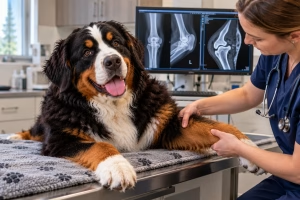
Your vet will start with a physical exam — flexing and extending the joint, checking range of motion, feeling for effusion and for pain. Radiographs come next, usually several views per elbow, and often of both elbows even if only one seems affected, because bilateral disease is common.
Plain radiographs have a real limitation here: a fragmented coronoid can be genuinely hard to see on film. A radiologist will often be looking for secondary signs instead — sclerosis at the base of the coronoid correlates extremely strongly with fragmentation, and arthritic change at the joint margins is usually visible before the fragment itself is.
CT is considerably more sensitive and is often what settles an uncertain case. If your dog has convincing clinical signs and clean-looking radiographs, that’s a reasonable conversation to have with your vet rather than accepting the films as the final answer.
Treatment
Two broad routes, and which one fits depends on lesion type, severity, age and how much clinical trouble the dog is actually in.
Conservative management — appropriate for milder cases and often the starting point:
- Weight control, which is the single most important lever. A lean dog loads the joint less, every step, for life. Our weight and body condition guide covers assessing it honestly.
- Exercise modification — not rest. Controlled, regular, low-impact activity maintains the muscle that supports the joint. Our exercise guide has the baseline to adapt.
- Anti-inflammatory medication as prescribed
- Omega-3 fatty acids and joint-support compounds such as polysulfated glycosaminoglycans, used as adjuncts rather than as pain control. Our supplement guide covers what the ingredients do
- Physical therapy and hydrotherapy, which are underused and genuinely effective for building support musculature without loading the joint
Surgery — usually arthroscopic, to remove loose fragments and assess the cartilage:
Arthroscopy is minimally invasive and lets the surgeon see the joint surface directly, which also gives a better sense of prognosis. More complex procedures exist for joint incongruity and for advanced disease.
The honest framing: surgery removes fragments, it does not remove arthritis. Damage already done to the cartilage stays done. Most dogs improve; most still have an arthritic elbow requiring lifelong management. Anyone presenting surgery as a cure is overselling it.
Which route fits your dog is a conversation with your vet, and a referral to an orthopedic specialist is reasonable for anything beyond mild.
What you can actually influence
Genetics set the baseline. A handful of things modify what happens on top of it — and all of them operate during the first two years.
Keep the puppy lean. Not underfed — lean. Rapid growth and excess weight during development are consistently implicated in developmental joint disease, and this is the highest-leverage thing in an owner’s control.
Don’t push growth. Feed a large-breed puppy formulation with appropriate calcium, and don’t supplement calcium on top of a complete diet. Faster growth is not better growth in a giant breed. Our feeding guide covers the principles and the growth chart covers tracking.
Restrict high-impact activity until skeletal maturity, around two years. Repetitive jumping, hard stop-start play on slick footing, forced running, stairs by the dozen, and repeated leaping in and out of a vehicle. Our training guide covers the restrictions and our car safety article covers ramps, which exist largely for this reason.
Think hard about neutering age, if you have a male. This matters more than most owners realise. In a UC Davis study, male Berners neutered before two years had roughly a six-fold increase in at least one joint disorder compared with intact males — and elbow dysplasia was one of the three disorders tracked. The proposed mechanism is that early loss of sex hormones delays growth-plate closure, altering joint alignment. Our spay/neuter timing article covers the evidence and the practical obstacles.
Buying a puppy: what to ask, and what it’s worth
Ask for OFA elbow certifications on both parents. Not hips only. People remember to ask about hips and forget elbows, and in this breed elbows are arguably the bigger orthopedic issue.
Now the part that isn’t usually said. That Dutch study of 974 Berners estimated the heritability of fragmented coronoid process at 0.06 — against 0.17 in Labradors and 0.24 in Golden Retrievers.
Heritability that low means that in this breed, relatively little of the variation in who develops the condition is explained by straightforward additive genetics as measured by parental phenotype. Practically:
Clear elbows on both parents are worth less as a guarantee in a Berner than in a Labrador. They are still absolutely worth demanding — a breeder who doesn’t screen elbows is telling you something important about how they operate, and screening does drive breed-level improvement over generations. But treat parental scores as a floor, not as protection. A puppy from two clear-elbowed parents can still develop this.
The researchers’ own conclusion was that until the biomechanical and genetic basis is better understood, accurate phenotyping with sensitive techniques is what matters most. Which is a scientist’s way of saying this disease is not yet well enough understood to breed cleanly out of.
What to ask beyond the certificates: what the breeder does about affected dogs in their lines, whether they follow up with puppy buyers, and whether they’ll tell you about elbow problems in previous litters. A breeder who talks openly about that is more reassuring than one with a clean file and no answers. Our breeder guide covers the wider conversation.
The long view
A dog diagnosed at eight months has arthritis to manage for the rest of its life. That sounds bleak and mostly isn’t — well-managed elbow arthritis is compatible with a good life, plenty of walks, and a dog that enjoys itself. What it requires is consistency: keeping weight off, keeping muscle on, staying ahead of pain rather than chasing it, and reassessing as the dog ages.
It also means the senior years arrive with more orthopedic load than they otherwise would, which matters in a breed that’s functionally a senior around six.
And if your dog is one of the many with radiographic changes and no clinical signs, the answer is the same and less dramatic: keep it lean, keep it moving sensibly, and mention it to your vet at the annual check.
For the other half of the orthopedic picture, our hip dysplasia article covers hips — different joint, different presentation, and worth understanding separately.
FAQ
At what age does elbow dysplasia show up in Bernese Mountain Dogs? Most often between five and ten months, during the period of fastest growth. That’s considerably earlier than hip dysplasia typically becomes obvious, and it’s the main reason the early signs get dismissed as a puppy phase.
What are the first signs? Intermittent front-leg lameness, stiffness after rest that loosens with movement, standing with elbows held out from the body, shifting weight backward, and reluctance on stairs or after longer walks. Any of these alone can be normal in a growing puppy — persistence over two or three weeks is what warrants a vet visit.
Can a dog have elbow dysplasia without limping? Yes, and commonly. OFA cites a study of 207 Rottweilers in which 68% of the non-lame dogs had degenerative joint disease in the elbow. Radiographic disease and visible lameness don’t reliably track together, so an absence of limping rules nothing out.
Both parents have clear elbows. Is my puppy safe? Safer, not safe. A Dutch study of 974 Bernese Mountain Dogs estimated the heritability of fragmented coronoid process at 0.06, against 0.17 in Labradors and 0.24 in Golden Retrievers. Parental elbow scores predict less in this breed than in others. Demand them anyway — a breeder who doesn’t screen is telling you something — but treat them as a floor rather than a guarantee.
How is it diagnosed? Physical examination, then radiographs of both elbows. A fragmented coronoid can be hard to see directly on film, so radiologists often look for secondary signs such as sclerosis at the base of the coronoid, which correlates very strongly with fragmentation. CT is considerably more sensitive and often settles uncertain cases.
Does my dog need surgery? It depends on the lesion, its severity and how much clinical trouble the dog is in. Milder cases are often managed conservatively with weight control, exercise modification, anti-inflammatories and physical therapy. Arthroscopy can remove loose fragments and assess cartilage damage. Surgery removes fragments; it doesn’t remove arthritis already present.
Can elbow dysplasia be prevented? Not entirely — genetics set the baseline. What’s modifiable is growth: keeping the puppy lean, feeding an appropriate large-breed puppy diet without extra calcium, restricting high-impact activity until skeletal maturity at around two years, and, for males, considering neutering age carefully given the association between early neutering and joint disorders in this breed.
Which is worse in Berners, hips or elbows? They’re different problems and both matter. Elbows arrive earlier, are the condition this breed is most predisposed to of any breed studied, and take a specific form here — fragmentation of the coronoid rather than the osteochondrosis seen more often in retrievers. Ask about both when buying a puppy.
