

Owner-written, not veterinary advice. This article is written by a Bernese Mountain Dog owner, not a veterinarian. It is general information gathered from veterinary and breed-club sources — not a diagnosis or a treatment plan. Every dog is different. If your dog is unwell or showing any sign described here, call your own vet. In an emergency, go straight in.
Bernese Mountain Dogs are large, people-oriented dogs that adapt to a lot of different homes — but they do have real needs around space, temperature, and company. Here’s an honest look at what kind of living situation suits a Berner, including whether apartment and city life can work.
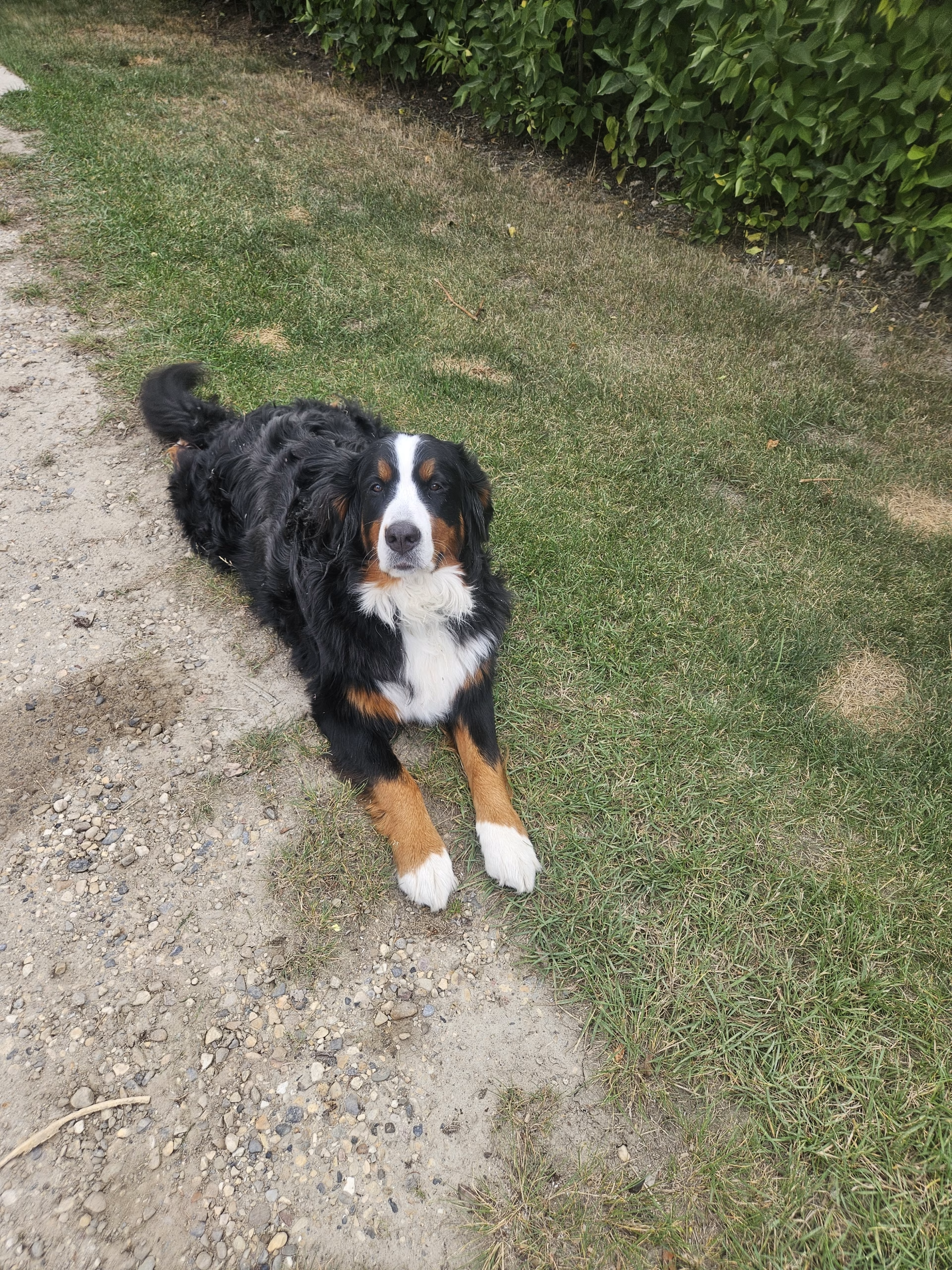
From my own experience: my dogs do best with a bit of room to move — a home with space to stretch out and run beats a tight footprint every time, even though they’re calm and settle indoors once they’ve had their exercise. What works for us is one to two walks a day; after that they’re happy to flop down near me. The thing I plan around most is heat — in warm weather I keep exercise to the cooler morning and evening and make sure there’s shade and water.
How much space does a Berner really need?
A full-grown Bernese Mountain Dog stands 23–27.5 inches at the shoulder and weighs roughly 70–115 pounds, so they take up room. That said, Berners are fairly calm indoors as adults — they tend to pick a spot and settle near their people rather than pace. What matters more than square footage is daily exercise and not leaving them isolated. A house with a securely fenced yard is ideal, but it is not a hard requirement.
Can a Bernese Mountain Dog live in an apartment?
Yes, with effort. Plenty of Berners live happily in apartments when their owners commit to consistent daily walks and outdoor time. The honest challenges are: their size in a small space, shedding in close quarters, the logistics of stairs or elevators (especially for a growing puppy or an aging dog with joint issues), and noise — while Berners aren’t typically barkers, any large dog in a shared building needs basic manners. Ground-floor units or buildings with an elevator are easier on the joints.
Climate: built for cold, sensitive to heat
This is the single most important living-condition factor for the breed. That thick double coat is made for cold weather, and most Berners are genuinely happy in snow and cool temperatures. Heat is the real risk. Bernese Mountain Dogs can overheat quickly, and hot, humid climates demand serious precautions: air conditioning, exercise limited to the cool early morning and evening, constant access to shade and water, and never being left in a hot car or yard. A Berner can live in a warm region, but the home and routine have to be built around keeping them cool.
What the heat data actually shows — and why the hot-car message is misleading
Everyone knows not to leave a dog in a car. Far fewer owners know that the car is not where most heat-related illness happens.
A study of UK veterinary records covering 905,543 dogs (Hall, Carter and O’Neill, Scientific Reports, 2020) found an annual incidence of heat-related illness of 0.04%, with a fatality rate of 14.18% among affected dogs. Roughly 40% of all events happened in a single July heatwave month. The risk factors matter for this breed in particular:
- Dogs over 50 kg had 3.42 times the odds of heat-related illness compared with dogs under 10 kg. A large male Berner sits squarely in that band.
- Dogs above their breed-and-sex mean bodyweight had 1.42 times the odds — another reason to keep a Berner lean.
- Purebred dogs had 1.86 times the odds of crossbreeds; dogs aged 12 and over, 1.75 times the odds of dogs under two.
- The Chow Chow — another heavy, double-coated breed — was among the breeds with significantly elevated odds.
The companion paper by the same authors (Animals, 2020) is the one that should change how you think about summer. Of 1,259 heat-related illness events, 74.2% were exertional — brought on by exercise. Only 12.9% were environmental, and just 5.2% involved a dog confined in a vehicle.
The public safety message is dominated by hot cars. The actual dominant cause is the walk.
What that means in practice
Cornell’s Riney Canine Health Center puts normal canine body temperature at 100.5–102.5 °F, with heatstroke developing when a dog can no longer thermoregulate and temperature reaches 105 °F or above. It names thick-coated and dark-coated dogs as a high-risk group — which describes a Bernese exactly. Warning signs to act on: heavy panting, drooling, vomiting or diarrhoea, weakness, stumbling, confusion, collapse. First aid is cool water on the dog and air conditioning on the way to the vet, not delay.
One honest caveat, because you will see confident numbers elsewhere: there is no authoritative published ambient-temperature threshold above which a double-coated dog should not be walked. Cornell gives a body-temperature threshold; the Hall studies give relative odds. The specific “never walk above 24 °C” figures circulating on pet-content sites are not sourced to anything. What the evidence does support is straightforward: move exercise to the coolest parts of the day, shorten it as temperature and humidity climb, watch the dog rather than the thermometer, and accept that some summer days the walk simply does not happen.
They need to be with their people
Berners are companion dogs first. They bond closely with their families and do poorly when left alone for long stretches — isolation can lead to anxiety and destructive behavior. The best living situation, regardless of house or apartment, is one where the dog is part of daily life rather than left outside or alone all day. A backyard is not a substitute for company.
Still deciding on the details? Two other guides cover the questions that come up most often before a Berner comes home: whether to get a male or female Bernese — the temperament differences are real but smaller than most people expect — and what size crate a Bernese actually needs, which is the one purchase people most often get wrong on the first try.
Setting up the space
Give a Berner a cool, draft-free spot of their own with a supportive (ideally orthopedic) bed — important for a heavy breed prone to joint problems. Provide good traction on slick floors (runners or rugs) to protect hips and elbows, especially for puppies and seniors. Keep fresh water always available, and make sure any yard fencing is secure and offers shade.
Is a Berner right for your home?
A Bernese Mountain Dog tends to thrive with an owner who is home often, can provide daily outdoor exercise, lives in or can manage a cooler environment, and has space for a large dog to stretch out. None of that requires a mansion — it requires commitment to climate control, exercise, and companionship.
Related reading: Bernese exercise needs · best dog beds for Bernese Mountain Dogs
How we research this / Sources
- Cornell Riney Canine Health Center — Heatstroke: a medical emergency
- Hall EJ, Carter AJ, O’Neill DG. Incidence and risk factors for heat-related illness (heatstroke) in UK dogs under primary veterinary care in 2016. Scientific Reports 2020;10:9128
- Hall EJ, Carter AJ, O’Neill DG. Dogs don’t die just in hot cars — exertional heat-related illness is a greater threat to UK dogs. Animals 2020;10(8):1324
