

An unrestrained hundred-pound dog in a 30mph crash doesn’t weigh a hundred pounds. It arrives at whatever is in front of it with force in the region of a small motorcycle. That’s the whole argument, and everything below follows from it.
Most of us know this in the abstract and drive around with the dog loose in the back anyway. I’d rather not lecture about that. What’s more useful is the part almost nobody knows: the restraint you bought probably hasn’t been validated for a dog your dog’s size, and “crash tested” on the box means essentially nothing.
This article covers equipment and practice, not veterinary advice. For a dog with existing joint problems or mobility limits, talk to your vet about how to get them in and out.
The certification problem
There is no government safety standard for pet car restraints in the United States. None. Unlike child seats, which are regulated, pet restraints are an unregulated market. Any manufacturer can print “crash tested” on packaging having conducted whatever test it invented in-house, and nothing prevents that.
The organisation filling the gap is the Center for Pet Safety, a non-profit that has run independent crash testing since 2011 using weighted canine dummies and a protocol adapted from the federal standard used for child seats. Their results have been bleak.
- 2011, large-dog restraints: a 100% failure rate. Not one product tested protected the dog or the human occupants.
- 2013, eleven harness brands — the brands that actually advertised testing — only one passed all criteria.
- Since 2011 they’ve tested close to 400 products in total.
Their pass criteria are worth knowing because they’re what you should be looking for:
- No catastrophic failure — the dog cannot become a projectile or come out of the restraint
- The dog stays on the seat for the duration of the crash
- Consistent performance across all sizes
- A tether that adjusts to six inches or less, because long tethers are themselves dangerous
That third one is where large dogs fall apart. Many brands failed specifically on the 75-pound test dog while passing at smaller sizes. A harness that holds a forty-pound spaniel is not a harness that holds a Berner, and until 2013 a lot of manufacturers were selling one as if it were the other.
The part that matters most for this breed
Certification for pet car restraints largely tops out around 75 pounds.
A Bernese Mountain Dog runs roughly 70 to 115. Which means that for most Berners — and nearly all Berner males — you are looking at products certified, if at all, on a test dog considerably smaller than yours.
When asked directly, manufacturers have been reasonably candid about this. One told a reviewer they were waiting on testing for dogs over 75 pounds and that it had been delayed. Another said their harness had passed independent testing but wanted owners of large dogs to understand that in a crash, a big dog is likely to hit the seat in front of it regardless — simply because car seats are spaced closer together than a large dog is long.
That’s an honest answer and it’s the right frame. For a dog this size, no restraint makes a crash safe. The realistic goal is stopping your dog from becoming a projectile that injures the people in the car, and improving its odds rather than guaranteeing them.
That’s still worth doing. It’s just not the same promise the packaging makes.
A walking harness is not a car harness
Worth stating plainly because the assumption is everywhere.
The harness you walk your Berner in is built to distribute steady pulling force across the chest without chafing. Perhaps 20 or 30 pounds of sustained load, comfortably, for an hour. Our gear guide covers choosing one for a strong dog, and that’s the right page for that job.
A crash restraint is solving a completely different problem: several thousand pounds of force delivered in under a tenth of a second, without the webbing tearing, the stitching separating, or the hardware opening. Different construction, different stitching, different load paths, different failure modes.
Clipping a seatbelt to a walking harness is one of the most common setups I see, and the crash footage on the failed products is unambiguous about what happens — multi-point failures, complete separation of harness from tether, dog launched forward. Don’t do it.
The options, ranked
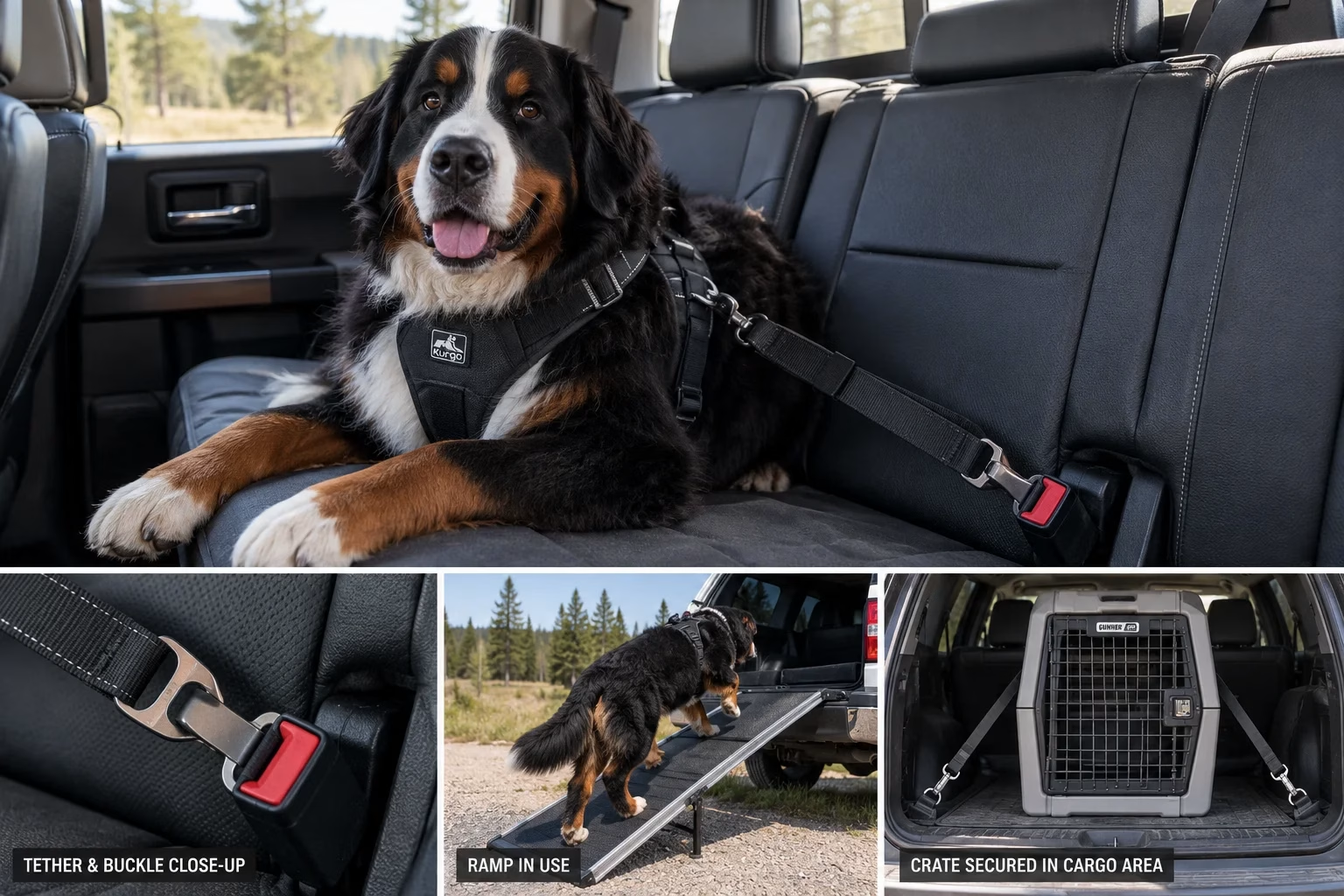
1. A properly secured travel crate
For a dog this size, a crash-tested crate is generally the strongest option available, and it has a second benefit: a dog in a crate stays contained after the crash, when doors are open and people are moving around. Loose dogs bolt at accident scenes, and that’s how a survivable crash turns into a dog on a highway.
Requirements:
- Crash-tested and certified, not just “heavy duty”
- Anchored. An unsecured crate is a projectile with a dog inside it. Use cargo anchor points or purpose-made straps; do not rely on the crate’s own weight
- Correctly sized — the dog able to stand, turn and lie down. Our crate size guide covers the measurements for a Berner
- Positioned in the cargo area of an SUV or estate, with the door facing forward where the design allows
The drawback is obvious: certified crates for giant breeds are expensive and they’re large enough that many cars can’t take one. That’s a real constraint and not a failure of nerve.
2. A certified harness
Practical for most cars, considerably cheaper, and genuinely better than nothing.
What to check:
- Current CPS certification for your dog’s weight bracket. Check the Center for Pet Safety’s certified list directly rather than trusting packaging or trusting this article — the crash study I’ve cited is from 2013 and product lines have changed since. I’m deliberately not naming a winning model for that reason.
- Tether six inches or shorter. Longer tethers allow the dog to build momentum before the restraint engages, which is worse than a short one.
- Attach to the actual seatbelt, threaded as the manufacturer specifies. Not to a headrest, not to a cargo hook.
- Back seat. Airbags are calibrated for adult humans and deploy at a speed that injures anything smaller.
3. A barrier or cargo net
A barrier stops the dog entering the passenger cabin. It does not restrain the dog, which means the dog is still thrown around the cargo area and can still be badly hurt.
Better than nothing. Meaningfully worse than a crate or a certified harness. Best used in combination with a harness rather than instead of one.
4. Loose in the car
No.
Getting a heavy dog in and out
A separate problem, and for many owners the more frequently relevant one.
Repeated jumping in and out of a vehicle is genuinely hard on a large dog’s joints — our training guide already names it among the high-impact activities to avoid before skeletal maturity at around two years. The landing impact from an SUV tailgate onto pavement, repeated daily for years, adds up.
Get a ramp, and get it early. The key thing is that the time to introduce a ramp is while your dog is young and confident, not when it’s eight and unsteady. A ramp is a strange, narrow, slightly bouncy surface and dogs need to learn it. Teaching that to an already-nervous senior is much harder than teaching it to a two-year-old for whom it’s a game.
What to look for: rated well above your dog’s weight, long enough that the incline isn’t steep — a short ramp to an SUV tailgate is close to a ladder — with a high-traction surface and side rails. Fold-out ramps are sturdier than telescoping ones; telescoping ones fit in more cars. Pick your compromise.
If your dog is already older or arthritic, the ramp plus a support harness with handles is the combination that works. Our senior care guide covers that setup.
Heat, and the rule with no exceptions
Never leave a Berner in a parked car. Not with the windows cracked, not in shade, not for five minutes.
A double-coated hundred-pound dog has less thermal margin than most, and our heat safety article covers why the danger threshold is far lower than people assume — including the finding that dogs present with heat-related illness at a median ambient temperature around 62°F.
Cars also make cooling harder even when you’re actively trying. Research on cooling overheated dogs found that dogs cooled less once placed in a vehicle, regardless of what cooling had been done beforehand. If your dog overheats on a hike, cool it thoroughly before you load it up, not after.
Long journeys
Motion sickness is common in puppies and many grow out of it as the inner ear matures. Signs are drooling, lip-licking, yawning, whining, then vomiting. Short positive trips — to somewhere good, not only to the vet — help more than anything. If it persists, there are effective prescription options; ask your vet rather than reaching for over-the-counter antihistamines, which sedate without treating the nausea.
Feeding. Light meal several hours before, or travel on a fairly empty stomach. This breed carries real bloat risk, so avoid a large meal immediately before or after a journey and give the dog time to settle either side.
Stops. Every two to three hours. Leashed before the door opens, every single time — an excited Berner exiting into a motorway services car park is a genuinely dangerous scenario.
Water. Offer at every stop. Some dogs won’t drink in transit at all, which is fine over a few hours and not fine over a long day.
Never in the bed of a pickup. Unsecured or tethered. Tethering in a truck bed adds strangulation to the list of possible outcomes.
What I’d actually tell you
If you can fit a certified crate and afford one, that’s the answer, and the containment-after-the-crash benefit is underrated.
If you can’t — most people can’t — a currently certified harness on the back seat with a short tether is a reasonable, honest second best. Check the Center for Pet Safety’s certified list for what’s current rather than trusting any article’s product picks, including this one.
And be clear-eyed about what you’re buying. For a dog this size, you are reducing risk, not eliminating it. You’re mostly stopping your dog from killing someone in the front seat and giving your dog better odds than it otherwise had. That’s worth the money and the two minutes of clipping in. It just isn’t the promise on the box.
FAQ
Are dog car harnesses actually safe? Some are considerably better than others, and many are not safe at all. In the Center for Pet Safety’s 2013 study of eleven harness brands that advertised testing, only one passed. An earlier study of large-dog restraints found a 100% failure rate. There is no government standard for pet restraints, so independent certification is the only meaningful signal.
What does “crash tested” mean on a dog harness? On its own, nothing. The pet restraint market is unregulated in the US, so a manufacturer can make that claim based on any test it chooses to run. Look for current certification from the Center for Pet Safety, at your dog’s weight, rather than a claim on the packaging.
Is a walking harness safe to use in the car? No. A walking harness is built for steady pulling force over time. A crash restraint has to handle thousands of pounds of force in a fraction of a second without the webbing, stitching or hardware failing. They’re different products and clipping a seatbelt to a walking harness is a common and dangerous substitution.
Should my Bernese Mountain Dog ride in a crate or a harness? A properly secured crash-tested crate is generally the stronger option for a dog this size, and it keeps the dog contained after a crash, when loose dogs tend to bolt. The drawbacks are cost and whether one fits your car. A currently certified harness on the back seat with a short tether is a reasonable second best.
Is there a restraint certified for a dog over 75 pounds? Certification largely tops out around 75 pounds, which is below the weight of most adult Berners. Check the Center for Pet Safety’s current certified list for your dog’s weight and contact manufacturers directly about testing data for heavier dogs. Be sceptical of anything claiming to make a crash safe for a hundred-pound dog.
Can my dog ride in the cargo area behind a barrier? A barrier keeps the dog out of the passenger cabin but doesn’t restrain it, so the dog is still thrown around the cargo area. It’s better than loose and worse than a crate or certified harness. Use it alongside a restraint rather than instead of one.
Do I need a ramp for my Berner? It’s worth having. Repeated jumping in and out of a vehicle is hard on a large dog’s joints, particularly before skeletal maturity at around two years. Introduce a ramp while the dog is young and confident — teaching it to an unsteady senior is much harder.
How do I stop my Berner getting car sick? Short, positive trips to places the dog enjoys, so the car doesn’t only predict the vet. Travel on a fairly light stomach. Most puppies improve as the inner ear matures. If it persists, ask your vet about prescription anti-nausea options rather than over-the-counter antihistamines, which sedate without treating the nausea.
