
Owner-written, not veterinary advice. This article is written by a Bernese Mountain Dog owner, not a veterinarian. It is general information gathered from veterinary and breed-club sources — not a diagnosis or a treatment plan. Every dog is different. If your dog is unwell or showing any sign described here, call your own vet. In an emergency, go straight in.
Health disclaimer: This article is for educational purposes and is not a substitute for veterinary diagnosis, treatment or nutritional advice. If you are concerned about your Bernese Mountain Dog’s health, contact your veterinarian. If your dog may be experiencing an emergency, contact an emergency veterinary clinic immediately.
What hip dysplasia is
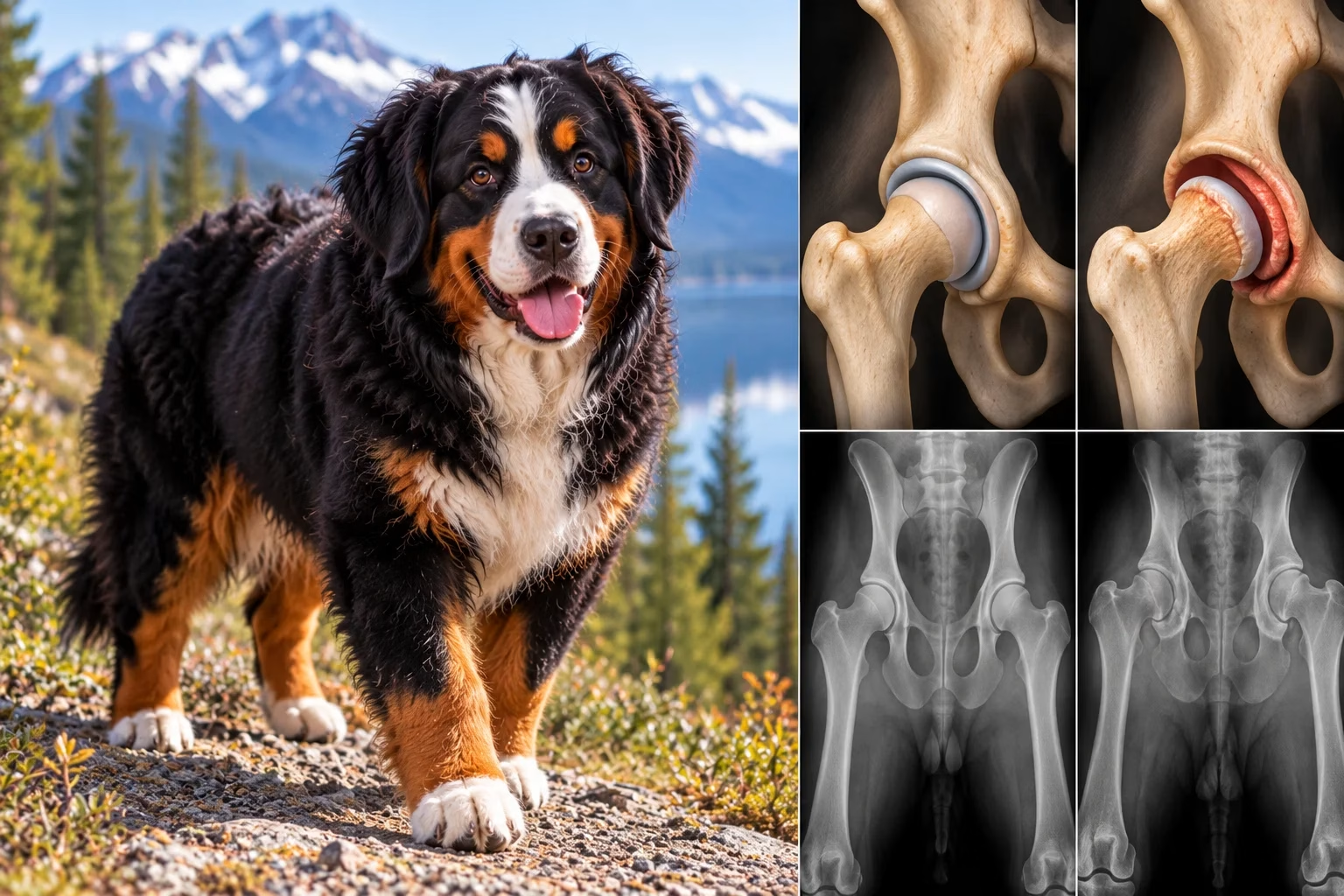
Hip dysplasia is a developmental condition in which a dog’s hip joint does not form quite as it should. The hip is a ball-and-socket joint; in a dysplastic hip, the ball and socket fit together loosely or unevenly. Over time that looseness leads to extra wear, inflammation, and osteoarthritis. It is one of the more common orthopedic conditions in large and giant breeds, and the Bernese Mountain Dog is among the breeds in which it is seen.
Why it matters for Bernese owners
A Bernese is a big, heavy dog, and the hips carry a great deal of that weight across a long life of walks, stairs, and play. Hip dysplasia does not affect every Berner, but understanding it helps owners make better choices — from how they choose a puppy, to how they manage growth and weight, to recognizing early signs and getting veterinary input sooner rather than later.
Signs an owner might notice
Hip dysplasia can appear in a young dog or develop gradually with age. Things owners sometimes notice include:
- Stiffness or slowness getting up, especially after rest or in cold weather
- Reluctance to jump, climb stairs, or get into the car
- A “bunny-hopping” gait in which the back legs move together
- Reduced interest in exercise, or tiring more easily
- A narrow or swaying stance in the hindquarters
- Signs of discomfort when the hips are touched or after activity
These signs can also point to other conditions, so they are a reason to see your veterinarian rather than a diagnosis on their own.
How it is diagnosed and screened
Hip dysplasia is diagnosed by a veterinarian through a physical examination and X-rays. There is an important difference between diagnosis in an individual pet and screening used in breeding programs. Organizations such as the Orthopedic Foundation for Animals (OFA) and the PennHIP method evaluate hip X-rays and grade hip conformation. Responsible breeders have their breeding dogs’ hips screened so they can make informed pairing decisions. If you are looking for a Bernese puppy, asking a breeder about hip screening of the parents is a fair and reasonable question.
How to actually read a breeder’s hip paperwork
Asking “are the parents hip-screened?” is the easy part. Knowing what the answer means is where most buyers get lost, and almost no breed page explains it. Here is enough to have the conversation properly.
OFA grades
The Orthopedic Foundation for Animals grades hips in seven categories. Three are within normal limits — Excellent, Good and Fair. Then Borderline, then the dysplastic grades: Mild, Moderate and Severe. A Fair is a pass, not a failure, and a breeder who is upfront about a Fair is being straight with you.
The age rule matters. OFA final certification requires the dog to be two years old. Anything earlier is a preliminary evaluation, and OFA publishes how those prelims hold up: a preliminary Excellent was 100% reliable for a normal hip at two years, Good 97.9%, and Fair 76.9%. So a prelim Fair at ten months is a good deal less predictive than a prelim Excellent, and neither is the same as a final certification. If a breeder shows you prelims that is fine — just know which one you are looking at.
PennHIP numbers
PennHIP works differently. Instead of a grade it measures joint laxity and reports a distraction index: the displacement of the femoral head relative to the socket, divided by the femoral head radius. It is a unitless number starting at zero, and lower is tighter. A distraction index below 0.30 is considered a tight hip with very low susceptibility to osteoarthritis. PennHIP reports where a dog sits relative to others of the same breed rather than pass or fail, and it can be performed reliably from 16 weeks of age — far earlier than an OFA final.
So if a breeder hands you a number like 0.42, that is not a grade you can line up against “Good”. Ask what the breed median was.
What screening does not tell you
This is the part a good breeder will tell you themselves. Cornell’s Riney Canine Health Center is explicit that radiographic screening alone is not sufficient, because dogs with normal hips can still produce affected puppies. Hip dysplasia is polygenic. Certificates on two parents reduce the risk; they do not remove it. Ask about the wider line, not just the sire and dam.
What a Bernese breeder should be showing you
The Bernese Mountain Dog Club of America’s recommended testing is hips, elbows, eyes, heart and degenerative myelopathy, plus one optional test from von Willebrand disease, thyroid, or the histiocytic sarcoma risk test. The club also asks breeders to publish all results, including the abnormal ones. A breeder who shows you only the good results is telling you something.
The one thing you control after the puppy comes home
Genetics set the risk. Weight is the lever you actually hold, and there is real evidence for how much it matters.
In a long-running study of 48 Labrador Retrievers (Smith and colleagues, JAVMA, 2006), dogs fed 25% less than their free-fed littermates across their whole lives developed radiographic hip osteoarthritis at a median age of 12 years, against 6 years in the control group. By age 14, prevalence was 83% in the control-fed dogs and 50% in the restricted-fed dogs.
Different breed, controlled research setting — so read it as direction rather than a promise. But the direction is not ambiguous, and it lines up with Cornell’s position that overfeeding and rapid growth worsen how strongly hip dysplasia expresses itself in a dog that is already predisposed. Keeping a Berner lean is not a cosmetic preference. It is the highest-value orthopedic decision an owner gets to make, and it costs nothing.
What influences the risk
Hip dysplasia has a strong genetic component, which is why screening of breeding dogs matters. But genetics is not the whole story — how a large-breed puppy grows also plays a role. Rapid growth, excess weight, and certain exercise patterns during puppyhood are commonly discussed as factors that can affect joint development. This is one reason large-breed puppy nutrition and keeping a growing Berner lean are worth discussing with your veterinarian. It is important to be clear, though: because the condition is largely genetic, owners cannot reliably “prevent” hip dysplasia through care alone.
Management and veterinary care
If a dog is diagnosed with hip dysplasia, the right approach depends on the dog’s age, the severity, and how much it affects daily life. Your veterinarian may discuss options such as keeping the dog at a healthy lean weight, controlled and joint-friendly exercise, physical therapy, pain and inflammation management, joint-support measures, and, in some cases, surgical options. Encouragingly, many dogs with hip dysplasia go on to live comfortable, good-quality lives with conservative management and attentive veterinary care. The specific plan should always be made with your vet, who can weigh the trade-offs for your individual dog.
The owner’s takeaway
For Bernese owners, the practical points are straightforward: choose a puppy from a breeder who screens hips, help a growing Berner stay lean and grow at a sensible rate, watch for changes in how your dog moves, and bring any concerns to your veterinarian early. Hip dysplasia cannot be fully prevented, but thoughtful choices and good veterinary care give a dog the best chance at a comfortable life.
Related reading
- Body condition and healthy weight — the evidence on lean feeding
- Puppy growth: why controlled growth beats fast growth
- Exercise needs, and managing load while the growth plates close
- Finding a breeder who health-tests properly
- The wider Bernese health picture
How we research this / Sources
- American Kennel Club — Hip Dysplasia in Dogs: Signs, Symptoms, Treatment
- VCA Animal Hospitals — Arthritis (Osteoarthritis) in Dogs
- American Kennel Club — Bernese Mountain Dog breed information
- Orthopedic Foundation for Animals — Hip Dysplasia
- Orthopedic Foundation for Animals — Preliminary Evaluations
- PennHIP — Measuring Hip Joint Laxity
- American College of Veterinary Surgeons — Canine Hip Dysplasia
- Cornell Riney Canine Health Center — Canine hip dysplasia
- Smith GK et al. Lifelong diet restriction and radiographic evidence of osteoarthritis of the hip joint in dogs. JAVMA 2006;229(5):690–693
- Bernese Mountain Dog Club of America — Recommended Testing
Written by Todd Grasse, founder of BerneseMountainLover.com and Bernese Mountain Dog owner. This article combines owner-focused guidance with the veterinary and breed-health sources listed above.
