
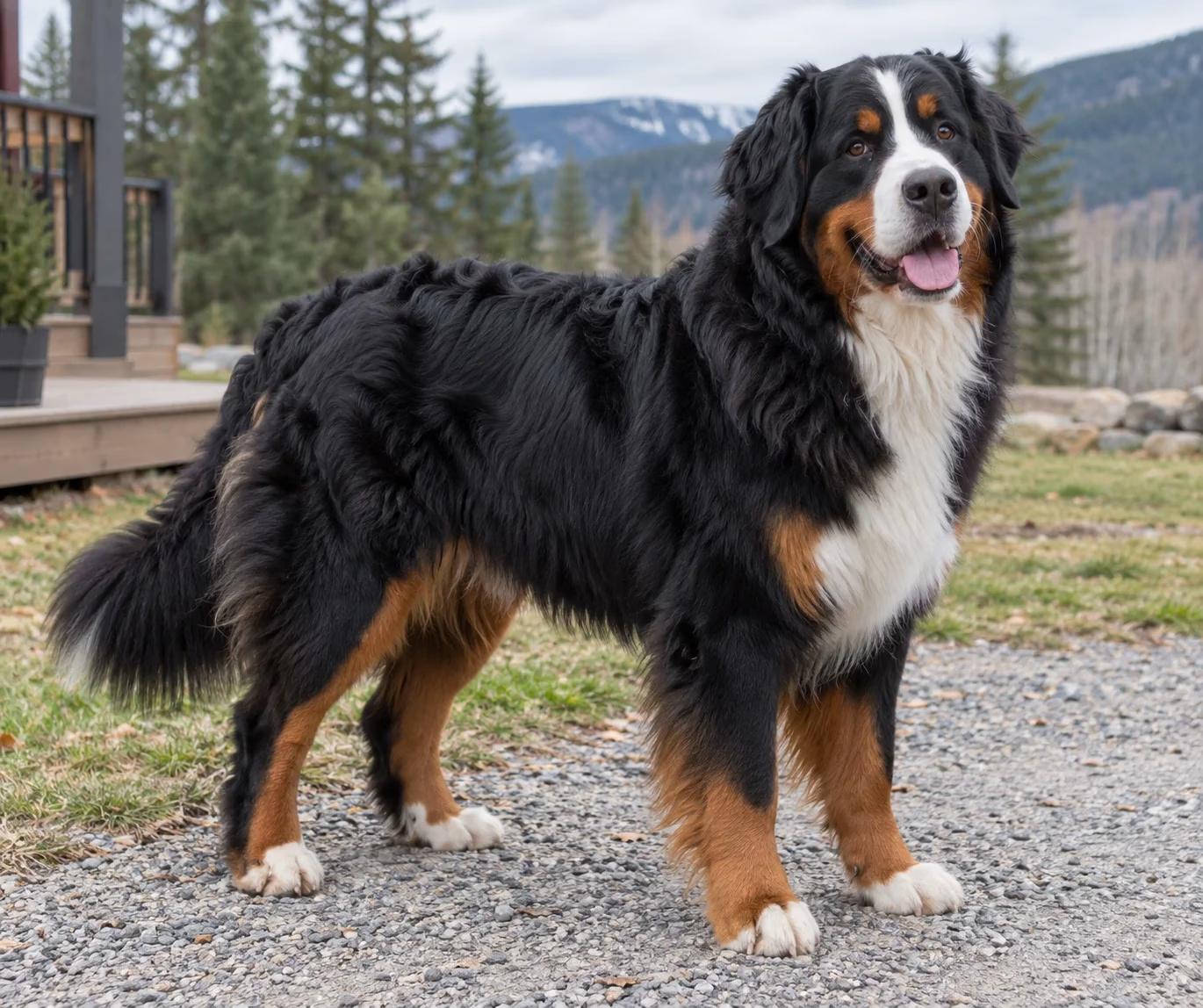
The quickest way to tell them apart: coat length. The Bernese has a long, silky double coat that hangs and feathers. The Greater Swiss has a short, dense one, roughly an inch and a quarter to two inches on top, lying flat against a heavier, more squarely built frame. Same tricolor pattern, same country of origin, same family of farm dogs — very different dogs to live with.
That’s the surface answer. The one that matters more is this: these breeds carry different health risks and different working temperaments, and the choice between them should turn on those, not on whether you prefer long hair or short.
I’ve lived with Bernese Mountain Dogs since 2011. I have not owned a Greater Swiss, and I’m not going to pretend otherwise — everything below about Swissies comes from breed standards, breed-club health material, and veterinary sources, and I’ve flagged where the evidence for the two breeds isn’t equally strong.
They’re cousins, not variants
Both breeds are Sennenhunde — farm dogs from the Swiss Alps, named for the Senn, the alpine dairymen they worked alongside. There are four: the Greater Swiss, the Bernese, the Appenzeller, and the Entlebucher, running from largest to smallest. All four share the black-rust-white tricolor pattern.
The Greater Swiss and the Bernese were both nearly lost around the turn of the twentieth century, and both were pulled back by the same small circle of Swiss enthusiasts. That shared rescue history is why they look so alike and why people mix them up constantly. An AKC judge who has bred Berners since the 1980s was asked whether the two get confused, and her answer was essentially: only when the Berner has blown its coat.
Which is a useful clue, actually. A Berner mid-shed can look startlingly Swissy-like around the body. Look at the tail and the back of the legs — the Berner keeps feathering there longer than anywhere else.
Size and build
| Bernese Mountain Dog | Greater Swiss Mountain Dog | |
|---|---|---|
| Height (males) | ~25–27.5 in | 25.5–28.5 in |
| Height (females) | ~23–26 in | 23.5–27 in |
| Typical adult weight | ~70–115 lb | ~85–140 lb |
| Build | Substantial, slightly longer than tall | Heavier boned, noticeably more mass |
| Coat | Long, silky, double | Short and dense (1¼–2 in), double |
Height overlaps more than people expect. The visible difference is mass, not stature — a big Swissy male carries meaningfully more weight than a big Berner male, and it’s distributed differently. The Berner’s coat also adds apparent bulk it doesn’t actually have, which is why a wet Berner always looks like it lost fifteen pounds.
Worth knowing: the GSMD breed standard specifies height but not weight. The weight ranges you see quoted, for both breeds, are typical adult figures rather than standard requirements. Treat them as ballpark.
Practical consequence: if you’re at the top of what you can physically handle with a Berner, a Swissy is not the lighter option. It’s the heavier one. That matters for lifting a dog into a car, managing one on a leash, and eventually helping an arthritic dog up stairs.
Coat and grooming — the myth worth killing
The single most common assumption about this comparison is that the short-coated breed is the low-maintenance one.
It isn’t. The Greater Swiss is double-coated. It sheds, it blows coat seasonally, and the hair it drops is short, stiff, and works itself into upholstery and car carpet in a way that long Berner hair doesn’t. Berner hair comes off in drifts you can pick up. Swissy hair embeds.
What genuinely differs is the brushing workload. Berners mat — behind the ears, in the armpits, in the trousers, in the tail feathering. Skip a few weeks in spring and you’re dealing with felted undercoat that has to be worked out or cut out. A Swissy doesn’t mat, so brushing is faster and lower-stakes, but it isn’t optional if you’d like to keep the shed volume manageable.
If shedding volume is the deciding factor for you, neither breed is your answer. That’s not a slogan — it’s the thing people underestimate and then resent. Our shedding guide covers what a Berner coat blowout actually looks like, and the grooming article covers the brushing routine that prevents matting.
Temperament: sensitive versus bold
This is where the breeds diverge most and where the standards are unusually clear about it.
The Greater Swiss standard describes a bold, faithful, willing worker — alert and vigilant. That’s a watchful dog with opinions. Swissies are typically more vocal, more assertive with strangers on their own property, and stronger on the leash. They were bred to drive stock and haul carts, and the drive to lean into a harness is still very much present. Owners consistently describe them as slow to mature mentally while being physically enormous, which is a demanding combination.
The Bernese is the softer of the two. Berners are affectionate to the point of being underfoot, more reserved with strangers than actively watchful, and genuinely sensitive to harsh correction — raise your voice with a Berner and you’ll often lose ground rather than gain it. Ours have been the sort of dogs who follow you room to room and then lie down across the doorway.
Neither profile is better. They suit different households:
- A Swissy suits someone who wants a dog with presence and some natural watchfulness, is comfortable with a confident dog, and will put real work into leash manners early.
- A Berner suits someone who wants a large dog that’s emotionally soft, wants a companion more than a guardian, and would rather manage coat than manage assertiveness.
Both need thorough early socialization. Both are large enough that a behavior problem becomes a safety problem. Our behavior guide covers what that looks like on the Berner side.
Health — read this section twice
Here’s where the comparison usually goes wrong. Most articles list a lifespan range for each breed side by side, implying the numbers are equally well established. They aren’t.
For the Bernese, the evidence is unusually good and unusually grim. A Swiss study followed 389 Bernese Mountain Dogs born in 2001 and 2002 through to the end of their lives. Median life expectancy was 8.4 years. Females lived meaningfully longer than males — 8.8 years against 7.7. And neoplasia accounted for 58.3% of deaths where a cause was identified. Cancer is not one risk among many for this breed; it is the dominant cause of death. Histiocytic sarcoma in particular is over-represented in Berners compared with dogs generally.
That’s a real cohort study with real follow-up. Our lifespan article goes through the data properly.
For the Greater Swiss, there is no equivalent published study. The 8–10 year figure you’ll see quoted comes from breed-club health surveys and breeder experience. Breed-club material identifies cancers, gastrointestinal conditions including bloat, and neurological conditions such as epilepsy among the leading causes of death, and describes the breed as relatively free of some cancers that burden other large breeds. That may well be accurate. It is not the same tier of evidence, and anyone telling you the Swissy definitively outlives the Berner by two years is extrapolating.
What I’d take from this honestly: the Berner’s cancer burden is documented and severe. The Swissy’s health picture is less well characterised, which is not the same thing as better.
Shared risks:
- Hip and elbow dysplasia in both. Ask for OFA or PennHIP results on both parents, and check elbows specifically — people remember to ask about hips and forget elbows. Our hip dysplasia article explains how to read the grades.
- Bloat / GDV in both, as deep-chested large breeds. Know the signs before you need them — unproductive retching, a distending abdomen, restlessness, drooling, collapse. This is a same-hour emergency. Our bloat guide covers the response and what prevention evidence actually supports.
A Swissy-specific one worth knowing about: splenic torsion. The spleen rotates on its own axis, engorges, and can drag the stomach with it. Greater Swiss breed-club health material treats it as one of the breed’s major problems and notes that the presentation is often vague — intermittent vomiting, poor appetite, listlessness, pale gums, a dog that’s just off — rather than the dramatic picture of a classic GDV. That vagueness is what makes it dangerous. It’s rare enough in most breeds that it isn’t on a general practitioner’s shortlist, and it barely appears in breed comparison articles.
If you go Swissy, know the term and know that it’s a surgical emergency.
Heat: both breeds come from a cool alpine climate and both handle heat poorly, the Berner slightly worse because of coat volume. Neither is a summer-in-Phoenix dog without serious air conditioning and dawn walks. Our living conditions article covers what the heat research means for a heavy-coated breed.
This section is general owner education, not veterinary advice. Talk to your vet about screening, gastropexy, and anything specific to your dog.
Exercise and work
Both are moderate-energy dogs that need consistent daily activity, not hard workouts, and both need their exercise restricted while their growth plates are still open. Neither should be a running partner as a puppy.
The difference is in appetite for work. Swissies were bred to pull, and many take to drafting and carting with obvious enthusiasm. Berners will do it happily too — it’s the historical job of the breed — but the average pet Berner is more content to lie on the floor between walks. Both breeds are eligible for the same AKC draft tests and working events; our dog sports article walks through what’s involved.
For daily exercise expectations on the Berner side, see the exercise needs guide.
Availability and cost
The Bernese is a well-established top-25 breed in the US. The Greater Swiss is considerably less common, though it’s been climbing the AKC rankings in recent years.
Practically, that means:
- More Berner breeders, which is good for choice and bad for filtering — the popularity has attracted volume operations, and the screening burden falls on you.
- Fewer Swissy breeders, generally longer waitlists, and a smaller, tighter breed community where reputation travels.
Purchase price is broadly comparable for a well-bred puppy from a health-tested litter. The ongoing costs — food, preventive care, insurance, eventual orthopedic or oncology care — are large-breed costs either way, and they are the part people underestimate. Our cost breakdown covers the Berner side in detail; most of it transfers.
Whichever you choose, the health testing questions are the same, and our guide to finding a reputable breeder applies to both.
So which one?
Lean Bernese if: you want a soft, affectionate, people-glued dog; you’re prepared for serious grooming; you’d rather have a companion than a watchdog; and you can face the breed’s cancer statistics honestly rather than hoping you’ll be the exception.
Lean Greater Swiss if: you want a physically bigger, more assertive working dog; you’ll commit to early leash training on a dog that genuinely wants to pull; you’d like some natural watchfulness; and you can accept a less thoroughly documented health picture.
Reconsider both if: shedding is a dealbreaker, you live somewhere hot without climate control, or you’re not in a position to absorb a five-figure veterinary bill at some point.
One last thing. People get pulled toward the Swissy because they’ve read the Berner’s lifespan numbers and want to avoid them. I understand the impulse completely. But you should choose based on which dog fits your life, not on which set of statistics is less thoroughly researched. The Berner’s short life is documented; that’s a reason to go in with open eyes, not a reason to pick a different breed you’d suit less well.
If you’re leaning Berner, the full owner’s guide is the place to start.
5. FAQ
Are Bernese and Greater Swiss Mountain Dogs the same breed? No. They’re two of the four Sennenhund breeds from Switzerland, along with the Appenzeller and the Entlebucher. They share ancestry, a tricolor pattern, and a near-extinction-and-revival history, but they’re separate breeds with separate standards.
Is a Greater Swiss just a short-haired Bernese? It’s the closest shorthand, but it’s misleading. The Swissy is heavier boned, generally larger, and bred with a bolder working temperament. The coat is the most visible difference, not the most important one.
Do Greater Swiss Mountain Dogs shed less than Berners? They shed less volume, but they still shed heavily — they’re double-coated and they blow coat seasonally. Swissy hair is short and stiff and works into fabric more stubbornly than long Berner hair. Neither is a low-shedding breed.
Which breed lives longer? Probably the Greater Swiss, but the comparison isn’t apples to apples. A Swiss cohort study put Bernese median life expectancy at 8.4 years with cancer causing most deaths. There’s no comparable published study for the Greater Swiss; the 8–10 year figure comes from breed-club surveys. Less documentation isn’t the same as better health.
Which is better for a first-time large-dog owner? Usually the Bernese, on temperament — Berners are softer and less assertive. But Berner grooming is substantially more work, so it depends on which kind of demand you’d rather handle.
Which one is bigger? The Greater Swiss, mainly in mass rather than height. Heights overlap considerably; a large Swissy male carries noticeably more weight than a large Berner male.
What is splenic torsion and why does it come up with Swissies? The spleen rotates on its axis and engorges, sometimes pulling the stomach with it. Greater Swiss breed-club health material treats it as a significant breed concern. Symptoms are often vague — intermittent vomiting, poor appetite, listlessness, pale gums — which makes it easy to miss. It’s a surgical emergency.
Do both breeds struggle in hot weather? Yes. Both are alpine breeds that tolerate heat poorly, the Berner somewhat worse because of coat volume. Both need shade, air conditioning in real heat, and exercise restricted to the coolest parts of the day.
