
Two things are worth knowing before anything else.
The chews sold hardest for big dogs are the ones that break their teeth. A board-certified veterinary dentist, asked by the AKC what she’s currently seeing, named elk antlers directly: they create significant tooth fractures, often requiring extraction. The 2019 AAHA Dental Care Guidelines put it plainly — fractured teeth can often be prevented by appropriate selection of chews and toys.
And anesthesia-free dental cleaning, which is marketed heavily to owners of large dogs, is opposed by every major veterinary body in North America. AAHA’s guidelines call it not appropriate. AVDC has had a position statement against it since 2004. AAHA-accredited practices that offer it can lose their accreditation.
Both of those are easy things to get wrong with the best intentions, and both are expensive to fix afterwards.
This is owner education, not veterinary advice, and it doesn’t diagnose anything. A cracked tooth or sore mouth is a vet appointment.
Why teeth matter more than they seem to
Roughly 60% of a tooth sits below the gumline. You cannot see it, and neither can your vet without dental radiographs. A mouth that looks fine from the outside can have significant bone loss underneath, and a dog will keep eating through pain that would have a person in a dentist’s chair the same afternoon.
Dogs are stoic about mouth pain in a way that consistently surprises owners. Berners more than most — this is a breed that quietly absorbs discomfort rather than complaining about it. Which means the absence of obvious signs tells you very little.
The chew problem
This is where large-breed owners do the most accidental damage, because the logic seems sound. Big dog, powerful jaws, therefore buy the hardest thing available so it lasts.
The result is a slab fracture — typically of the upper fourth premolar, the large shearing tooth at the back of the mouth that does the heavy work. A slice of the tooth breaks off. If the fracture exposes the pulp it’s painful and it’s an open route for infection, and the treatment is root canal or extraction. Extracting a carnassial tooth from a hundred-pound dog is not a minor procedure.
The chews most associated with fractures:
- Antlers, elk antlers especially
- Hooves
- Real bones, cooked or raw
- Hard nylon chews
- Ice cubes, for enthusiastic chewers
- Rocks — which some Berners do pick up, and which do exactly what you’d expect
The rough principle: if you can’t make a dent in it with a thumbnail, or it wouldn’t flex at all under your weight, it’s harder than your dog’s tooth. Teeth are strong in compression and poor at resisting a sharp point loaded at an angle — which is exactly what a hard, unyielding object does when a molar comes down on it.
That’s a general rule of thumb rather than a clinical standard, but it fails safe.
What to look for instead: the Veterinary Oral Health Council maintains a list of products tested for safety and effectiveness in reducing plaque and tartar. A VOHC accepted mark is a meaningful signal in a market otherwise full of unverifiable claims.
Our chew toys guide covers durability and what stands up to a Berner. Durability and dental safety aren’t the same property, and the ideal chew is the one that survives your dog without out-competing his teeth.
The home routine
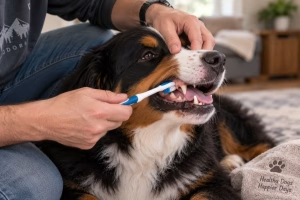
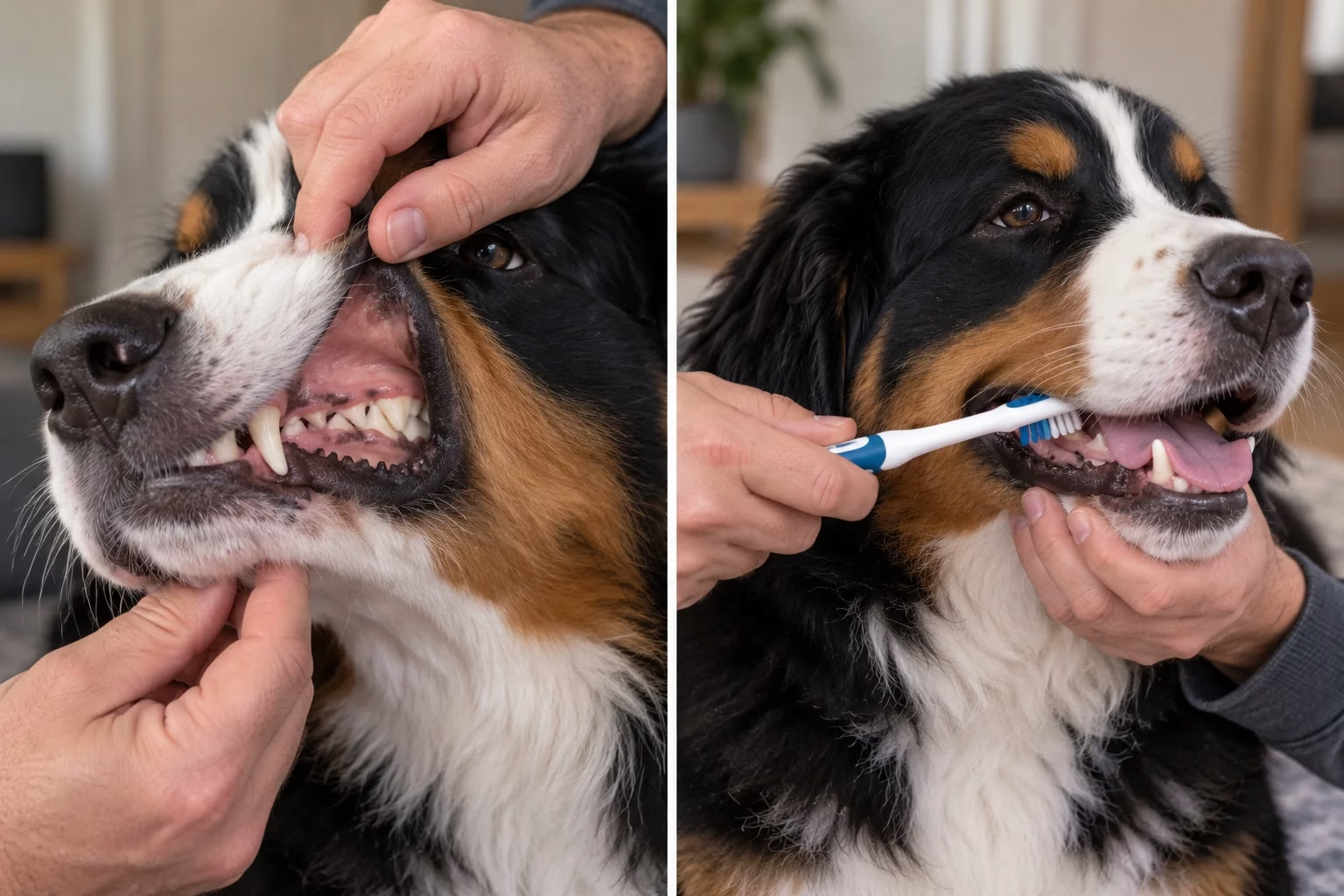
Brushing is the thing that works. Nothing else replaces mechanical plaque removal, and the frequency that matters is daily or close to it. Weekly brushing is better than none and won’t hold back periodontal disease on its own.
How to make it stick:
- Use dog toothpaste. Human toothpaste contains fluoride and sometimes xylitol, which is toxic to dogs.
- Start with your finger, or a finger brush, before introducing a bristle brush.
- Build slowly over weeks. Let the dog lick the paste. Then touch the gums. Then one tooth. Then a few. Nothing productive happens in a wrestling match.
- Concentrate on the outside surfaces of the upper back teeth. That’s where calculus accumulates fastest and where the tongue does least.
- Attach it to something that already happens — after the evening walk, before the last trip out. A routine survives; a good intention doesn’t.
A puppy that learns at ten weeks that mouth handling is normal is a dog you can brush at eight. Starting this during the first month home is far easier than starting at three years old, which is our first month guide’s argument for a lot of things.
Dental diets, water additives and chews can help around the edges. VOHC accepted products have been tested; most things on the shelf haven’t. None of them substitutes for a brush.
Professional cleanings, and the thing being sold to you
At some point your dog will need a proper cleaning under general anesthesia — a COHAT, comprehensive oral health assessment and treatment. That involves scaling above and below the gumline, a tooth-by-tooth examination, probing, and dental radiographs.
One veterinary dentist recommends every patient be anesthetized by around two years old to get a baseline set of intraoral radiographs — not only for periodontal disease, but to find broken, abnormal or unerupted teeth before they cause trouble.
Why anesthesia-free cleaning is a bad idea
The service is real, it’s widely offered — by some grooming salons and pet stores as well as veterinary practices — and the appeal is obvious. It’s cheaper, and it avoids a thing that frightens people.
The veterinary position is unusually unanimous.
The 2019 AAHA Dental Care Guidelines state that non-anesthetic dentistry is not appropriate, citing patient stress, injury, risk of aspiration, and lack of diagnostic capability. The AVDC has held a position statement against dental scaling without anesthesia since 2004, and prefers the more accurate term non-professional dental scaling. AAHA calls it below the standard of care, and accredited practices that don’t comply can fail their evaluation.
The reasons, in plain terms:
- It only cleans what’s visible. Sixty percent of the tooth is under the gumline, and that’s where periodontal disease lives. The teeth look better. The disease continues.
- No radiographs means no diagnosis. Bone loss, root abscesses, resorptive lesions and fractures below the gumline are invisible without imaging.
- Sharp instruments in a conscious mouth. Removing calculus requires scaling tools with a sharp working edge. A head movement can injure the dog’s oral tissues, and the operator can be bitten.
- No intubation means no protected airway. Debris and fluid can be aspirated, which risks aspiration pneumonia.
- It can hide the problem. A clean-looking mouth reassures an owner whose dog has progressing disease — arguably the worst outcome, because it delays real treatment.
There’s also a licensing dimension. The AVDC position notes that in the US and Canada only licensed veterinarians may practice veterinary medicine, dentistry included, and that anyone else providing dental services is practicing without a license.
But anesthesia on a big dog — isn’t that risky?
This is a reasonable worry and it deserves a real answer rather than dismissal.
Modern veterinary anesthesia is considerably safer than its reputation, and the protocol for a healthy adult dog is routine: pre-anesthetic bloodwork, an IV catheter, intubation, monitoring throughout, and controlled recovery. Ask your vet exactly what monitoring they use and who watches the dog during recovery — a practice that answers that well is a practice you can trust with it.
The more useful reframe is about timing. Anesthetic risk rises with age and with concurrent disease. A dental at three on a healthy dog is a lower-risk proposition than the same dental at eight on a dog with an arthritic back end and something else going on. Deferring dental work until the mouth is bad enough to force the issue means having the conversation at the worst possible point — and in a breed that’s functionally a senior at around six, that point arrives sooner than you’d think.
If your dog genuinely has a condition that raises anesthetic risk, that’s a conversation with your vet about how to manage it, not a reason to choose a procedure that doesn’t work.
Cost is real too — drugs are dosed by weight and a Berner is a lot of weight. Our cost guide covers ownership economics. Worth knowing that a cleaning done on schedule is cheaper than extractions done late.
Signs worth a vet visit
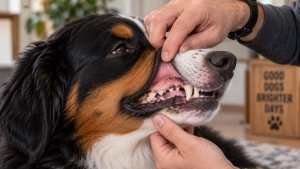
The AAHA guidelines list what a practitioner checks for, and most of it is visible to an attentive owner:
- Bad breath. The most commonly dismissed sign there is. “Dog breath” is not normal — it usually means bacteria.
- Discoloured, fractured, mobile or missing teeth
- Red, swollen or bleeding gums, or gums receding from the teeth
- Drooling, or a change in how much
- Difficulty eating — dropping food, chewing on one side, taking longer
- Pawing at the face, or resisting having the muzzle touched
- Facial swelling, especially below an eye, which can indicate a tooth root abscess
A fractured tooth is worth showing your vet even if the dog seems fine. A pulp-exposed tooth is painful and it’s a route for infection, whether or not your dog tells you about it.
What I’d actually do
- Brush daily, or as close as you manage. It’s the only thing that genuinely works at home.
- Bin the antlers, hooves, bones and hard nylon. Check the VOHC list.
- Get a baseline COHAT with radiographs while the dog is young and healthy, rather than waiting for a mouth bad enough to force it.
- Decline anesthesia-free cleaning. Not because it’s expensive — because it treats appearance and leaves the disease.
- Treat bad breath as information, not as a fact of life with big dogs.
FAQ
Are anesthesia-free dental cleanings safe for dogs? No, and every major veterinary body opposes them. The 2019 AAHA Dental Care Guidelines call non-anesthetic dentistry not appropriate, citing patient stress, injury, aspiration risk and lack of diagnostic capability. AVDC has held a position statement against it since 2004. The procedure cleans only visible surfaces while roughly 60% of the tooth sits below the gumline, where periodontal disease actually occurs.
Are antlers bad for dogs’ teeth? Veterinary dentists identify them as a significant cause of tooth fractures often requiring extraction, with elk antlers named specifically. The same applies to hooves, bones and hard nylon chews. AAHA’s guidelines note that fractured teeth can often be prevented by appropriate chew and toy selection. Look for products carrying Veterinary Oral Health Council acceptance instead.
How do I know if a chew is too hard? A rough rule: if you can’t dent it with a thumbnail, or it wouldn’t flex under your weight, it’s harder than your dog’s tooth. It isn’t a clinical standard, but it fails safe.
How often should I brush my dog’s teeth? Daily, or as near as you can manage. Brushing is the only home measure that reliably removes plaque. Dental diets, water additives and chews help at the margins but don’t replace it. Use dog toothpaste — human toothpaste contains fluoride and sometimes xylitol, which is toxic to dogs.
When should my Berner have a first professional dental cleaning? One veterinary dentist recommends every patient be anesthetized by around two years old for a baseline set of intraoral radiographs, which also screen for broken, abnormal or unerupted teeth. After that, frequency depends on what the exam and radiographs show.
Is anesthesia risky for a large dog? Modern veterinary anesthesia is considerably safer than its reputation for a healthy adult dog, with pre-anesthetic bloodwork, IV access, intubation and continuous monitoring as standard. Risk rises with age and concurrent disease, which is the argument for doing dental work while a dog is young rather than deferring it. Ask your vet what monitoring they use and who supervises recovery.
What is a slab fracture? A break where a slice of tooth shears off, typically from the upper fourth premolar — the large shearing tooth at the back of the mouth. It’s usually caused by chewing something harder than the tooth. If the fracture exposes the pulp it’s painful and provides a route for infection, and treatment is root canal or extraction.
Is bad breath in dogs normal? No. It’s the most commonly dismissed sign of dental disease and usually indicates bacteria associated with periodontal disease rather than something inherent to dogs.
