

Health disclaimer: This article is for educational purposes and is not a substitute for veterinary diagnosis, treatment or nutritional advice. If you are concerned about your Bernese Mountain Dog’s health, contact your veterinarian. If your dog may be experiencing an emergency, contact an emergency veterinary clinic immediately.
ⓘ Affiliate Disclosure: This post contains affiliate links. As an Amazon Associate, we earn from qualifying purchases at no extra cost to you. Read our full disclosure.
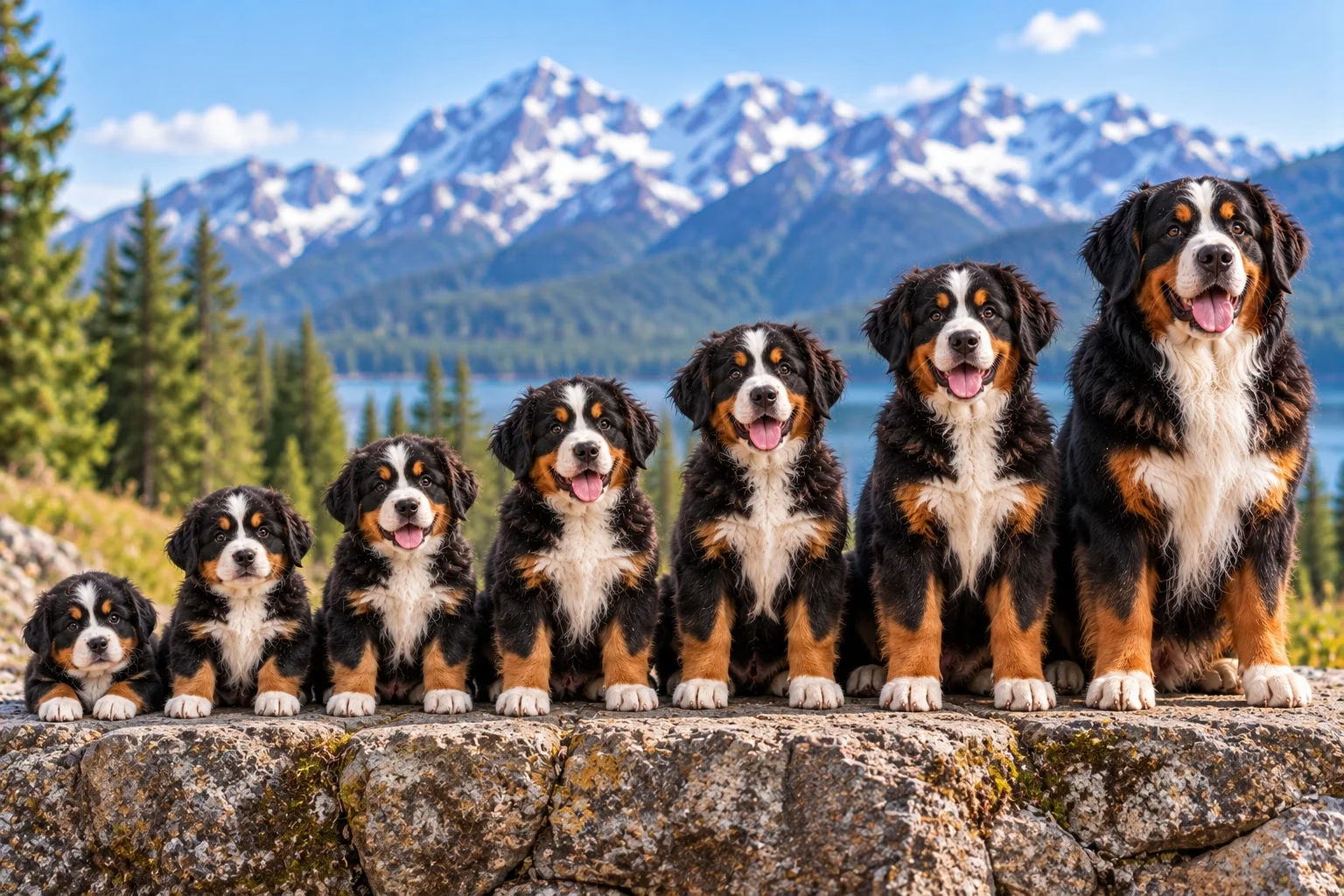
Watching a Bernese Mountain Dog puppy grow is one of the most rewarding experiences a dog owner can have — and one of the most surprising. These dogs transform from 1–2 lb newborns into 80–115 lb adults in just 18–24 months, and every phase brings new milestones, new needs, and new considerations for their health and nutrition. This comprehensive Bernese Mountain Dog puppy growth chart breaks down development month by month, including expected weight ranges, behavioral milestones, and nutritional guidance for each stage.
Bernese Mountain Dog Puppy Growth Chart by Month
Use this growth chart as a general guideline. Individual Berners will vary based on gender (males are substantially larger than females), genetics, and nutrition. If your puppy falls significantly outside these ranges, consult your veterinarian.
| Age | Male Weight | Female Weight | Key Milestone |
|---|---|---|---|
| Birth | 1–2 lbs | 1–2 lbs | Eyes/ears closed; nursing only |
| 4 weeks | 4–6 lbs | 3–5 lbs | Eyes open, beginning to play |
| 8 weeks | 12–18 lbs | 10–15 lbs | Goes to new home; first vaccines |
| 3 months | 22–30 lbs | 18–26 lbs | Critical socialization window |
| 4 months | 35–45 lbs | 28–38 lbs | Rapid growth phase; 3–4 meals/day |
| 5 months | 45–60 lbs | 38–50 lbs | Adolescent behavior begins |
| 6 months | 55–70 lbs | 45–60 lbs | Adult teeth coming in; reduce to 2 meals |
| 8 months | 65–80 lbs | 52–68 lbs | Growth slowing; adolescent phase |
| 10 months | 72–88 lbs | 58–74 lbs | Approaching adult height |
| 12 months | 78–95 lbs | 62–80 lbs | Near adult height; still filling out |
| 18 months | 85–105 lbs | 68–88 lbs | Mostly adult weight; still maturing mentally |
| 24 months | 90–115 lbs | 70–95 lbs | Full adult size and maturity |
Stage-by-Stage Development Guide
Birth to 8 Weeks: Neonatal and Socialization Foundations
During this phase, your future Berner is entirely in the breeder’s care. The best breeders practice Early Neurological Stimulation (ENS) — a series of gentle exercises (tactile stimulation, thermal stimulation, proprioception challenges) performed daily from days 3–16 that produce measurable improvements in stress tolerance and cardiovascular efficiency in adulthood. They also expose puppies to household sounds, different surfaces, gentle handling by multiple people, and brief separations to build confidence.
By 8 weeks, a well-bred Berner puppy should be curious, social, willing to approach people, and neither highly fearful nor overly bold. This is the ideal window to bring a puppy home — after the critical socialization programming that the breeder has begun can be continued by you.
8–12 Weeks: The Critical Socialization Window
Puppies that go home at 8 weeks are entering what behaviorists call the primary socialization period (8–16 weeks). Whatever your puppy is exposed to positively during this window will be accepted as “normal” for life. Whatever is missed creates permanent gaps in confidence that are very difficult to overcome later.
Your absolute priority during this phase is socialization — not obedience training, not exercise, not showing off your puppy. Safely expose your Berner to: different types of people (hats, beards, children, elderly, uniforms), different surfaces (grass, gravel, metal grates, stairs), different sounds (traffic, children playing, vacuum cleaners), and gentle interactions with friendly, vaccinated dogs. Your puppy is not yet fully vaccinated during this window, so be selective about where they contact unknown dogs — puppy classes held in sanitized facilities are generally considered safe and valuable.
At 8 weeks, your puppy needs a 48-inch crate with a divider panel that can be adjusted as they grow. Start with the crate space just large enough for them to stand, turn around, and lie down — this encourages them to hold their bladder rather than using a corner of the crate as a bathroom.
3–6 Months: The Rapid Growth Phase
This is the period of most dramatic physical growth. Your Berner puppy will roughly double in weight between months 3 and 6, and their bone plates are actively developing. This is critically important to understand: do not over-exercise a BMD puppy during this phase.
The general guideline is the “5-minute rule” — no more than 5 minutes of exercise per month of age, twice daily. A 4-month-old puppy gets a maximum of 20 minutes of structured walking, twice a day. Free play in the yard is generally fine — the concern is forced, repetitive exercise on hard surfaces that puts stress on developing growth plates. Long hikes, running alongside bikes, and extended fetching sessions should wait until 18–24 months when the growth plates fully close.
Feed your puppy 3–4 small meals per day during this phase using a large-breed puppy formula. This is non-negotiable for Berners. Large-breed puppy foods are specifically formulated with controlled calcium and phosphorus ratios to support healthy, controlled bone growth. General “all-breed” puppy foods have too much calcium for giant breed puppies and can actually contribute to skeletal development problems. Look for a large breed puppy food with controlled calcium levels.
6–12 Months: Adolescence Begins
Around 5–7 months, most Berner owners notice a shift in their puppy’s behavior. The highly responsive, people-focused puppy may suddenly seem more independent, more easily distracted, and occasionally as though they’ve “forgotten” their training. Welcome to adolescence.
Hormonal changes during this phase are real and affect trainability. This is not the time to give up on training — it’s the time to double down on consistency and patience. Adolescent Berners can be challenging: they may test boundaries, pull harder on leash, and seem to make choices between listening to you and chasing a squirrel that they wouldn’t have made at 10 weeks old. A front-clip no-pull harness during this phase is strongly recommended.
By 12 months, your Berner will have reached approximately 85–95% of their adult height but will continue to fill out and build muscle until 18–24 months. Transition from puppy food to large-breed adult formula between 12–18 months, as guided by your veterinarian.
12–24 Months: Approaching Full Maturity
The final growth phase in Bernese Mountain Dogs is gradual. Between 12 and 24 months, your dog will fill out through the chest and hindquarters, reaching their full adult weight and muscular development. Mentally, Berners remain somewhat puppy-like well into their second year — consistent training and enrichment are important throughout this period.
At 18 months, consider adding joint health supplements to your Berner’s routine. Given the breed’s predisposition to hip and elbow dysplasia, starting fish oil (omega-3 fatty acids) and glucosamine/chondroitin at this stage provides proactive support for lifelong joint health. A quality fish oil supplement for large breed dogs is one of the most evidence-supported additions to any Berner’s diet.
When to Switch from Puppy to Adult Food
This is one of the most common questions Berner owners ask during the growth phase. The answer is: between 12 and 18 months, and the exact timing should be guided by your veterinarian based on your individual dog’s development. Some vets recommend transitioning at 12 months for Berners; others prefer waiting until 18 months when growth is more completely finished. Either way, transition gradually over 7–10 days by mixing increasing proportions of adult food into the puppy food to avoid digestive upset.
Frequently Asked Questions: BMD Puppy Growth Chart
How much should a 3-month-old Bernese Mountain Dog weigh?
A 3-month-old male Berner typically weighs 22–30 pounds, while females weigh 18–26 pounds. Significant variation outside this range warrants a conversation with your veterinarian about nutrition and health.
When are Bernese Mountain Dogs fully grown?
Bernese Mountain Dogs reach their adult height around 12–14 months but continue to fill out and build muscle until 18–24 months. They are not considered fully mature (physically or mentally) until approximately 2 years of age.
How fast do Bernese Mountain Dog puppies grow?
Very fast. The period between 8 weeks and 6 months sees the most dramatic growth — puppies can gain 4–6 lbs per week during peak growth phases. Adequate large-breed puppy nutrition is essential during this time.
When should I switch my Bernese Mountain Dog from puppy food to adult food?
Between 12 and 18 months, based on guidance from your veterinarian. Large-breed puppy formulas should not be fed past 18 months, as the elevated calorie levels for growth can contribute to obesity in adult dogs.
Is it normal for Bernese Mountain Dog puppies to grow unevenly?
Yes — large breed puppies often grow in “spurts” and can look temporarily gangly or uncoordinated as different body parts grow at different rates. This is normal and resolves as the dog approaches full maturity around 18–24 months.
Monitoring Your Bernese Mountain Dog’s Weight: Healthy vs Overweight
The growth chart above provides general weight ranges, but weight alone doesn’t tell the full story. A more useful assessment is the Body Condition Score (BCS) — a hands-on evaluation of whether your dog is at a healthy weight regardless of the number on the scale.
To assess your Berner’s BCS, run your hands firmly along their ribcage from front to back. You should be able to feel individual ribs easily but not see them prominently. When viewed from above, your dog should have a visible waist (hourglass shape) behind the rib cage. When viewed from the side, there should be a slight abdominal tuck — the belly should not hang level with or below the chest.
Overweight Berners are at significantly higher risk for joint problems, diabetes, and earlier onset of arthritis — all major quality-of-life concerns for a breed already prone to orthopedic issues. If your Berner is gaining weight too quickly or you can’t feel their ribs, reduce food portions by 10% and recheck in two weeks. An accurate digital pet scale for large dogs makes tracking weight at home easy and precise.
Exercise Guidelines by Age for Bernese Mountain Dog Puppies
One of the most important things to understand about raising a Berner puppy is the 5-Minute Rule for exercise. Over-exercising a large-breed puppy before their growth plates close can contribute to joint damage that lasts a lifetime. Here is a practical age-based exercise guide:
| Age | Max Exercise Per Session | Notes |
|---|---|---|
| 8–12 weeks | 10–15 minutes | Short walks, free yard play only |
| 3 months | 15 minutes, twice daily | Leash walking on soft surfaces |
| 4 months | 20 minutes, twice daily | Avoid stairs and jumping |
| 5 months | 25 minutes, twice daily | Continue avoiding forced running |
| 6 months | 30 minutes, twice daily | Begin obedience training sessions |
| 12 months | 45–60 minutes daily | Approaching adult exercise needs |
| 18–24 months | 60 minutes daily | Growth plates closing; full activity OK |
Swimming is the one exception to strict exercise limitations — the buoyancy of water removes impact stress from joints, making it an excellent low-impact option for Berner puppies even during the restricted exercise phase. If you have access to a safe, shallow swimming area, supervised water play is encouraged for Berners of all ages.
Developmental Milestones Beyond Weight
While the growth chart focuses on weight, there are important behavioral and physical milestones to track alongside it:
Teeth: Berner puppies lose their 28 puppy teeth and grow 42 adult teeth between approximately 4 and 6 months of age. This teething process is uncomfortable, and puppies will chew more intensively during this period. Provide safe, appropriately-sized durable teething toys for large breed puppies and keep valuable items out of reach.
Sexual Maturity: Most Berner females come into their first heat around 6–9 months. Berner males can father puppies from approximately 6 months. Responsible breeders and veterinarians typically recommend waiting until 18–24 months to spay or neuter, allowing full hormonal development that appears to benefit joint health, cancer risk, and overall development in large breeds.
Coat Development: The distinctive Bernese Mountain Dog tri-color coat develops gradually. Many puppies have a fluffier, less defined coat in the first several months that sheds and is replaced by the adult double coat around 12–18 months. The final adult coat is usually fully established by 24 months.
Tracking your Berner’s development through photos, weight records, and behavioral notes each month creates a valuable health record and one of the most cherished keepsakes of your time with this remarkable breed.
Growing alongside your Berner requires knowing how to meet their needs at each stage. Read our complete guide on bringing home a Bernese Mountain Dog puppy for the first-week essentials, and our Bernese Mountain Dog exercise needs guide to understand how to keep your growing dog healthy without damaging developing joints. For nutrition guidance at every stage, our best food for Bernese Mountain Dog guide covers feeding from puppyhood to the senior years.
Owner-written, not veterinary advice. This article is written by a Bernese Mountain Dog owner, not a veterinarian. It is general information gathered from veterinary and breed-club sources — not a diagnosis or a treatment plan. Every dog is different. If your dog is unwell or showing any sign described here, call your own vet. In an emergency, go straight in.
How we research this / Sources
- American Kennel Club — Best Dog Food for Large Breeds (incl. large-breed puppies)
- American Kennel Club — Hip Dysplasia in Dogs
- American Kennel Club — Bernese Mountain Dog breed information
Written by Todd Grasse, founder of BerneseMountainLover.com and Bernese Mountain Dog owner. This article combines owner-focused guidance with the veterinary and breed-health sources listed above.

1 Comment
I visited various blogs but the audio quality for audio songs present at
this web page is truly excellent.