
Bernese Mountain Dogs have their own version of degenerative myelopathy — a genetic mutation that, as far as the research shows, occurs in no other breed.
That matters for one very practical reason. A DM test that only screens for the common mutation can come back “clear” on a Berner that carries the breed-specific one. If you or your breeder had a dog tested, and the result was reassuring, it’s worth finding out exactly which variants that test looked for.
This is owner education, not veterinary advice. It doesn’t diagnose anything, and nothing here replaces a neurological examination. If your dog is losing hind-end function, that’s a vet appointment.
What DM is
Degenerative myelopathy is a progressive disease of the spinal cord. The nerve fibres that carry signals to and from the hind legs gradually degenerate, and the dog loses coordination and then strength in its back end. It’s often compared to amyotrophic lateral sclerosis in people, and researchers use dogs with DM as a naturally occurring model for studying it.
Three things about it that owners most need to know:
It’s usually not painful. This is the defining feature, and it’s genuinely a small mercy. A dog with DM isn’t reluctant to move because it hurts — the back end simply isn’t doing what it’s told. That’s also what distinguishes it from the arthritis and joint disease it’s most often mistaken for.
It’s progressive. It does not reverse and there’s currently no cure. Management focuses on keeping the dog mobile and comfortable for as long as possible.
It typically appears in older dogs. The Bernese case that led to the discovery of the breed’s own mutation was an eight-year-old female.
The Berner’s own mutation
DM is associated with mutations in a gene called SOD1. Two different mutations are known.
| SOD1:c.118A (often called SOD1A) | SOD1:c.52T (often called SOD1B) | |
|---|---|---|
| Where it’s found | Many breeds — German Shepherds, Boxers, Pembroke Welsh Corgis, Rhodesian Ridgebacks, Chesapeake Bay Retrievers and others | Appears to be limited to Bernese Mountain Dogs |
| When identified | 2009 | 2011, in a Bernese Mountain Dog |
| How common | Widespread | Rare |
Berners carry both. A study that genotyped 408 Bernese Mountain Dogs for both mutations found:
| Heterozygous (one copy) | Homozygous (two copies) | |
|---|---|---|
| c.118A — the common mutation | 46.1% | 6.6% |
| c.52T — the Berner-specific mutation | 15.9% | 0.5% |
The common mutation is considerably more widespread in the breed than the Berner-specific one. But the Berner-specific one is there, and roughly one Berner in six in that sample was carrying it.
Why your dog’s DM test result might not mean what you think
This is the section worth reading twice.
Many DM tests screen only for the common c.118A mutation. That’s the one most breeds have, and it’s the one most commercial tests were built around.
For most breeds, that’s fine. For a Berner, it leaves a gap. A Bernese Mountain Dog can test clear for c.118A while carrying c.52T — and a test that didn’t look for c.52T will never tell you.
There’s a further complication. A dog with one copy of each mutation — a compound heterozygote — has been documented with confirmed DM. So a Berner that looks like a mere carrier on each test individually may be at meaningful risk once both results are read together.
The practical upshot:
- Ask exactly which SOD1 variants a test screens for before relying on the result. Not “does it test for DM” — which variants.
- For a Berner, you want both c.118A and c.52T. Some labs offer a breed-specific panel.
- Read the two results together, not separately. One copy of each is a different picture from one copy of one.
- If your dog was tested years ago, check what that test covered. The Berner-specific mutation was only identified in 2011, and older tests may not include it.
Our breeder guide covers health testing more broadly. This is a good question to ask a breeder specifically, because a breeder who knows the answer immediately is telling you something about how carefully they test.
“At risk” is not a diagnosis
DM is inherited as an autosomal recessive trait with incomplete penetrance. In plain terms: carrying the genetic risk does not mean a dog will develop the disease.
When the common mutation was first identified, every affected dog tested was homozygous for it — but some homozygous dogs showed no signs of DM at all. The researchers suggested either incomplete penetrance or other genetic factors involved. Later work identified variants in another gene that modify DM risk.
And risk isn’t equal across genotypes. Follow-up research concluded that dogs homozygous for c.118A are at much higher risk than dogs heterozygous for c.52T.
So a test result gives you a genetic risk category, not a forecast:
- Clear / normal on both variants — very low genetic risk from the known mutations
- Carrier — one copy of one mutation. Generally not expected to develop DM from that alone, but relevant for breeding, and relevant if combined with a copy of the other variant
- At risk / affected genotype — two copies, or one of each. Elevated genetic risk. Not a diagnosis. Many such dogs never develop clinical disease
If your dog tests “at risk,” the right response is awareness, not grief. Know the early signs, mention the result to your vet, and get on with living with a healthy dog.
Signs and progression
DM develops slowly, usually over months to a few years. The early signs are subtle and very easy to file under “getting old.”
Early:
- Scuffing or wearing down the nails of the back feet, from dragging the toes
- A slight wobble or sway in the hindquarters, especially when turning
- Crossing the back legs, or standing with them oddly placed
- Slipping more than usual on smooth floors
- Knuckling — the back paw folding over so the dog stands on the top of it
As it progresses:
- Obvious weakness in the hind legs
- Difficulty getting up, and difficulty with stairs
- Falling, particularly when turning or on slippery surfaces
- Eventually, inability to walk on the hind legs
Later:
- Loss of bladder and bowel control
- Weakness spreading to the front legs
In the Bernese case that identified the breed’s own mutation, the dog progressed from partial hind-limb paralysis to full paralysis with bowel incontinence.
DM or hips? The distinction owners can see
Hind-end weakness in an older Berner has several possible causes, and DM is only one of them. The single most useful thing an owner can observe is whether it seems to hurt.
| Degenerative myelopathy | Hip dysplasia / arthritis | |
|---|---|---|
| Pain | Typically painless | Painful |
| Main problem | Loss of coordination, then strength | Stiffness and soreness |
| Pattern | Steadily progressive | Good days and bad days; worse after rest and cold |
| Response to pain medication | Little or none — there’s no pain to treat | Usually improves |
| Nails | Back nails scuffed from toe-dragging | Usually normal wear |
Plenty of older Berners have arthritis and something neurological, which muddies things. But if your dog is losing hind-end function and doesn’t seem sore, tell your vet that specifically. Our hip dysplasia article covers the orthopedic side.
Diagnosis
There’s no single test that confirms DM in a living dog. Diagnosis is by exclusion — ruling out the other things that cause similar signs: spinal disc disease, tumours affecting the spinal cord, orthopedic disease, and others.
That typically involves a neurological examination, imaging of the spine (often MRI) to exclude compressive causes, and genetic testing to establish risk. A definitive diagnosis is made only by examining the spinal cord tissue after death.
A neurology referral is worth asking for. The conditions that mimic DM include several that are treatable, and ruling those out properly is the whole point of the workup.
Management: what actually helps
There’s no treatment that stops or reverses DM. What does make a measurable difference is exercise.
A study found that daily controlled physiotherapy increased survival time in dogs with suspected DM, and that affected dogs receiving physiotherapy stayed on their feet longer than those that didn’t. Keeping the dog moving, in a structured way, is the single best-supported intervention available.
What that looks like in practice:
- Daily controlled exercise — regular walks at the dog’s pace rather than rest
- Hydrotherapy, where available — swimming or an underwater treadmill works the muscles without load
- Physiotherapy exercises a rehabilitation vet can teach you to do at home
- Keeping weight down, because every pound matters more when the back end is weakening
And the practical adaptations for a large dog, which matter enormously with a breed this size:
- Traction everywhere — rugs and runners along every route the dog uses
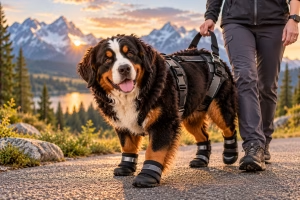
- A support harness with a handle over the hips, so you can help without lifting the whole dog
- Booties to protect back feet from scuffing
- A rear-support sling or, eventually, a wheeled cart, which many dogs adapt to remarkably well
Our senior care guide covers mobility support for a large aging dog in detail, including assessing quality of life as things progress.
For breeders
Because DM is recessive, the goal isn’t to eliminate every carrier from a breeding programme — that would narrow an already limited gene pool. The goal is to avoid producing dogs with an at-risk genotype.
That means testing both parents for both variants, and pairing so that puppies can’t inherit two risk alleles. A breeder testing only for c.118A is working with half the picture in this breed.
FAQ
Is there a DM mutation specific to Bernese Mountain Dogs? Yes. Degenerative myelopathy is associated with mutations in the SOD1 gene. Most breeds carry a mutation called c.118A. In 2011 researchers identified a second mutation, c.52T, in a Bernese Mountain Dog, and later work concluded that variant is rare and appears to be limited to the breed. Berners can carry either or both.
My Berner tested clear for DM. Is he definitely clear? Only if the test screened for both SOD1 variants. Many DM tests look only for the common c.118A mutation, which leaves the Berner-specific c.52T undetected. Ask the lab exactly which variants were tested. If the test was done some years ago, check whether it included c.52T, which was identified in 2011.
My dog tested “at risk.” Will he get DM? Not necessarily. DM shows incomplete penetrance — some dogs with an at-risk genotype never develop the disease, and other genetic factors modify risk. Research also indicates dogs with two copies of c.118A are at much higher risk than dogs carrying c.52T. An at-risk result is a reason to know the early signs, not a diagnosis.
What is a compound heterozygote? A dog carrying one copy of each of the two SOD1 mutations. Each result alone might read as “carrier,” but a compound heterozygous Bernese Mountain Dog has been documented with confirmed DM. That’s why the two test results should be read together.
Is degenerative myelopathy painful? Typically not, which is the main thing distinguishing it from arthritis and hip disease. The dog loses coordination and strength rather than experiencing pain. It’s one of the reasons it’s so often mistaken for normal aging.
How is DM different from hip dysplasia? DM is usually painless and steadily progressive, with loss of coordination, toe-dragging and scuffed back nails. Hip dysplasia and arthritis are painful, with stiffness that’s worse after rest and cold, and they usually respond to pain medication. Many older dogs have both. If your dog is weak but doesn’t seem sore, tell your vet that specifically.
Can DM be treated? There’s no treatment that stops or reverses it. The best-supported intervention is exercise: a study found daily controlled physiotherapy increased survival time and kept affected dogs on their feet longer. Hydrotherapy, weight control, traction, support harnesses and eventually a cart all help maintain mobility and quality of life.
How is DM diagnosed? By exclusion in a living dog — a neurological exam and usually spinal imaging to rule out disc disease, tumours and other causes that look similar, plus genetic testing to establish risk. Definitive diagnosis requires examining spinal cord tissue after death. A neurology referral is worth asking for, since several conditions that mimic DM are treatable.
