
The temperature at which dogs start ending up at the vet with heat-related illness is lower than almost anyone expects. In a study of UK veterinary records, the median ambient temperature on days dogs presented with heat-related illness was 16.9°C — roughly 62°F.
Read that again. Median. Half the cases happened on days cooler than that.
Sixty-two degrees is a nice day. It’s the kind of afternoon that makes you want to take the dog somewhere. And that’s precisely the problem — because the most common trigger in that data wasn’t a hot car or a dog shut in a conservatory. It was exercise. Dogs overheating on walks, on hikes, playing fetch, on days their owners considered mild.
If you own a Berner, this matters more than it does for most breeds. Two of the risk factors that study identified independently were body weight over 50 kg (110 lb) and being heavier than the average for your breed and sex. A well-grown Berner male clears the first routinely. A slightly overweight one clears both.
One thing to be straight about: the Bernese was not among the breeds specifically named as high-risk in that study — those were the Chow Chow, Bulldog and French Bulldog. The weight findings are what apply here, not a breed finding. But because Berners aren’t flat-faced, owners tend to mentally file heat risk as somebody else’s problem. The data says size is its own lever, independent of face shape.
The full data is UK primary-care records, so the absolute incidence figures don’t transfer directly to Arizona or Georgia. The risk factors and the temperature finding do.
This is owner education, not veterinary advice. Heat-related illness is an emergency — if you think your dog is in trouble, act on the protocol below and call your vet.
If it’s happening right now
Putting this first because someone reading this page is reading it in a panic.
Signs, roughly in order of severity:
- Mild: heavy or altered panting that doesn’t settle, lethargy, unwillingness to keep going
- Moderate: vomiting or diarrhoea, wobbling, briefly collapsing, a single seizure
- Severe: disorientation or unresponsiveness, continued seizures, bloody vomit or diarrhoea, bleeding that won’t stop
The survival gap between those brackets is enormous. In the UK data, 97% of dogs treated at the mild stage survived. At the severe stage, 43% did. Acting at “he’s panting oddly and doesn’t want to walk anymore” is the entire game.
The protocol: cool first, transport second
This is the part where the advice you’ve probably absorbed is wrong.
- Stop. Get into shade or air conditioning.
- Pour cold water over the dog — as much as you have, as cold as you have. A hose, a bucket, a stream, a paddling pool. If you can immerse the dog, immerse it.
- Get air moving over the wet dog. A fan, a breeze, an open car window with the AC blasting. Water plus airflow is what actually pulls heat out.
- Keep cooling. Then transport, and keep cooling on the way.
- Call the vet while you’re cooling, not before you start.
Three myths that need to die
“Cold water causes shock — use tepid water only.” Not supported by evidence. Veterinary emergency and critical care guidance recommends cold-water immersion for young healthy dogs and evaporative cooling — water plus air movement — for older or unwell ones. In one study, dogs voluntarily entered water close to freezing and cooled rapidly with no adverse effects. Use whatever water you have, as long as it’s cooler than the dog. The longer the dog stays hot, the more organ damage accumulates, and some of it doesn’t reverse.
“Lay wet towels over the dog.” This is the single most common thing owners do and it’s near-useless. In the UK data, 51.3% of the dogs who received any cooling got wet towels. A towel left on a hot dog stops evaporating and starts insulating — it traps heat. Better than nothing, far worse than pouring water on.
“Get to the vet immediately, cool there.” Only 21.7% of dogs presenting with heatstroke had been cooled before transport. Of the ones who had been, only 10.8% needed further cooling on arrival. A car is a bad cooling environment; dogs cool less in vehicles regardless of what you did beforehand. Minutes at a high body temperature cause damage, and the drive is minutes you don’t have to spend.
If your dog is still conscious, let it drink a little. If it’s unconscious, every second counts — cool and go.
Prevention: what actually reduces risk
Timing beats everything
Move walks to early morning. Not “before it gets hot” — actually early, because ground and air both hold heat well into the evening and a 7pm walk on a warm day is often worse than a 7am one at the same air temperature.
The useful mental shift: stop deciding by the thermometer and start deciding by the dog. A Berner that lies down mid-walk, seeks shade unprompted, or slows without being told is telling you the outing is over. Berners are stoic and biddable, which is a dangerous combination in heat — they will keep going for you well past the point where they should have stopped. That’s the mechanism behind exertional heat illness. It isn’t neglect. It’s a willing dog and an owner reading the day rather than the animal.
Humidity matters as much as temperature and gets ignored. Panting works by evaporation. In humid air, evaporation slows, and the dog’s only meaningful cooling system loses efficiency. 78°F and humid is worse than 85°F and dry.
The pavement test
Press the back of your hand flat to the surface and hold it for seven seconds. If you can’t, the dog can’t walk on it. Asphalt in direct sun runs far hotter than the air, and pad burns are common, painful and slow to heal.
Grass, dirt trails, shaded sidewalks. And check the surface, not the forecast — a shaded path and an exposed parking lot on the same afternoon are different environments entirely.
Water and shade
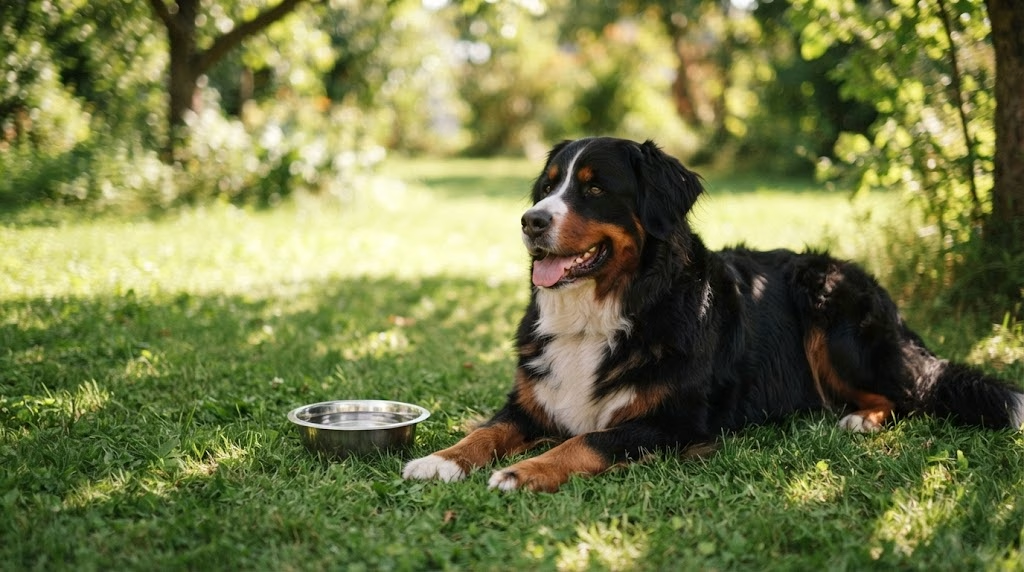
More water bowls than you think you need, in more places. Add ice. A dog that has to travel to drink drinks less.
Shade needs to be real shade — a tree or a solid structure, not a mesh screen. And crucially, shade moves. A run or a yard that’s shaded at 10am can be full sun by 2pm. If your dog spends unsupervised time outdoors, walk the space at midday once and see what’s actually there.
Cars
Never. Not with the windows cracked, not for five minutes, not in the shade. There’s no version of this that’s fine, and a 100-pound double-coated dog has less margin than most.
Watch weight
This is the one prevention lever with study support behind it. Being heavier than the breed and sex average was an independent risk factor for heat-related illness — separate from absolute size. An overweight Berner is carrying insulation it can’t shed and a cardiovascular load it doesn’t need.
If you’ve been meaning to get a few pounds off your dog, this is the argument. Our weight and body condition guide covers how to assess it honestly.
Cooling gear: what works, roughly ranked
- Air conditioning. Unglamorous, unbeatable, the actual answer in a hot climate.
- A wading pool. Cheap, and most Berners will use one voluntarily. Standing in water cools from the feet and belly, where the coat is thinnest.
- Elevated cot beds. Airflow underneath does more than a gel pad does.
- Cooling mats. Modest benefit. Many Berners won’t stay on them.
- Cooling vests. Only work if kept wet, and a wet vest on a dry dog in humid air is close to useless. On a hike where you can re-soak it, they help.
Skip anything that involves wrapping the dog in fabric and leaving it there.
Should you shave your Berner?
No. And this comes up every summer.
The reasoning: a double coat isn’t just warmth. The undercoat traps a layer of air that insulates against heat as well as cold, and the topcoat shields skin from direct sun. Shave it and you remove the barrier, expose skin that has never seen sunlight to sunburn, and in many double-coated dogs the coat grows back with altered texture that sheds worse and insulates less than what you removed.
What to do instead is get the dead undercoat out, which is a completely different operation from taking the coat off. A properly de-shedded Berner has airflow to the skin. A matted one has a felted layer of dead hair holding heat against the body, which is genuinely dangerous in summer and is the actual coat-related risk. Our grooming guide and shedding article cover the tools.
Trimming feathering short, or tidying the hair between the pads, is fine and can help. Taking the body coat down to the skin is not.
Who’s at extra risk
Within the breed, some dogs have less margin than others:
- Puppies and young adults. The exertional form of heat illness skews young — the dogs most willing to run past their own limits.
- Seniors. Thermoregulation declines with age, and the environmental form of heat illness skews old. In a breed that’s a senior at around six, that arrives sooner than owners expect.
- Overweight dogs. Documented risk factor.
- Dogs with any respiratory or cardiac condition. Panting is the cooling system; anything that compromises breathing compromises cooling.
- Dogs with thick, unmanaged coats. Not the coat itself, the dead undercoat in it.
If your dog is in two or more of those groups, drop your thresholds accordingly.
Can a Berner live somewhere hot?
Yes, with real climate control and real discipline. Berners live perfectly well in Texas and Florida and Arizona — but their owners run air conditioning year-round, walk at dawn, and accept that the dog does not go outside for enjoyment between roughly 10am and 7pm for four months of the year.
What doesn’t work is a hot climate plus a yard dog, or a hot climate plus a household that wants a hiking companion in July. Our living conditions article covers the broader suitability question.
For the opposite season, the cold-weather guide covers winter — which this breed handles about as well as any dog alive.
The short version
- The danger starts around 60°F, not 90°F, and exercise is the most common trigger.
- Weight is a documented risk factor, and it’s the one you can change.
- Walk at dawn. Read the dog, not the thermometer.
- Seven-second hand test on pavement.
- Don’t shave. De-shed instead.
- If it goes wrong: cold water, lots of it, air moving over the dog, cool first and transport second. Not tepid water. Not wet towels laid on top.
Act at “something’s off.” The survival numbers between mild and severe are not close.
FAQ
What temperature is too hot for a Bernese Mountain Dog? There isn’t a clean threshold, and that’s the point. UK veterinary data found the median ambient temperature on days dogs presented with heat-related illness was about 62°F, with exercise the most common trigger. For a Berner, treat anything above the mid-60s as a day to shorten and reschedule walks, and factor in humidity — humid air makes panting less effective, so 78°F and humid can be worse than 85°F and dry.
Should I shave my Bernese Mountain Dog in summer? No. The double coat insulates against heat as well as cold and shields skin from sun, and in many double-coated dogs it regrows with worse texture. What helps is removing the dead undercoat, which is a different job — a matted coat traps heat against the body and is the real coat-related risk.
Is cold water dangerous for an overheated dog? No. That’s a persistent myth. Veterinary emergency guidance recommends cold-water immersion for young healthy dogs and water plus air movement for older or unwell ones. Use whatever water is available as long as it’s cooler than the dog. Staying hot causes organ damage; cold water does not cause shock.
What should I do first if my Berner is overheating? Cool first, transport second. Get into shade, pour cold water over the dog or immerse it, get air moving across the wet coat, and call your vet while you’re cooling rather than before you start. Only about a fifth of dogs presenting with heatstroke in one UK study had been cooled before transport, and cars are poor cooling environments.
Are wet towels a good way to cool a dog? Not really. They were the most common method owners used and they’re among the least effective — a towel left on a hot dog stops evaporating and starts insulating. Pouring water over the dog with air moving across it works far better.
How do I know if my Berner is overheating or just hot? Watch for panting that doesn’t settle when the dog stops, lethargy, and unwillingness to continue. Those are the mild signs, and they’re where you should act — survival at the mild stage was around 97% in one UK study, against 43% at the severe stage. Vomiting, wobbling, collapse, disorientation or seizures mean you’re already past mild.
How hot is too hot for pavement? Press the back of your hand flat against it for seven seconds. If you can’t hold it there, don’t walk your dog on it. Asphalt in direct sun runs well above air temperature, and pad burns are painful and slow to heal.
Can Bernese Mountain Dogs live in hot climates? Yes, with air conditioning and genuine discipline about timing. What doesn’t work is a Berner kept primarily outdoors in a hot climate, or a household expecting a summer hiking companion. The dog can be happy; the schedule has to change.
Are senior Berners at greater risk in heat? Yes. Thermoregulation declines with age, and older dogs are over-represented in the environmental form of heat illness. Given that a Berner is functionally a senior at around six, that comes sooner than most owners plan for.
