

A CHIC number does not mean a dog is healthy. It means the required tests were completed and the results were published. A dog with failing results can hold one.
That isn’t a cynical reading. It’s what the Bernese Mountain Dog Club of America says itself: the requirements do not require results to be free from disease, only that the tests be completed and shared so that informed breeding and buying decisions can be made. The club goes further and states plainly that one should never assume a dog qualifying for CHIC has cleared the required testing — only that the testing was done and made public.
Which means the certification is a starting point, not an answer. The actual answer is in the results, and you can look those up yourself.
This is owner education, not veterinary or breeding advice. Testing requirements change — verify current requirements with the BMDCA and OFA before relying on anything here.
What testing this breed should have
The BMDCA’s minimum recommended health testing is:
| Test | |
|---|---|
| Hips | Required |
| Elbows | Required |
| Eyes | Required |
| Heart | Required |
| Degenerative Myelopathy | Required |
| Plus one of: von Willebrand disease, thyroid, or histiocytic sarcoma risk test | One required |
For a dog that may be bred, the club recommends adhering to the CHIC requirements for these tests. The CHIC programme — run jointly by the OFA and the AKC Canine Health Foundation — sets breed-specific protocols with each parent club, and issues a number to dogs that complete all of them with results published openly.
For this breed, CHIC’s requirements include an AKC DNA profile, hip evaluation, elbow evaluation, eye certification, a cardiac evaluation, DM DNA results for both SOD1-A and SOD1-B, and one of the optional tests above.
That DM requirement is worth pausing on. There are two separate SOD1 mutations associated with degenerative myelopathy, and one of them appears to occur only in Bernese Mountain Dogs. Many commercial DM tests screen for just the common variant. CHIC requires both — which means you have a concrete standard to hold a breeder to rather than a vague question. Our degenerative myelopathy article explains why the second variant matters.
How to read each result
Hips
Two accepted methods, and the BMDCA presents both:
OFA evaluation — hip-extended radiographs, graded by a panel of radiologists. Final certification requires the dog to be at least 24 months old. Grades run from Excellent through Good and Fair to Borderline and the dysplastic grades. It’s the more common route and it is a subjective grading of an image.
PennHIP — measures joint laxity and reports a Distraction Index, a quantitative number compared against the breed’s distribution. It can be performed from as young as 16 weeks, though after 12 months is recommended for reliable results.
The BMDCA quotes PennHIP’s own guidance on what to do with the number: breeders should select stock from the tightest 40% of the breed — the 60th percentile or better — which maintains genetic diversity while still applying meaningful selection pressure.
A practical point: a PennHIP DI tells you where a dog sits relative to its breed. An OFA grade of “Good” tells you a panel considered the image good. Both are useful; the first is more informative if you know what to do with it. Our hip dysplasia article covers the condition itself.
Elbows
Radiographs evaluated by the OFA, also at 24 months or older for final certification. The result is normal, or one of three dysplastic grades.
Ask for elbows specifically. People remember hips and forget elbows, and in this breed elbows are arguably the bigger orthopedic problem — our elbow dysplasia article covers why, including a finding that parental elbow scores predict less in Berners than in retriever breeds. That’s a reason to treat clear elbows as a floor rather than a guarantee, not a reason to skip asking.
Eyes
An examination by a veterinary ophthalmologist, with results registered through the OFA’s eye certification programme. Eye exams can be performed at any age, and should be repeated annually — a clear exam from four years ago tells you about a dog four years ago.
Check the date on any eye certification you’re shown.
Heart
A cardiac evaluation, primarily screening for congenital disease including subaortic stenosis. CHIC accepts a basic exam performed by a cardiologist, a congenital cardiac exam, or an advanced cardiac exam. Minimum age is generally 12 months.
Who performed it matters. An exam by a board-certified cardiologist is a different thing from auscultation by a general practitioner, and the certification will say which. If a breeder’s cardiac clearance is a basic exam, that’s within the rules — just know what you’re looking at.
Degenerative myelopathy
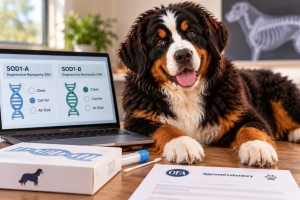
DNA results for both SOD1-A and SOD1-B from an approved laboratory, registered with the OFA.
Results report genotype — clear, carrier, or at-risk — for each variant. Read the two together, because a dog carrying one copy of each has been documented with the disease. A result showing “carrier” on each test separately is not the same picture as two unrelated carrier results.
The optional test
One of von Willebrand disease (a DNA-based clotting-disorder test), thyroid, or the histiocytic sarcoma risk test.
On the HS risk test specifically: it reports susceptibility, not destiny. Research into the genetics of histiocytic sarcoma in this breed has identified susceptibility loci and a breed-specific gene variant, while concluding that transmission is oligogenic and that the variant is neither necessary nor sufficient for disease. A risk result is genuinely useful information for a breeding decision. It is not a prediction about an individual dog, and anyone presenting it as one is overselling. Our histiocytic sarcoma article covers the disease.
Clear by parentage
A dog can be certified clear by parentage for a DNA-based test if both parents tested normal — provided the sire, dam and offspring all have AKC DNA numbers verifying parentage.
That’s legitimate and it saves testing every puppy. What it requires is the DNA profiling to actually be in place, so if a breeder cites clear by parentage, the parents’ results and the DNA numbers should all be verifiable.
CHIC, BRT, and why the difference matters
The BMDCA runs a second scheme alongside CHIC called BRT — Berner Recommended Testing.
The club implemented it not as a replacement for CHIC but to encourage as many owners as possible to complete all the tests and share the information, without the cost of submitting results to the OFA. Its requirements are, in the club’s own description, more inclusive and less stringent for that reason.
Both schemes share the same philosophy: the value is in open sharing of all testing, including abnormal results.
What this means for a buyer: a BRT qualification tells you the testing was done and shared. It is a different and lower bar than CHIC. Neither tells you the dog passed. If a breeder mentions either, the follow-up question is the same — what were the actual results?
The step almost nobody takes
Everything above is interpretation. This part is verification, and it takes about ten minutes.
Two databases:
The OFA database holds the registered results — hips, elbows, cardiac, eyes, thyroid, DNA tests. Search by the dog’s registered name or AKC number.
The Berner-Garde Foundation database is breed-specific: a large searchable collection of health records for individual Bernese Mountain Dogs, compiled over many years from owner submissions and public sources including the OFA. It lets you look at the dog’s relatives, not just the dog — which for a breed with a heritable cancer burden is the more informative view.
Cross-check both against what the breeder told you.
- Results that don’t appear in either database, when they’re claimed to be registered
- Grades or genotypes that don’t match what you were told
- Certifications dated before the minimum age for that test
- An eye certification several years old presented as current
- A “CHIC certified” claim with no CHIC number you can look up
Any of those is worth a direct question. A good breeder will be pleased you checked — it’s the whole point of publishing results.
What to ask
- Can I have the registered names or AKC numbers of both parents, so I can look up the results myself?
- Do both parents have CHIC numbers, and what were the actual grades and genotypes?
- For DM, were both SOD1-A and SOD1-B tested, and what were both results?
- Which optional test did you do, and what did it show?
- Who performed the cardiac exam, and was it a basic, congenital or advanced exam?
- How old was each dog when the hips and elbows were certified?
- Are there health records for the grandparents?
The last one separates the good from the excellent. The BMDCA has always advocated open sharing of results not only for breeding dogs but for their close relatives, and a breeder who volunteers that information is operating the way the club intends.
For everything else about choosing a breeder, our breeder guide covers the wider conversation.
A note on rescues and adult dogs
None of this applies to a rescue. An adopted adult usually arrives with no testing history, and that’s simply the trade-off — you’re taking on unknown genetics in exchange for a dog that needs a home. Our adoption guide and puppy versus rescue comparison cover that choice.
What you can do is ask the rescue what’s known, and have your own vet assess hips, elbows and heart so you have a baseline going forward.
The short version
- A CHIC number means tested and published. Not passed. The parent club says so explicitly.
- Five required tests plus one optional: hips, elbows, eyes, heart, DM, and one of vWD, thyroid or HS risk.
- DM means both variants. CHIC requires SOD1-A and SOD1-B.
- Hips and elbows certify at 24 months. Anything earlier isn’t final.
- Eye exams expire in practice — check the date.
- Verify it yourself in the OFA database and Berner-Garde. Ten minutes, and it’s the only step that actually confirms anything.
FAQ
What does a CHIC number mean? That a dog completed all the health tests its parent club requires for the breed, and that the results were published openly in the OFA database. It does not mean the dog passed. The BMDCA states explicitly that the requirements don’t require results to be free from disease, only that testing be completed and shared. A dog with failing results can hold a CHIC number.
What health tests should a Bernese Mountain Dog breeder have done? The BMDCA’s minimum recommended testing is hips, elbows, eyes, heart and degenerative myelopathy, plus one of von Willebrand disease, thyroid, or the histiocytic sarcoma risk test. For dogs that may be bred, the club recommends following the CHIC requirements for those tests, which also include an AKC DNA profile.
Is PennHIP better than OFA for hips? They measure different things. OFA is a radiologist panel’s grade of hip-extended radiographs, requiring the dog to be at least 24 months old. PennHIP measures joint laxity and reports a Distraction Index positioned against the breed’s distribution, and can be done earlier. The BMDCA accepts both and quotes PennHIP’s guidance that breeders select from the tightest 40% of the breed — the 60th percentile or better.
Why does DM testing need two results? Because two different SOD1 mutations are associated with degenerative myelopathy, and one appears to occur only in Bernese Mountain Dogs. CHIC requires results for both SOD1-A and SOD1-B. A dog carrying one copy of each has been documented with the disease, so the two results should be read together rather than separately.
What is BRT and how is it different from CHIC? Berner Recommended Testing is the BMDCA’s own parallel scheme, created to encourage more owners to complete and share testing without the cost of registering results with the OFA. The club describes its requirements as more inclusive and less stringent than CHIC’s. Like CHIC, it certifies that testing was done and shared — not that the dog passed.
How do I check a dog’s health testing myself? Search the dog’s registered name or AKC number in the OFA database, then cross-check the Berner-Garde Foundation database, which is breed-specific and includes relatives’ records. Compare what you find against what the breeder told you. Missing entries, mismatched grades, or certifications dated before the minimum age for that test are all worth asking about.
How old does a dog have to be for certification? Final OFA hip and elbow certification requires the dog to be at least 24 months. Cardiac certification is generally from 12 months. Eye exams can be done at any age and should be repeated annually. PennHIP can be performed from 16 weeks, though after 12 months is recommended.
Does the histiocytic sarcoma risk test tell me if my dog will get cancer? No. It reports susceptibility. Research on the genetics of histiocytic sarcoma in this breed has identified susceptibility loci and a breed-specific variant while concluding that transmission is oligogenic and the variant is neither necessary nor sufficient for disease. It’s useful information for a breeding decision, not a prediction about an individual dog.
