
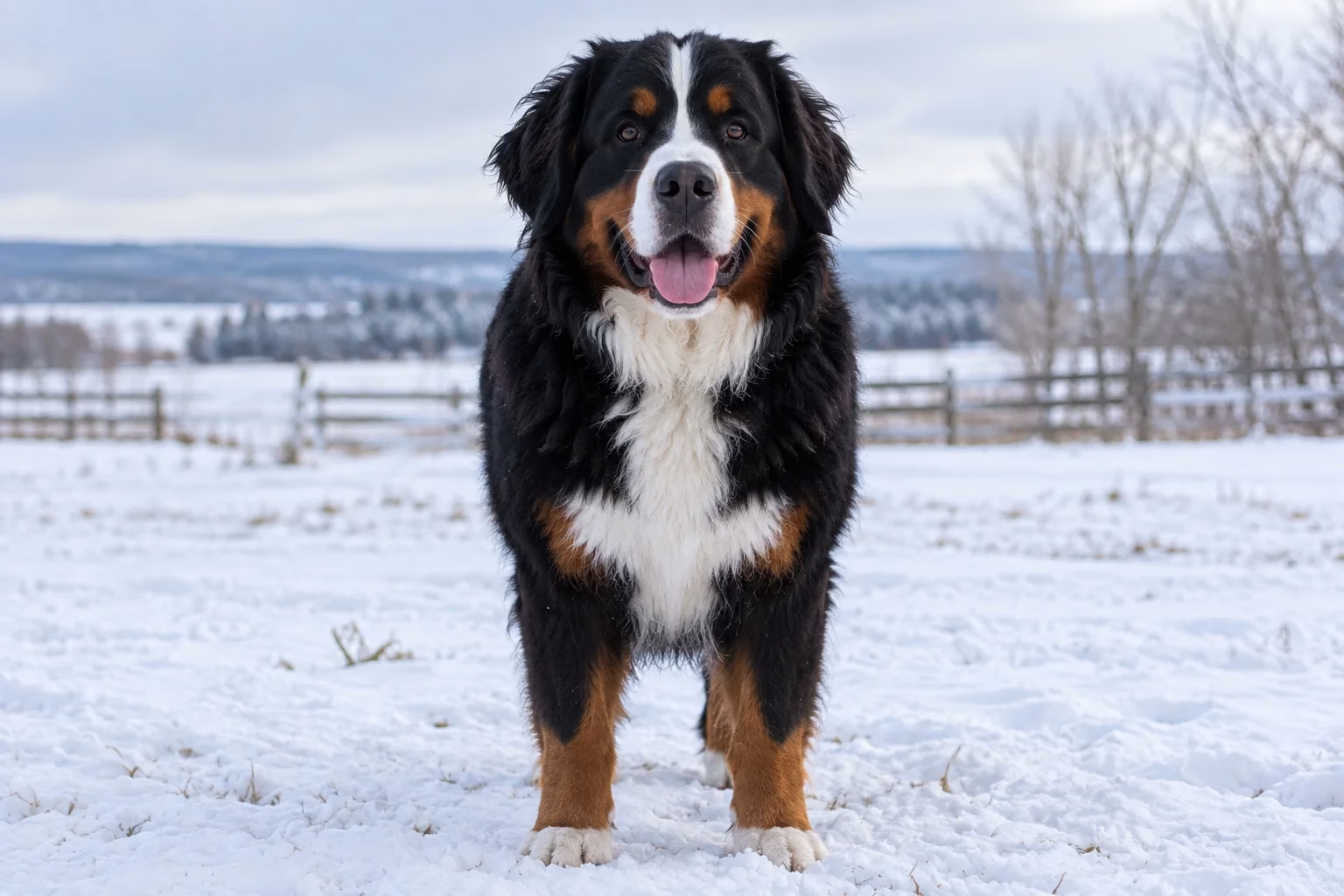
There is one correct colour for a Bernese Mountain Dog, and every breed standard says the same thing: tri-coloured, with a jet black ground colour and rich rust and clear white markings.
Not one of several accepted colours. One. The AKC standard lists any ground colour other than black as a disqualification, and the UKC standard disqualifies any colour combination other than tri-colour, along with albinism.
Which answers the question that brings most people to a page like this. A “rare colour” Bernese Mountain Dog — the red one, the black-and-white one, the chocolate one, priced above the rest of the litter — is not a rare and valuable variant. It’s either a mismarked Berner or a dog that isn’t entirely a Berner.
If your own dog has a wonky blaze or no white on its tail tip, skip to the section on normal variation. That’s cosmetic and it doesn’t matter.
What the standard actually says
Worth reading in full once, because it’s more specific than most people expect.
The ground colour is jet black. The markings are rich rust and clear white, and symmetry of markings is desired.
Rust appears:
- Over each eye
- On the cheeks, reaching at least to the corner of the mouth
- On each side of the chest
- On all four legs
- Under the tail
White appears as:
- A blaze up the face and a muzzle band
- A chest marking that typically forms an inverted cross
- The tip of the tail
- On the feet — desired, but not extending higher than the pasterns
Markings other than those described are faulted in direct relationship to the extent of the deviation. White legs or a white collar are serious faults. Blue eye colour is a disqualification, and the nose is always black.
The named markings
Berner people have names for several of these, and they’re worth knowing.
The Swiss cross. The white chest marking, which in a well-marked dog forms an inverted cross when the dog is viewed head-on. The standard describes it as an inverted cross; the breed community calls it the Swiss cross.
The Swiss kiss. A white mark behind the neck, or partly on the neck. It’s a recognised and rather liked marking — but note that a full white ring around the neck is a different thing, and a white collar is a serious fault.
The horseshoe. A perfectly marked head gives the impression of a white horseshoe around the nose, formed by the blaze meeting the muzzle band.
None of these is required for a dog to be a Berner. They’re the details people look for.
Normal variation, and why your dog is fine
No two Berners are marked identically, and the standard itself acknowledges this by grading deviations rather than treating them as pass/fail. A great many perfectly well-bred Berners have:
- A blaze that’s crooked, too wide, too narrow, or off-centre
- No white on the tail tip
- Asymmetric rust — more over one eye than the other
- White that runs a bit high on a foot
- More or less white on the chest than the ideal
- A small white patch somewhere unexpected
These are cosmetic faults. They matter in a conformation ring and they matter to a breeder planning a litter. For a companion dog they mean precisely nothing — not for health, not for temperament, not for the dog’s quality as a dog.
It’s also worth saying plainly: puppies from excellent, thoroughly health-tested breeders are frequently mismarked. Markings are not a proxy for breeding quality. Some of the best-bred Berners in the world are pet-homed because their blaze went sideways.
Faults versus disqualifications
This distinction is the thing that lets you interpret what you’re being told, and almost no owner knows it.
| What it means | Examples | |
|---|---|---|
| Fault | A deviation from the ideal, graded by how far it deviates. Still a Bernese Mountain Dog | Crooked blaze, asymmetric rust, missing tail tip, too much or too little white |
| Serious fault | A significant deviation. Still a Bernese Mountain Dog | White legs. A white collar. Also inverted or everted eyelids, and an overshot or undershot bite |
| Disqualification | Cannot be shown in conformation | Any ground colour other than black. Blue eye colour. The UKC adds albinism and any colour combination other than tri-colour |
A faulted dog is a Berner with imperfect markings. A disqualifying ground colour is a different matter entirely — because the breed’s black ground colour is fixed, a dog that doesn’t have it raises a question about what’s in its pedigree.
“Rare colours” and what they usually are
Here’s what’s actually being sold when a puppy is advertised as an unusual colour.
“Rare red” or “rust and white.” A Berner without the black ground colour. Disqualifying. In a breed where black is fixed, this is unusual enough to warrant asking hard questions about the pedigree.
“Black and white” — a dog missing the rust markings. Disqualifying under the UKC standard’s tri-colour requirement.
“Chocolate” or “brown.” Not a Bernese ground colour. Any ground colour other than black is disqualifying.
“Blue” or “merle.” Merle is not a pattern found in the Bernese Mountain Dog. A dog presented as a merle Berner is, in practical terms, not a purebred Berner — our Bernedoodle article covers what happens to coat predictability when breeds are crossed.
Blue eyes. A disqualification in the standard. Worth asking about, and worth knowing that the standard calls for dark brown eyes.
The registration trap
The most common piece of evidence offered for a “rare colour” puppy is registration paperwork.
Registries record colour as a descriptive field, and that field can include combinations the breed standard doesn’t permit. So a dog can be registered with a non-standard colour listed on its paperwork. The paperwork is accurate — it’s recording what the dog looks like.
What it is not is an endorsement. Registration is a pedigree record. It says the parents were registered. It does not say the dog conforms to the standard, and it certainly doesn’t say the colour is a recognised variety. A breeder presenting a registration certificate as proof that a colour is legitimate is either confused about what registration means, or counting on you being.
Why paying extra for colour is a bad deal
This is the part that actually matters, and it isn’t about aesthetics.
A breeder’s selection priorities are finite. Every litter is a set of choices about which dogs to breed and why. When colour becomes a selling point, it becomes a selection pressure — and in this breed, that pressure competes directly with the ones that matter.
The Bernese Mountain Dog has a median lifespan of around 8.4 years, carries the greatest predisposition to the main form of elbow dysplasia of any breed studied, and has a cancer burden that dominates its mortality. Our articles on lifespan, elbow dysplasia and histiocytic sarcoma cover what that means.
Against that, a breeding programme optimising for an unusual coat colour is optimising for the one trait that has no bearing on whether your dog is sound at eight.
And a premium charged for colour tells you where that breeder’s attention is. The money would buy OFA hip and elbow certifications on both parents several times over.
The questions that actually matter when choosing a puppy have nothing to do with markings. Our breeder guide covers them.
Does colour or marking affect anything?
Not as far as the evidence goes, for the colours that occur within the breed. Markings are cosmetic, and there’s no established relationship between a Berner’s particular pattern and its temperament, health or lifespan.
What does carry information is a non-standard ground colour — not because the colour itself is harmful, but because of what it suggests about how the dog was bred and by whom.
Where the pattern comes from
The tricolour pattern isn’t unique to this breed. All four Swiss Sennenhund breeds — the Bernese, the Greater Swiss, the Appenzeller and the Entlebucher — share it. It’s the family signature, and it’s why people confuse a mid-shed Berner with a Greater Swiss, which our comparison article covers.
The pattern is fixed in the breed because it’s been selected for, consistently, for a very long time. That consistency is exactly why a dog presenting in a substantially different colour is worth a second look at the pedigree rather than a premium.
What to ask if a puppy is advertised as an unusual colour
- What is the ground colour, and what does the breed standard say about it?
- Are both parents standard-marked tri-colour Berners? Can I see them?
- Why is this puppy priced differently from its littermates?
- What are the OFA hip and elbow results for both parents?
- Has there been any outcrossing in this line?
A good breeder will answer all of those without hesitation, and will usually tell you unprompted that a mismarked puppy is a pet-quality puppy priced accordingly — lower, not higher.
FAQ
What colours do Bernese Mountain Dogs come in? One. The breed is tri-coloured: a jet black ground colour with rich rust and clear white markings. The AKC standard lists any ground colour other than black as a disqualification, and the UKC standard disqualifies any colour combination other than tri-colour.
Are there rare colour Bernese Mountain Dogs? Not as a recognised variety. A Berner advertised as red, black-and-white, chocolate, blue or merle is either mismarked or not entirely a Bernese Mountain Dog. There is no premium colour in this breed, and a breeder charging more for one is selling something the standard doesn’t recognise.
My Berner’s blaze is crooked. Is that a problem? No. Markings vary considerably and the standard grades deviations by extent rather than treating them as pass/fail. A crooked blaze, missing white tail tip, asymmetric rust or extra white are cosmetic faults that matter in a show ring and mean nothing for a companion dog. Well-bred puppies from excellent breeders are frequently mismarked.
What’s the difference between a fault and a disqualification? A fault is a deviation from the ideal, graded by how far it deviates — the dog is still a Bernese Mountain Dog. White legs and a white collar are serious faults. A disqualification means the dog can’t be shown in conformation; for this breed that includes any ground colour other than black, and blue eye colour.
What is a Swiss kiss? A white marking behind or partly on the neck. It’s a recognised and well-liked marking in the breed. A full white ring around the neck is different — a white collar is a serious fault.
What is the Swiss cross? The white chest marking, which in a well-marked dog forms an inverted cross viewed head-on. The breed standard describes it as an inverted cross.
Can Bernese Mountain Dogs have blue eyes? It happens, and it’s a disqualification under the breed standard, which calls for dark brown eyes. It’s worth asking a breeder about.
Does a Berner’s markings affect its health or temperament? No established relationship exists between a Berner’s particular markings and its temperament, health or lifespan. A non-standard ground colour carries information, but about how the dog was bred rather than about the dog.
