
Both of these are symptoms, not diseases. That single distinction is the most useful thing on this page, and it’s the reason so many dogs get the same problem over and over.
A hot spot — acute moist dermatitis — is damage the dog does to itself in response to something painful or itchy. The raw, oozing patch you found this morning is the result. Something caused the itch.
An ear infection is much the same. The normal ear canal isn’t sterile: bacteria and yeast live there in small numbers and they won’t cause otitis in a healthy ear. When they overgrow, something changed the environment first.
Treat the lesion and skip the cause, and you’ll be back in six weeks.
This is owner education, not veterinary advice, and it doesn’t diagnose anything. An active hot spot or a painful ear is a vet appointment, not a search result — the sections below are about what to expect and what you can do alongside.
Why this breed, specifically
Two bits of conformation, both entirely normal for a Berner, both working against you.
The double coat holds moisture. Dogs with heavy, dense undercoats are more susceptible to hot spots because the coat retains environmental moisture against the skin. A Berner that swims, gets rained on, or comes out of a bath not quite dry is carrying a damp layer next to warm skin for hours. Chronic maceration — skin kept wet — impairs its barrier function and opens the door to opportunistic infection.
The ears drop. Otitis externa affects an estimated 15–20% of dogs, and long-haired, pendulous-eared breeds are more susceptible than erect-eared ones for the simple reason that an upright ear ventilates and a folded one doesn’t. Add hair on the concave side of the pinna and inside the canal, and you have a warm, humid, poorly ventilated space.
Neither is a defect. It’s what the breed is. It just means the prevention work is real work rather than optional.
And a third problem that’s specific to a coat this thick: you can’t see the skin. A hot spot can go from nothing to a large, painful lesion in a matter of hours, and under a Berner’s coat you may not see it at all. Owners of thick-coated dogs typically find these by smell, or by noticing the dog worrying at one spot, rather than by looking.
Hot spots
What you’ll find
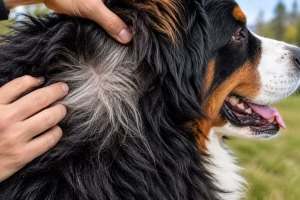
A patch of skin that is red, wet or oozing, hairless or with the hair matted down into it, warm, and painful. Often unpleasant-smelling. Commonly on the face or neck near an ear, on the flank, or at the rump.
It typically involves surface bacterial overgrowth rather than a true deep infection — but left alone lesions can progress quickly to folliculitis and sometimes furunculosis, which is a considerably bigger problem.
What caused it
This is the question that matters. The documented inciting factors:
- Flea bite hypersensitivity, which is a primary one — lesions often appear shortly after flea exposure
- Other ectoparasites
- Otitis externa — an ear infection. A hot spot beside the ear points here first
- Allergic skin disease, including atopy and food allergy
- Foreign bodies — a grass seed, a burr
- Irritating substances on the skin
- Trapped moisture under a matted coat, which is the breed-specific route
Location is a clue. A lesion on the cheek or neck below one ear makes ear disease the first thing to check — a vet will typically run cytology on both the skin lesion and the ear canal on that side. A lesion at the tail base points toward fleas or anal gland trouble. One on a flank the dog can easily reach points toward generalised itch.
Treatment, and the part owners resist
The hair over and around the lesion has to come off. All of it, back to healthy skin. This is the step Berner owners hate most, and it isn’t negotiable. Hair holds moisture and discharge against the wound, and a lesion that stays wet doesn’t heal. It grows back.
The rest of the standard approach:
- Clipping and cleaning the area
- Topical therapy, and systemic antibiotics where the lesion warrants it
- Pain and inflammation control. A short course of oral steroid is often used to stop the itch fast, because the self-trauma is what’s driving the damage
- An e-collar. Non-negotiable. The dog is the one making the lesion, and it will keep making it
- Finding and treating the underlying cause
What’s reasonable to do at home
Small, early, and the dog will let you touch it: clip the hair away, clean gently with a vet-appropriate antiseptic, keep it dry, and get a cone on.
Call the vet if the lesion is large or growing, the dog won’t let you near it, there’s significant pain, it isn’t improving within a day or two, or your dog gets these repeatedly. Repeat hot spots are a diagnostic problem, not a nursing problem.
Don’t apply human ointments, cover it with a dressing, or leave it under the coat to “let it breathe” — it won’t, that’s the whole issue.
Ear infections
Signs
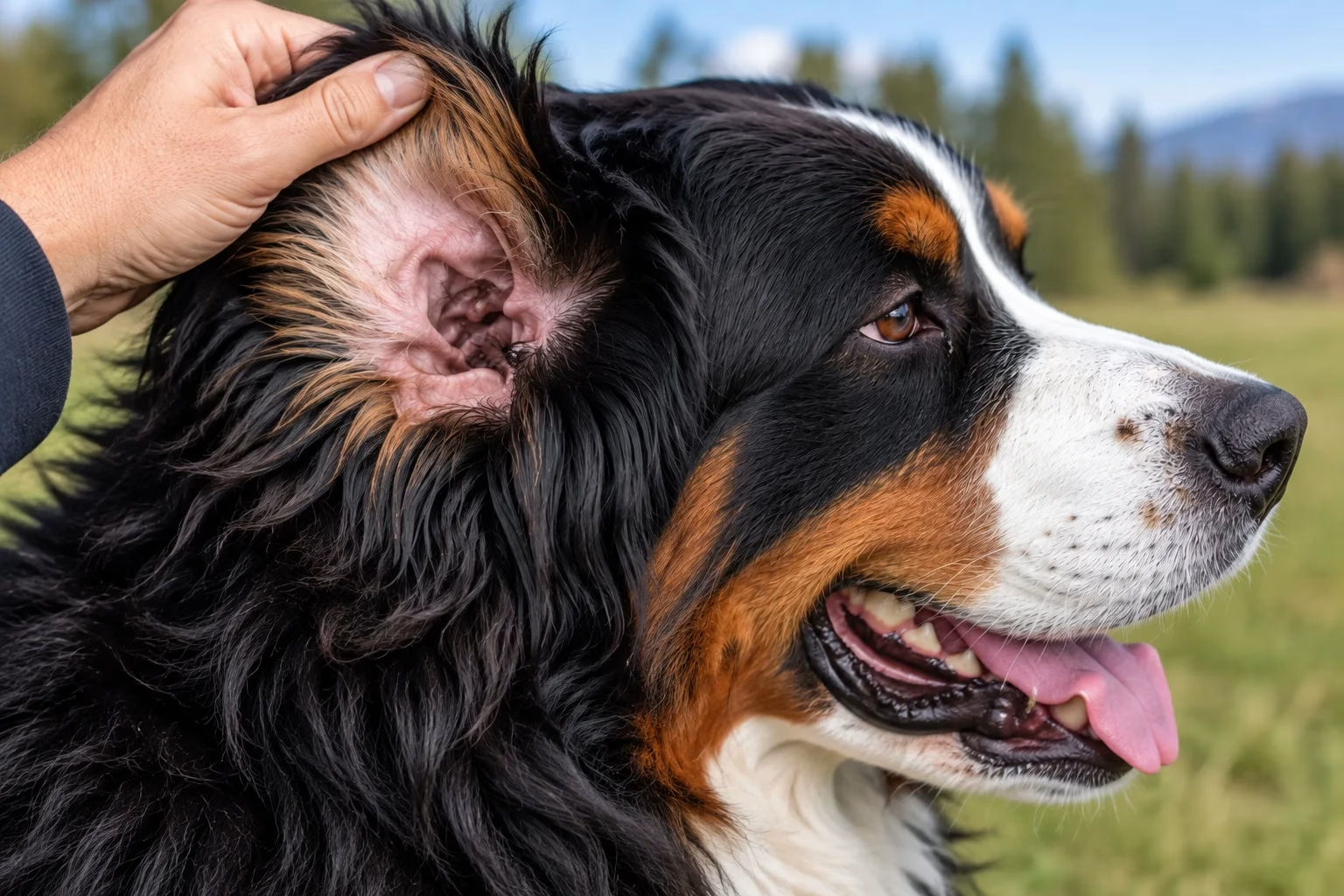
Head shaking, scratching at the ear, a foul smell, discharge, redness or swelling inside the ear flap, scaly skin, and pain or head tilt. One ear or both. Sudden or grumbling on for months.
With drop ears, check by lifting the flap. A Berner won’t usually present you with the inside of its own ear.
Why it keeps coming back
Because the infection is the secondary event. Vets distinguish between:
Primary causes — what actually starts the inflammation. Allergies and hypersensitivity are the most common, along with keratinization disorders, parasites, foreign bodies, ear gland disorders and autoimmune disease.
Predisposing factors — what makes the ear a good environment for trouble. Pendulous pinnae, narrow canals, hair in the canal, and excessive moisture from swimming or frequent bathing.
Secondary infections — the bacteria and yeast that overgrow once the first two have set the scene.
Most treatment addresses only the third. Clear the infection, don’t touch the allergy, and the ear returns to its previous state within weeks. A dog with recurring otitis nearly always has an unresolved primary cause, and that’s the conversation to have with your vet rather than accepting a fourth round of drops.
It’s worth pushing on this, because chronic untreated otitis causes irreversible change — the canal can thicken and eventually ossify, and infection can extend to the middle ear. The endpoint of a long-neglected ear is surgery to remove the canal entirely. Getting to the primary cause early is what prevents that.
Cleaning, and when not to
If your vet recommends regular cleaning, they’ll show you the technique. A common pattern is starting frequently and tapering to once or twice weekly for maintenance.
Never use cotton swabs. They push debris down the canal and cause trauma, and iatrogenic damage from aggressive swabbing is a recognised predisposing factor in its own right.
Don’t clean a healthy ear on a schedule for the sake of it. Over-cleaning with irritant solutions is itself a predisposing factor. Check ears regularly; clean them when there’s a reason.
On plucking ear hair
Worth knowing because it’s done routinely at a lot of grooming salons.
Clipping hair from the concave side of the ear flap and around the ear opening improves ventilation and lowers humidity, and that’s generally helpful in a drop-eared breed. But Merck’s guidance is that hair should not routinely be removed from inside the ear canal if it isn’t causing a problem, because doing so can induce an acute inflammatory reaction.
So: trimming around the opening and on the flap, reasonable. Routine plucking of canal hair on a dog with healthy ears, not automatically — ask your vet whether your dog specifically needs it rather than treating it as standard grooming. A dog with recurrent otitis and a very hairy canal may well benefit. A dog with clean ears and no history may be made worse.
Prevention that actually works
Dry the dog properly. Not towel-and-hope. After swimming or bathing, a Berner’s undercoat stays wet long after the topcoat feels dry — get down to the skin, and pay attention to behind the ears, the neck folds, the armpits and the tail base.
Keep ears dry. Avoid water in the ears during bathing. If your dog swims regularly, ask your vet about a drying agent.
Clear the mats, especially behind the ears. That’s the classic hot spot site on this breed, and a felted pad of dead undercoat holds moisture against skin indefinitely. Our grooming guide and shedding article cover the tools. This is the same reason a properly de-shedded coat matters in summer heat — our hot weather article covers that side.
Stay on flea prevention year-round. Flea bite hypersensitivity is a leading cause of hot spots, and a hypersensitive dog needs remarkably few fleas to react.
Look and smell, weekly. Hands through the coat, lift both ear flaps. On a dog this hairy that’s the only reliable surveillance you have, and it takes two minutes.
Habituate a puppy to ear handling early. A dog that accepts having its ears lifted and cleaned from ten weeks is a dog you can treat at seven. Building that during the first month home is much easier than starting during a painful flare — our first month guide covers the wider handling work.
When it’s recurring
If your dog has had several hot spots or several ear infections, stop thinking of them as separate incidents. That’s a pattern, and the pattern usually has one explanation — most often an allergy, seasonal or food-related.
Worth asking your vet:
- Could this be allergic, and how would we work that up?
- Should we run cytology to see what’s actually overgrowing rather than treating empirically?
- Is a referral to a veterinary dermatologist appropriate?
- Is there an anatomical factor here we should be managing rather than treating around?
Chasing individual flare-ups is expensive, and it doesn’t work.
FAQ
What causes hot spots on dogs? A hot spot is self-inflicted damage in response to something itchy or painful, so the lesion is a symptom rather than the disease. Documented triggers include flea bite hypersensitivity, other parasites, ear infections, allergic skin disease, foreign bodies, irritants, and moisture trapped under a matted coat. Dogs with heavy dense undercoats are more susceptible because the coat holds moisture against the skin.
Can I treat a hot spot at home? A small, early lesion the dog will let you touch: clip the hair away completely, clean gently with a vet-appropriate antiseptic, keep it dry, and put a cone on. See a vet if the lesion is large or spreading, the dog is in real pain, it isn’t improving within a day or two, or your dog gets these repeatedly. Don’t use human ointments or cover it with a dressing.
Why does the hair have to be clipped? Hair holds moisture and discharge against the wound, and a lesion that stays wet doesn’t heal. On a heavy-coated breed this is the step owners resist most and it’s the one that matters most. It grows back.
Why does my Berner keep getting ear infections? Because the infection is usually secondary. The normal ear canal already contains bacteria and yeast in low numbers, and they don’t cause otitis in a healthy ear. Recurring infections nearly always mean an unresolved primary cause — most commonly allergy — combined with predisposing factors like drop ears, hair in the canal and moisture. Treating only the infection returns the ear to its previous state within weeks.
Should I pluck my dog’s ear hair? Not as a routine. Clipping hair from the ear flap and around the opening improves ventilation and is generally useful in a drop-eared breed. But veterinary guidance is that hair shouldn’t routinely be removed from inside the canal if it isn’t causing a problem, since doing so can trigger an acute inflammatory reaction. Ask your vet whether your dog specifically needs it.
How should I clean my dog’s ears? Only as often as your vet advises, using a solution they recommend, with the technique they show you. Never use cotton swabs — they push debris deeper and cause trauma, and aggressive swabbing is itself a recognised risk factor. Don’t clean healthy ears on a schedule for its own sake; over-cleaning with irritant solutions is also a predisposing factor.
How do I dry a double coat properly after swimming? Get down to the skin rather than stopping when the topcoat feels dry. The undercoat stays wet for hours. Pay particular attention behind the ears, the neck, the armpits and the tail base, and avoid water entering the ears during baths. If your dog swims often, ask your vet about an ear drying agent.
When is an ear infection serious? Any painful ear warrants a vet visit, but chronic untreated otitis is the real concern — the canal can thicken and eventually ossify, and infection can extend to the middle ear. The endpoint of a long-neglected ear is surgery to remove the canal. Recurring infections should prompt a search for the primary cause rather than another round of drops.
