
Owner-written, not veterinary advice. This article is written by a Bernese Mountain Dog owner, not a veterinarian. It is general information gathered from veterinary and breed-club sources — not a diagnosis or a treatment plan. Every dog is different. If your dog is unwell or showing any sign described here, call your own vet. In an emergency, go straight in.
Health disclaimer: This article is for educational purposes and is not a substitute for veterinary diagnosis, treatment or nutritional advice. If you are concerned about your Bernese Mountain Dog’s health, contact your veterinarian. If your dog may be experiencing an emergency, contact an emergency veterinary clinic immediately.
Understanding Bernese health as an owner
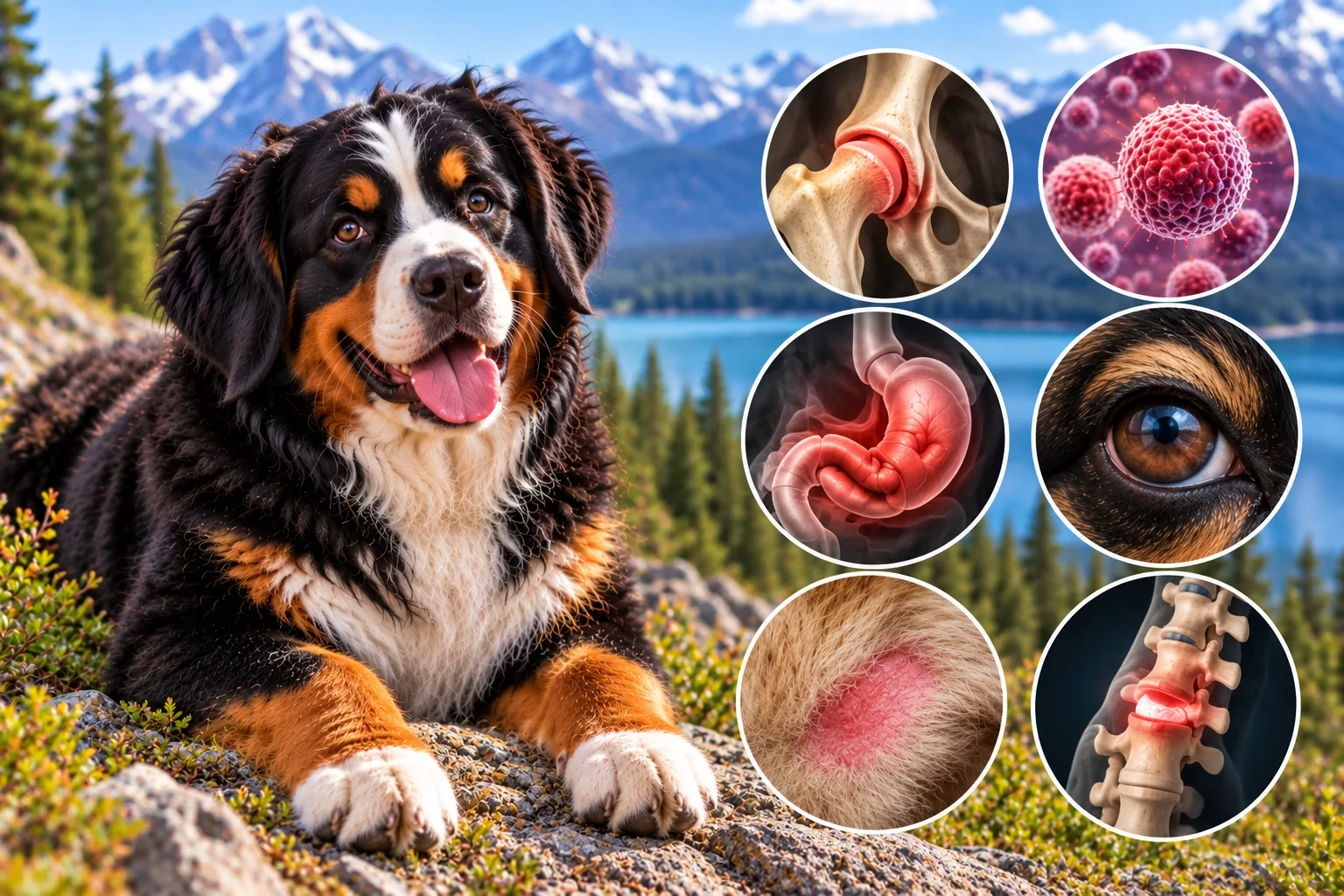
Every breed has its health profile, and the Bernese Mountain Dog is no exception. This article is a plain-language overview of the conditions Bernese owners most often hear about. It is not a diagnostic tool, and it is not a reason to worry — most Berners will never develop most of these conditions. The goal is simply for owners to know what their veterinarian is watching for, what questions to ask a breeder, and when to seek veterinary advice.
Knowing the breed’s health profile is one of the most important parts of caring for a Berner well. It does not take the joy out of loving the breed — it helps you make better choices, spot trouble earlier, and give your dog the best chance at a longer, more comfortable life. A general dog-care article might tell you to watch for limping or stomach upset; a Bernese owner needs to know that limping can point to orthopedic disease and a swollen, restless belly can become a life-threatening emergency within hours.
Cancer
Cancer is the health concern most associated with the breed, and it is a significant cause of death in Bernese Mountain Dogs. The breed is recognized as predisposed to certain cancers, including histiocytic sarcoma, lymphoma, osteosarcoma, and mast cell tumors.
Some cancers develop quietly — a dog may seem a little tired, less eager to eat, or simply not himself for a few days. Others appear as obvious lumps, unexplained weight loss, labored breathing, persistent lameness, or enlarged lymph nodes. Early signs are often vague, and Berners tend to be stoic. There is no way for an owner to prevent cancer, but knowing your dog’s normal — checking for new lumps during grooming, noticing changes in appetite, energy, or weight — helps you bring concerns to your veterinarian early, when more options are often available. If your Berner has a new lump, persistent weakness, unusual swelling, appetite changes, or pain that does not resolve, move the vet visit up the list. For more on the breed’s lifespan and cancer awareness, see our guide to Bernese Mountain Dog lifespan.
Histiocytic sarcoma: what is actually known
This is the cancer the breed is known for, and it is worth separating what is established from what gets repeated.
Presentation and forms. NC State Veterinary Hospital describes three forms: localised disease (bone, joint, skin or lung), disseminated disease, and a hemophagocytic form arising in the spleen. Early signs are often unremarkable — lethargy, reduced appetite, weight loss — alongside something site-specific such as lameness or laboured breathing. Diagnosis is by biopsy or aspirate with staging imaging.
Prognosis, stated plainly. For aggressively treated localised disease, NC State reports averages of roughly 1.5 to 3 years, and Penn Vet gives a median of 1 to 1.5 years. The hemophagocytic form carries a grave prognosis measured in weeks to a couple of months. These are hard numbers to read as an owner, and they are the reason early investigation of a persistent lameness in a middle-aged Berner is worth doing rather than waiting out.
The one risk-factor study worth knowing. Ruple and Morley (Journal of Veterinary Internal Medicine, 2016) studied 216 Bernese Mountain Dogs from 140 litters — 135 with histiocytic sarcoma and 81 unaffected littermates — controlling for family relationship. Dogs with orthopedic conditions were roughly 2.5 to 2.8 times more likely to develop the disease. Long-term prescription anti-inflammatory use was associated with about a 68–70% lower risk.
Read that second finding carefully. The authors themselves say prospective work is needed before anyone claims cause and effect. It is an association found in one study, not a preventive protocol, and nobody should be medicating a healthy dog on the strength of it. It is, however, a genuinely interesting question to raise with your vet if your dog is already on long-term anti-inflammatories for joint disease.
Heritability. The Bernese Mountain Dog Club of America describes histiocytic sarcoma as the breed’s most prevalent cancer and as having been shown to be inherited, with research ongoing. What does not exist is a single-gene test that predicts whether a given dog will develop it. Any breeder implying otherwise is overselling. A histiocytic sarcoma risk test does exist and appears on the club’s optional testing list, but treat it as a risk indicator, not a verdict.
Hip and elbow dysplasia
As a large breed, the Bernese is among the breeds in which hip dysplasia — and the related elbow dysplasia — are seen. These are developmental joint conditions that can lead to pain, stiffness, exercise intolerance, and arthritis that worsens with age. You may notice a puppy who bunny-hops when running, struggles to get up, sits awkwardly, or hesitates on stairs; in adults the signs can be subtler, such as slowing down or pausing before jumping into the car.
These conditions have a strong genetic component, which is why responsible breeders screen breeding dogs’ hips and elbows — but environment matters too. Keeping a Berner lean, feeding a diet formulated for large-breed growth, providing regular low-impact exercise, and using traction-friendly flooring all reduce strain on vulnerable joints. Our detailed article on hip dysplasia in Bernese Mountain Dogs covers the signs, screening, and veterinary care in more depth.
Bloat (GDV)
Gastric dilatation-volvulus, or bloat, is a life-threatening emergency more common in large, deep-chested breeds. The stomach fills with gas and may twist, cutting off blood flow. Warning signs include a swollen or tight abdomen, repeated unproductive retching, pacing, drooling, restlessness, and visible distress. This is not a situation to monitor overnight — if you suspect bloat, go to an emergency veterinarian immediately. Every Bernese owner should know the warning signs and have an emergency-vet plan. Please read our dedicated guide on GDV and bloat — it is the most time-critical topic on this site.
Inherited and other conditions to be aware of
Bernese owners and breeders also discuss several other conditions. Owners do not need to memorize these — they are simply things a veterinarian or a responsible breeder may mention:
- Eye conditions such as progressive retinal atrophy, cataracts, and eyelid abnormalities, which is why eye screening is part of responsible breeding. Have squinting, redness, cloudiness, or vision changes evaluated promptly.
- Heart conditions, including subaortic stenosis, which a veterinarian listens for during checkups. Not every murmur signals severe disease, but it should never be brushed aside in a large breed.
- Von Willebrand disease, an inherited bleeding disorder seen in the breed, for which breeders can test.
- Degenerative myelopathy, a progressive spinal-cord condition seen in older dogs of some breeds. It often begins with hind-end weakness or dragging paws and can initially look like arthritis, so proper veterinary workup matters.
- Skin and coat issues — a thick double coat can hide hot spots, infections, parasites, and lumps, so thorough grooming is part of health monitoring in this breed.
The presence of a condition on this list does not mean your dog will develop it. It means these are areas where veterinary checkups and health-tested breeding lines genuinely matter.
What this means for choosing a puppy
Good care cannot fully cancel out inherited risk — genetics matter too. That is why breeder selection is one of the biggest health decisions you make before your puppy comes home. The single most useful thing you can do for your dog’s health is to choose a breeder who health-tests their breeding dogs — hips, elbows, eyes, heart, and the genetic tests appropriate to the breed — and who is open about the longevity and health history of their lines. A responsible breeder will not promise a disease-free dog, but they will reduce preventable risk through careful selection and transparency. If you are adopting an adult Berner, ask for all available medical records, prior surgeries, current medications, and any mobility or behavior concerns.
What this means for daily care
For owners already living with a Berner, the practical routine is the same regardless of which conditions are in the back of your mind: keep your dog at a lean, healthy weight; keep up with regular veterinary checkups; learn your dog’s normal so you notice changes in appetite, stamina, gait, or behavior early; and groom thoroughly enough to catch new lumps or skin problems. A pet insurance policy or a dedicated emergency fund is also worth serious thought with this breed, because it affects how quickly you can say yes to diagnostics, surgery, or emergency care.
Some symptoms should move you from concern to action without much debate: difficulty breathing, a distended abdomen, repeated retching, collapse, sudden inability to stand, severe pain, seizures, or pale gums all deserve immediate veterinary attention. For everything else — a limp lasting more than a day or two, a growing lump, appetite loss, persistent vomiting or diarrhea, unusual fatigue — do not downplay persistent symptoms. With Berners, early evaluation is usually the safer choice.
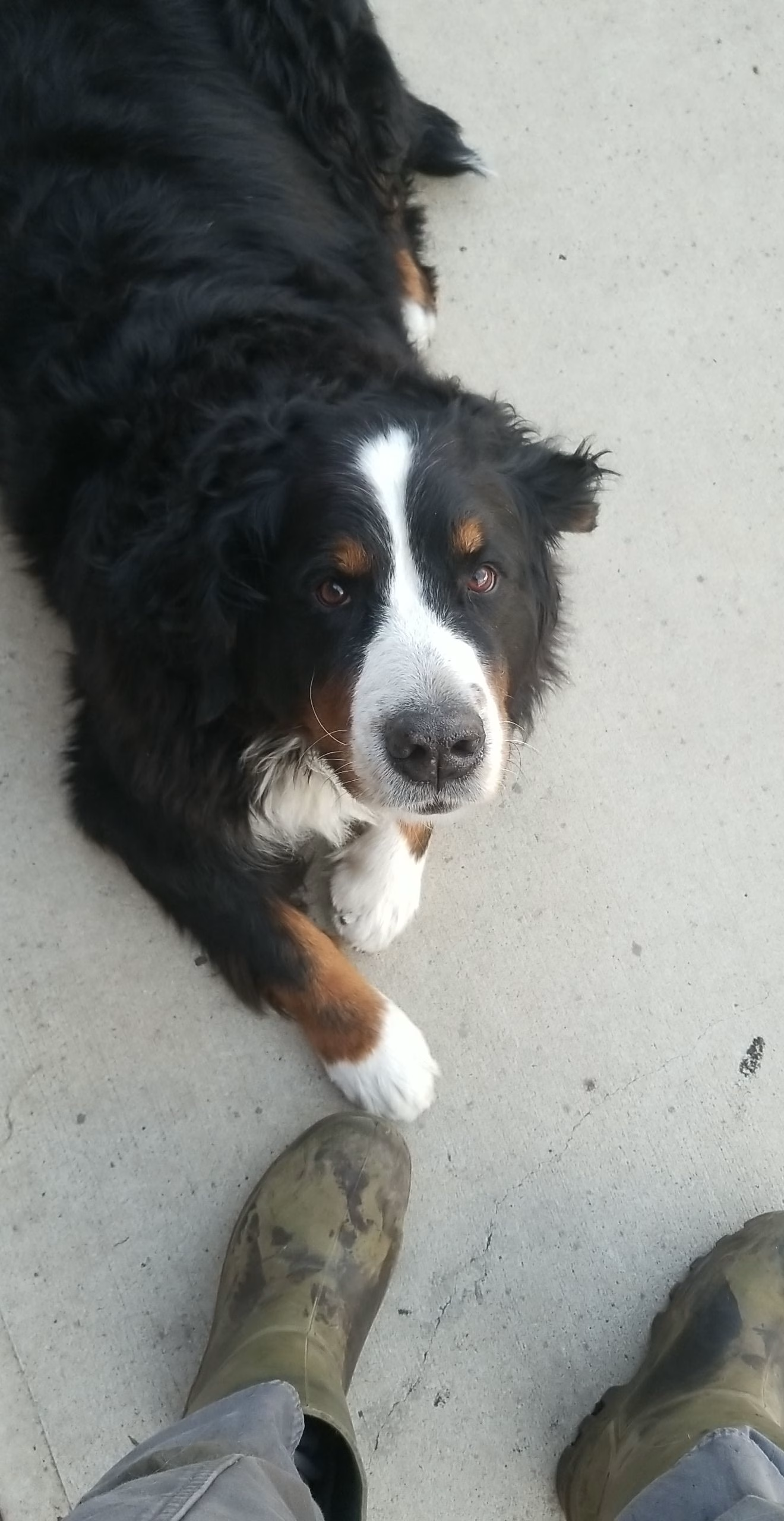
From my own experience: the scariest health moments I’ve had with my own Berners weren’t the slow-developing ones — they were sudden. One of my dogs, Scarlett, once got into mouse poison that she found in the garage; it meant an emergency trip and having her stomach pumped, and it all happened fast. It’s the reason I keep my nearest emergency vet’s number saved and household toxins well out of reach. If something ever seems suddenly, seriously wrong, don’t try to wait it out.
Go deeper on the individual conditions
- Hip dysplasia: how to read OFA and PennHIP results
- Bloat (GDV): warning signs and emergency response
- Bernese lifespan: what the published data actually says
- Body condition and healthy weight
- What health testing a breeder should be able to show you
How we research this / Sources
- American Kennel Club — Bernese Mountain Dog breed information
- American Kennel Club — Hip Dysplasia in Dogs
- American Kennel Club — Bloat (GDV) in Dogs
- VCA Animal Hospitals — Arthritis (Osteoarthritis) in Dogs
- NC State Veterinary Hospital — Canine Histiocytic Sarcoma
- Ruple A, Morley PS. Risk factors associated with development of histiocytic sarcoma in Bernese Mountain Dogs. J Vet Intern Med 2016;30(4):1197–1203
- Penn Vet — Histiocytic Sarcoma in Dogs (owner information)
- Orthopedic Foundation for Animals — Degenerative Myelopathy
- Bernese Mountain Dog Club of America — Recommended Testing
Written by Todd Grasse, founder of BerneseMountainLover.com and Bernese Mountain Dog owner. This article combines owner-focused guidance with the veterinary and breed-health sources listed above.
