
Owner-written, not veterinary advice. This article is written by a Bernese Mountain Dog owner, not a veterinarian. It is general information gathered from veterinary and breed-club sources — not a diagnosis or a treatment plan. Every dog is different. If your dog is unwell or showing any sign described here, call your own vet. In an emergency, go straight in.
Emergency: Suspected GDV/bloat is a life-threatening emergency. Contact an emergency veterinarian immediately. Do not wait to see whether symptoms improve.
Health disclaimer: This article is for educational purposes and is not a substitute for veterinary diagnosis, treatment or nutritional advice. If you are concerned about your Bernese Mountain Dog’s health, contact your veterinarian. If your dog may be experiencing an emergency, contact an emergency veterinary clinic immediately.
What GDV (bloat) is
Gastric dilatation and volvulus — usually shortened to GDV, and often just called “bloat” — is one of the most serious emergencies a large-breed dog owner can face. It happens in two stages. First the stomach fills rapidly with gas and fluid. Then, in many cases, the swollen stomach rotates on itself, sealing off both ends. Once the stomach twists, gas cannot escape, blood flow to the stomach and other organs is cut off, and a dog can deteriorate within hours. GDV is always treated as a true emergency.
Why Bernese Mountain Dog owners should know about it
GDV is most common in large and giant breeds with deep chests, and the Bernese Mountain Dog fits that general profile. That does not mean every Berner will experience bloat — most never will — but it does mean this is a risk worth understanding before it ever becomes urgent. Knowing the warning signs and having a plan for after-hours emergencies is one of the most practical things a Bernese owner can do.
Warning signs to take seriously
GDV usually comes on suddenly. The signs owners most often notice include:
- Unproductive retching — the dog repeatedly tries to vomit but little or nothing comes up. This is one of the most telling signs.
- A swollen, tight, or distended belly, sometimes firm to the touch.
- Restlessness and pacing — the dog cannot get comfortable or settle.
- Excessive drooling.
- Signs of pain, a hunched posture, or looking anxiously at the abdomen.
- Rapid or labored breathing, pale gums, weakness, or collapse as the situation worsens.
Not every dog shows every sign, and the abdomen is not always obviously swollen — especially under the thick coat of a Bernese. If something seems wrong and your dog is retching without producing anything, treat it as an emergency.
What to do if you suspect bloat
Go to a veterinarian immediately. Do not wait to see whether things improve, and do not try home remedies — there is no safe way to treat GDV at home. Call ahead to your veterinary clinic or the nearest emergency hospital so they can prepare for your arrival. The sooner a dog with GDV is stabilized, the better the outcome tends to be.
It is worth keeping the name, address, and phone number of your nearest 24-hour emergency veterinary hospital somewhere easy to find — before you ever need it.
What treatment involves
At the hospital, the veterinary team will work to stabilize your dog, relieve the pressure in the stomach, and assess whether the stomach has twisted. Confirmed GDV is treated surgically. During surgery the stomach is returned to its normal position, and in most cases the surgeon also performs a gastropexy — attaching the stomach to the body wall so it is far less likely to twist again. Your veterinarian is the right person to explain the specific options, risks, and aftercare for your dog.
Can the risk be reduced?
There is no guaranteed way to prevent GDV, but owners of at-risk breeds can talk to their veterinarian about steps that may lower the risk:
- Preventive gastropexy. For breeds considered at risk, some veterinarians recommend a prophylactic gastropexy, often done at the same time as spay or neuter surgery. Ask your own vet whether it makes sense for your dog.
- Feeding routine. Feeding measured meals rather than one very large meal a day, and using a slow-feeder bowl for fast eaters, are commonly suggested. Evidence on specifics is mixed, so ask your veterinarian what they recommend.
- Activity around meals. Many vets suggest avoiding intense exercise immediately before and after eating.
- Know your dog. Pay attention to changes in appetite, comfort, and behavior, and keep up with regular veterinary checkups.
Raised feeding bowls were once widely recommended, but research on them has been mixed and some studies have associated them with increased risk in large breeds. This is another reason to follow your own veterinarian’s current advice rather than general internet guidance.
What the research actually shows
Most bloat advice online gets repeated without a source. Here is what the primary veterinary literature actually found, so you can weigh it yourself.
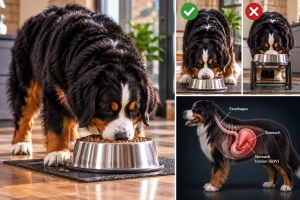
The largest risk-factor study. Glickman and colleagues followed 1,637 large and giant-breed dogs across 11 breeds (JAVMA, 2000; 217(10):1492–1499). Cumulative incidence was about 6%. The factors significantly associated with higher risk were increasing age, having a first-degree relative that had bloated, faster eating speed, and a raised feeding bowl. The authors attributed roughly 20% of cases in large breeds and 52% in giant breeds to raised bowls.
The advice that did not hold up. Exercise after eating — probably the most repeated piece of bloat advice on the internet — was not a significant risk factor in that study. Cornell’s Riney Canine Health Center still suggests limiting activity after meals, and it costs nothing to do so, but treat it as sensible caution rather than an established cause. Anyone stating it as settled fact is going past the evidence.
Raised bowls are genuinely contested. A peer-reviewed knowledge summary in Veterinary Evidence (RCVS Knowledge) found that only two studies address raised feeders and that their findings conflict — Glickman 2000 found increased risk, Pipan and colleagues (JAVMA, 2012) did not agree. Its practical conclusion was that, without better evidence, a floor-level bowl is the safer default for an at-risk dog.
Family history is the risk factor owners ignore. A first-degree relative that had bloated was among the strongest associations in Glickman’s data. That is a question worth putting to a breeder directly, and almost nobody does.
Gastropexy, stated honestly. Cornell reports recurrence falls to roughly 3–5% with a gastropexy, against about 80% without one, and that survival exceeds 80% when treatment is prompt. A decision-analysis model (Ward and colleagues, Preventive Veterinary Medicine, 2003) estimated that gastropexy reduces GDV-related mortality by somewhere between 2.2 and 29.6 times depending on breed, and found it cost-effective where lifetime risk was above about 34%. Two caveats worth stating: that was a model rather than a trial, and the Bernese Mountain Dog was not one of the breeds it published a lifetime-risk figure for. So the defensible position is that gastropexy clearly reduces GDV mortality in high-risk breeds and is worth raising with your vet at spay or neuter — not that it is proven worthwhile for Berners specifically.
The owner’s takeaway
GDV is frightening, but the two things within an owner’s control are preparation and speed: understand the warning signs, know where your emergency vet is, and act immediately if you suspect bloat. Combined with regular veterinary care and a conversation about whether a preventive gastropexy is appropriate for your Bernese, that is the most practical approach an owner can take.
Related reading
- The wider Bernese health picture
- Bernese lifespan and causes of death
- Feeding a Bernese: meal size, routine and what matters
- Exercise needs and activity around meals
How we research this / Sources
- VCA Animal Hospitals — Bloat: Gastric Dilatation and Volvulus in Dogs
- American Kennel Club — Bloat (GDV) in Dogs: What It Is and How It’s Treated
- American Kennel Club — Bernese Mountain Dog breed information
- American College of Veterinary Surgeons — Gastric Dilatation-Volvulus
- Cornell Riney Canine Health Center — Gastric dilatation volvulus (GDV) or “bloat”
- Glickman LT et al. Non-dietary risk factors for gastric dilatation-volvulus in large and giant breed dogs. JAVMA 2000;217(10):1492–1499
- Buckley L. Are dogs fed from a raised bowl at increased risk of GDV? Veterinary Evidence (RCVS Knowledge) Knowledge Summary
- Ward MP, Patronek GJ, Glickman LT. Benefits of prophylactic gastropexy for dogs at risk of GDV. Preventive Veterinary Medicine 2003;60(4):319–329
Written by Todd Grasse, founder of BerneseMountainLover.com and Bernese Mountain Dog owner. This article combines owner-focused guidance with the veterinary and breed-health sources listed above.
