
Health disclaimer: This article is for educational purposes and is not a substitute for veterinary diagnosis, treatment or nutritional advice. If you are concerned about your Bernese Mountain Dog’s health or weight, contact your veterinarian. If your dog may be experiencing an emergency, contact an emergency veterinary clinic immediately.
That number on the scale is more than just a statistic — it is a direct window into your Bernese Mountain Dog’s health and longevity. Getting their weight right is one of the most important things you can do as an owner. The right weight means protected joints, more energy, flexibility, and the best possible quality of life. This guide explains the life-extending benefits of a healthy weight for a Berner, the common weight mistakes owners make, and a clear, practical plan to help your dog stay lean and comfortable. Weight management decisions should always be made together with your veterinarian. Think of a weight management plan as an investment into the longevity of your favorite companion.
Why Weight is Everything for a Berner
Large-breed weight management is not optional!! A Bernese Mountain Dog’s massive frame is both magnificent and vulnerable. Their joints — especially the hips and elbows — are prone to dysplasia and arthritis, especially over time. Every extra pound of body weight adds stress to these joints, accelerating wear and discomfort. Obesity is also a recognized risk factor for several conditions this breed is already predisposed to. Maintaining a healthy weight is one of the simplest, most effective forms of preventive care you can practice.
The Cost of Getting It Wrong
Well-intentioned love often shows up as overfeeding, and the consequences are real.
- The puppy growth problem: Overfeeding a Bernese puppy pushes their bones to grow too quickly. This does not create a bigger, stronger dog — rapid growth is a recognized contributor to the hip and elbow dysplasia seen in the breed.
- The toll of obesity: An overweight Bernese is at greater risk of joint pain, cruciate ligament injury, and other health problems. Research on body condition is striking: a landmark lifelong study of dogs found that those kept lean lived a median of roughly 1.8 years longer than their overweight littermates. For a breed whose average lifespan is only 7–10 years, that is an enormous difference, and the times we get with these Berners is already short enough.
- The “fluffy coat” deception: A Berner’s thick double coat easily hides extra pounds. Owners often do not realize their dog is overweight until they put their hands on them. Relying on appearance alone is unreliable in this breed. This is why it helps to have a clear idea on their weight with regular vet checkups and scale visits.
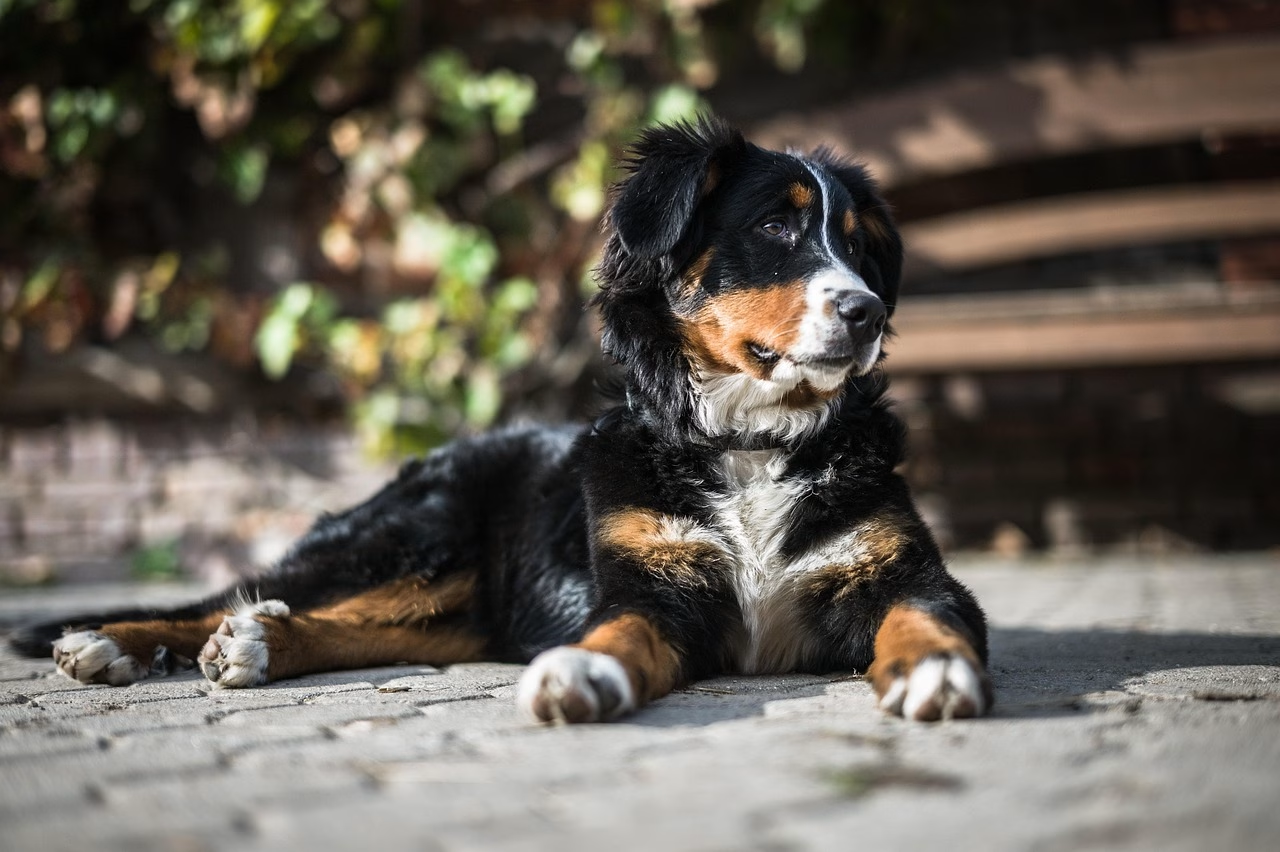
Below: My Scarlett, as a puppy. She had such the kindest eyes ❤️


Also Read: Homemade Diets for Bernese Mountain Dogs: Nutritional Risks and Veterinary Guidance
What is the Ideal Bernese Mountain Dog Weight?
Forget a single magic number. A healthy weight for a Bernese is a range based on their individual frame.
- Adult Males: Typically 90–115 pounds (41–52 kg)
- Adult Females: Typically 70–95 pounds (32–43 kg)
Some large-boned males can healthily reach 120 pounds, while some petite females may be fit at 65 pounds. The number matters less than their Body Condition Score (BCS).
The Body Condition Score: Your Hands-On Guide
Forget the scale for a moment. This is how you really tell if your dog is at a healthy weight.
The Rib Test: Run your hands along their sides. You should be able to easily feel their ribs under a thin layer of fat — without pressing hard, but not visually prominent. That for me was always a good deciding factor on if we needed more exercise, or less food intake.
The Bird’s-Eye View: Look down at your dog from above. You should see a clear, defined waist behind the ribs — an hourglass shape, not a straight tube or a bulging oval.
The Side Profile: Viewed from the side, the abdomen should tuck up from the rib cage toward the hind legs. A sagging or straight belly line is a sign of excess weight.
P.S: A tip that I’ve learned over the years is to do this analysis during or just after a bath, or after a dog is wet (while the hair is still damp). That way, you have an accurate view of the physical body (less hair). As stated above, the hair can be really deceiving, and many owners (including myself) can easily overlook what shape your dog is actually in.
Below: Scarlett and I out camping near the river. We were in and out of the river that day!
The Bernese Mountain Dog Weight Chart (Guideline)
| Age | Male Weight (lbs) | Female Weight (lbs) | Key Focus |
| 3 months | 25-35 lbs | 22-32 lbs | Steady, slow growth |
| 6 months | 55-70 lbs | 50-65 lbs | Controlled calorie intake |
| 1 year | 80-100 lbs | 70-90 lbs | ~75% of adult size |
| 18-24 months | 90-115 lbs | 70-95 lbs | Full adult weight |
This is a guideline. Your dog’s individual build is more important than any single number, and your veterinarian is the best source for an individual assessment.
How to Achieve and Maintain a Healthy Weight
- Measure their food every meal. Use a measuring cup and feed for their ideal weight, not their current weight. If your dog should weigh 100 lbs but currently weighs 110 lbs, feed the amount appropriate for a 100 lb dog and reassess body condition every few weeks with your vet’s guidance.
- Choose the right food. Feed a high-quality, large-breed formula with controlled calcium and phosphorus levels for healthy joints. I am currently feeding premium dog food from the pet store.
- Treats are not a food group. Treats should make up no more than 10% of daily calories. Healthy alternatives include pieces of carrot, green beans, or apple.
- Regular, moderate exercise. Two roughly 30-minute walks per day plus some play is a reasonable baseline for many adults. Avoid high-impact exercise like repeated jumping, especially for puppies. Swimming is an excellent low-impact option for their joints as well.
The Lifelong Benefits of Weight Management
Keeping your Bernese at a healthy weight pays off big time in reduced joint stress and pain, better mobility, more energy and playfulness, and a better chance at a longer, more comfortable life. It is one of the few longevity factors genuinely within our control as an owner. I would highly recommend paying attention to their weight and ensuring they are getting enough exercise.
Bernese Mountain Dog Weight by Age: The Complete Growth Chart
One of the most common questions BMD owners ask is “is my dog a healthy weight?” The challenge is that BMDs grow dramatically fast during their first 18 months and then continue filling out until around age 2–3. Comparing your puppy’s weight to the breed average is useful, but tracking the growth trajectory over time is more important than any single measurement.
Here are typical weight ranges for Bernese Mountain Dogs by age (individual variation is normal — genetics, diet, and spay/neuter status all affect the numbers):
- 8 weeks (typical pickup age): 12–18 lbs (males slightly heavier)
- 3 months: 25–35 lbs
- 4 months: 35–48 lbs
- 5 months: 45–60 lbs
- 6 months: 55–70 lbs
- 8 months: 65–85 lbs
- 10 months: 70–95 lbs
- 12 months: 75–100 lbs (should be close to adult height, rest of growth from here may be slightly taller but they will certainly “fill out” from here on)
- 18 months: 80–108 lbs (near adult weight, bit more “filling out” to go)
- 2–3 years (fully grown): Males 80–115 lbs | Females 70–95 lbs
If your puppy is consistently 20%+ below these ranges, discuss nutritional adequacy with your veterinarian. If consistently above, evaluate caloric intake — overweight puppies during the growth phase have a significantly higher risk of developing hip and elbow dysplasia.
The Body Condition Score: Assessing Weight Without a Scale
The number on the scale tells you one thing; the Body Condition Score (BCS) tells you what actually matters — whether your dog’s fat and muscle distribution reflects appropriate body composition for their frame. The BCS is a 9-point system used by veterinarians, where 4–5 is ideal for most dogs.
Ribs: Place your hands flat on the ribcage with light pressure. You should feel individual ribs distinctly without pressing hard. Visible ribs suggest underweight (BCS 2–3); ribs that are hard to feel under fat suggest overweight (BCS 6–7+).
Waist: From above, a dog at ideal weight has a visible narrowing behind the rib cage. No visible waist indicates excess abdominal fat.
Abdomen: From the side, the abdomen should tuck up slightly behind the ribcage. An abdomen level with or below the ribcage indicates overweight.
The challenge for Bernese owners is the breed’s abundant coat, which makes visual assessment difficult — you must feel through the fur to assess the ribs accurately. Many owners inadvertently allow BMDs to become overweight because the coat conceals body-condition changes that would be obvious on a short-haired breed. If you are unsure, ask your veterinarian to show you the rib-feel assessment in person. Another option I have found that works good, is to do the assessment after a bath – so that you can physically see without the hair.
Why Weight Management Is Critical for Bernese Mountain Dogs Specifically
For most breeds, a few extra pounds is a moderate concern. For Bernese Mountain Dogs, it is genuinely urgent — because of the breed’s specific health vulnerabilities.
Hip and elbow dysplasia risk: Excess body weight directly increases mechanical stress on the hip and elbow joints with every step. BMDs are already genetically predisposed to dysplasia; Orthopedic Foundation for Animals (OFA) data shows hip dysplasia in roughly 20% of evaluated BMDs. Weight management is one of the few modifiable factors that directly influences dysplasia severity and progression. Luckily I have not had issues with this one yet.
Cancer risk: Obesity is associated with increased cancer risk in dogs across multiple tumor types. Given that BMDs already face among the highest cancer mortality rates of any breed, keeping a dog lean is a sensible part of overall risk management. We had a bit of cancer with Scarlett and it certainly was not great. It can be heartbreaking; hence why keeping their weight in check is vital.
Lifespan: The long-term body-condition research noted above — lean dogs living a median of about 1.8 years longer than overweight littermates — is especially meaningful for a breed whose average lifespan is already only 7–10 years.
Heat tolerance: Overweight BMDs are more susceptible to heat stress, which is already a challenge for the breed’s thick double coat. Excess body fat increases metabolic heat production and reduces thermoregulation efficiency.
How Much Should You Feed a Bernese Mountain Dog?
The feeding guide on your dog food bag is a starting point, not a prescription. These guides are formulated for the average active, unaltered adult dog — but your BMD may be larger or smaller than average, may be spayed/neutered (which reduces caloric needs by 10–15%), and may be more or less active. Use the bag guide as a starting point and adjust based on actual body condition, ideally with veterinary input.
General caloric guidelines for adult BMDs (using a standard-density kibble at roughly 350–400 kcal/cup):
- 70 lb female, lightly active: ~1,400–1,600 kcal/day (about 3.5–4 cups)
- 85 lb female, moderately active: ~1,600–1,900 kcal/day (about 4–5 cups)
- 95 lb male, lightly active: ~1,800–2,000 kcal/day (about 4.5–5 cups)
- 110 lb male, moderately active: ~2,100–2,400 kcal/day (about 5–6 cups)
Feed in two meals per day rather than one large meal — this is commonly advised to help reduce bloat/GDV risk. Always measure food rather than free-feeding, and account for treats in daily calorie totals. A single large dog treat can contain 40–100 calories, and training treats add up quickly. If you have multiple dogs, it may be wise to feed them separately to ensure that they are each getting their recommended quantity. I used to feed Indy as a puppy, in a separate room from Scarlett to make sure that she got all of the food for herself.
Weight Loss for an Overweight Bernese Mountain Dog
If your BMD is overweight, the goal is gradual, controlled weight loss — not rapid restriction. Losing more than 1–2% of body weight per week causes muscle loss alongside fat loss, which is counterproductive for a breed where muscle mass supports compromised joints. For a 100 lb BMD, safe weight loss is roughly 1–2 lbs per month.
A common approach is to reduce current daily caloric intake by about 15–20% and reassess body condition monthly, paired with increased low-impact exercise (swimming is ideal for dogs with joint issues; leash walking is appropriate if joints permit). Do not switch to a “diet” or “weight management” food without veterinary guidance — for many overweight BMDs, reducing the portion size of a quality regular food is preferable to a reduced-calorie formula. Any weight-loss plan should be designed and monitored with your veterinarian.
Frequently Asked Questions: Bernese Mountain Dog Weight
My Bernese Mountain Dog is 6 months old and weighs 50 lbs — is that too small? At 6 months, a healthy BMD ranges from 55–70 lbs — 50 lbs is on the lower end but within normal range for a smaller-framed female or a smaller puppy. Consult your veterinarian if concerned, and track growth at monthly weigh-ins.
My vet says my BMD is overweight, but they don’t look fat to me. This is very common due to the thick coat. Ask your vet to show you how to do the rib-feel assessment yourself — once you can feel for rib coverage rather than relying on visual cues through the coat, the assessment becomes much easier.
Is it normal for a BMD to lose weight in summer? Mild seasonal fluctuation (2–3 lbs) is normal. More than 5 lbs of unexplained weight loss at any time of year warrants a veterinary evaluation, as it can indicate metabolic disease, cancer, or GI issues.
At what age should I switch from puppy food to adult food? For giant breeds like the BMD, the transition is generally recommended around 18 months — later than the 12-month transition common for smaller breeds — because of their extended growth period.
The Scale of Love
Managing your Bernese Mountain Dog’s weight is one of the purest acts of care. It means saying “no” to pleading eyes and being diligent about diet and exercise. The reward is real: more healthy years, more comfortable movement, and more good time with your gentle giant. Do not guess — use your hands, your eyes, and your veterinarian’s guidance. Help them live light, live long, and live well.
Owner-written, not veterinary advice. This article is written by a Bernese Mountain Dog owner, not a veterinarian. It is general information gathered from veterinary and breed-club sources — not a diagnosis or a treatment plan. Every dog is different. If your dog is unwell or showing any sign described here, call your own vet. In an emergency, go straight in.
How we research this / Sources
- American Kennel Club — Obesity in Dogs: What to Know
- American Kennel Club — Best Dog Food for Large Breeds
- American Kennel Club — Bernese Mountain Dog breed information
Written by Todd Grasse, founder of BerneseMountainLover.com and Bernese Mountain Dog owner. This article combines owner-focused guidance with the veterinary and breed-health sources listed above.
