

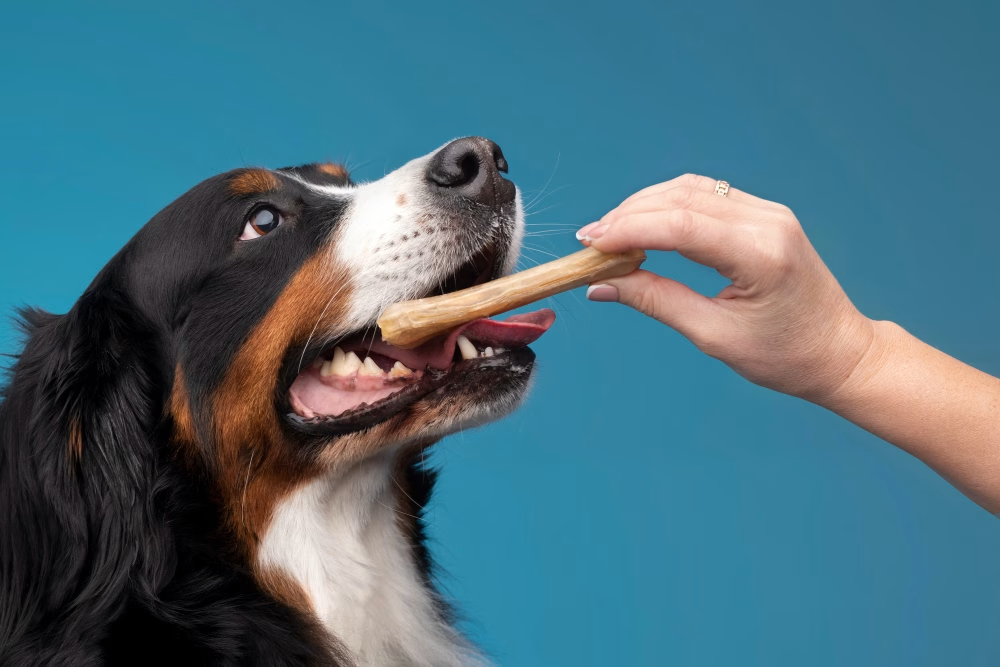
Owner-written, not veterinary advice. This article is written by a Bernese Mountain Dog owner, not a veterinarian. It is general information gathered from veterinary and breed-club sources — not a diagnosis or a treatment plan. Every dog is different. If your dog is unwell or showing any sign described here, call your own vet. In an emergency, go straight in.
Important: Homemade diets that are not formulated by a qualified professional can be dangerously incomplete for a large breed like the Bernese Mountain Dog. Before feeding any homemade diet, consult your veterinarian or a board-certified veterinary nutritionist.
Health disclaimer: This article is for educational purposes and is not a substitute for veterinary diagnosis, treatment or nutritional advice. If you are concerned about your Bernese Mountain Dog’s health or diet, contact your veterinarian.
Why owners consider homemade diets
Plenty of thoughtful Bernese owners think about cooking for their dogs. The appeal is understandable: you control the ingredients, you can avoid things your dog reacts to, and preparing food yourself feels caring. Those are reasonable motivations. The purpose of this article is not to talk anyone out of it, but to be honest about what doing it safely actually requires.
The real risk: an incomplete diet
The biggest danger with homemade dog food is not a single bad ingredient — it is a diet that is quietly incomplete. Dogs need a specific balance of protein, fat, calories, vitamins, and minerals, in the right ratios. Recipes found online and in books are frequently shown, when analyzed, to be missing or imbalanced in essential nutrients. A diet can look fresh, healthy, and appealing and still fall short of what a dog needs over months and years. Because the effects of nutritional gaps develop slowly, an owner may not see a problem until real harm has been done.
What happened when researchers actually tested the recipes
This is the part that should decide the question for most people, and it rarely gets quoted properly.
Researchers at the UC Davis School of Veterinary Medicine evaluated 200 recipes for home-prepared maintenance diets, drawn from 34 sources including books and websites (Stockman and colleagues, JAVMA, 2013). The findings:
- 95% lacked adequate levels of at least one essential nutrient.
- More than 83% had multiple deficiencies.
- Choline, vitamin D, zinc and vitamin E were the common shortfalls.
- Only nine of the 200 recipes met minimum standards.
- Only four of the 200 were written by board-certified veterinary nutritionists — and all four of those had acceptable nutrient profiles.
That last pair of numbers is the whole argument in one line. The recipes written by people qualified to formulate diets worked. The overwhelming majority of everything else did not.
The problem that survives a good recipe

Getting a properly formulated recipe is necessary but it is not sufficient. The Clinical Nutrition Service at Tufts reports that one year after receiving instructions, only 13% of owners were still feeding the original, nutritionally balanced recipe. The rest had drifted — substituting an ingredient that was out of stock, skipping the supplement, eyeballing quantities instead of weighing them.
None of those feel like a big deal on the day. Over months, in a large dog that is still growing or already carrying joint disease, they are how a balanced diet quietly becomes an unbalanced one.
If you are going to feed homemade, the honest requirements are: a recipe formulated for your dog by a board-certified veterinary nutritionist, weighed rather than estimated portions, the supplements actually given, and no ingredient substitutions without checking. If that sounds like more discipline than you want to sign up for, that is a legitimate answer — and a complete commercial diet is the better choice.
Why the stakes are higher for a Bernese
Two things make careful nutrition especially important for this breed. First, the Bernese is a large breed, and large dogs — particularly growing puppies — are sensitive to the balance of calories, calcium, and phosphorus during development; getting that wrong can affect bone and joint growth. Second, this is a breed that already carries meaningful health risks, so there is no benefit in adding an avoidable nutritional one. Puppies, pregnant or nursing dogs, and dogs with existing health conditions are the highest-stakes cases of all.
The right way to feed homemade
If you want to feed a homemade diet, the safe path is to work with a board-certified veterinary nutritionist — a veterinarian with specialist training in animal nutrition. A qualified nutritionist can formulate a recipe that is complete and balanced for your specific dog, accounting for age, weight, activity, and health. Your regular veterinarian can also help and can refer you. This is the single most important point in this article: a homemade diet should be formulated, not improvised.
A responsible homemade-feeding process usually looks like this:
- Talk to your veterinarian about whether a homemade diet is appropriate for your dog.
- Have a recipe formulated by a board-certified veterinary nutritionist for your individual dog.
- Follow the recipe precisely — ingredient swaps and “close enough” substitutions can unbalance it.
- Use any supplements exactly as specified, since homemade diets often rely on them to be complete.
- Recheck with your veterinarian over time, and re-formulate as your dog’s age and needs change.
A note on recipes
This article does not provide homemade recipes. A recipe that is safe and complete for one dog may not be appropriate for another, and a recipe that has not been formulated by a qualified professional cannot be assumed to be balanced. Treat any recipe you find — anywhere — as a starting point to discuss with a professional, not a finished plan.
Commercial diets are a valid choice
It is also worth saying plainly: a good commercial dog food that meets established nutritional standards is a completely reasonable, responsible way to feed a Bernese. Homemade feeding is not inherently better for the breed. The best diet is the one that is complete, balanced, appropriate for your dog’s life stage, and sustainable for you to provide consistently — and that is a conversation to have with your veterinarian. For more on choosing a balanced large-breed diet, see our guide to feeding a Bernese Mountain Dog.
The owner’s takeaway
Homemade feeding can be done well, but only with professional formulation behind it. If you are drawn to it, start with your veterinarian and a board-certified veterinary nutritionist rather than an internet recipe. That single step is the difference between a homemade diet that genuinely supports your Bernese and one that quietly works against them.
Related reading
- Feeding a Bernese Mountain Dog: the practical guide
- Body condition and healthy weight
- Large-breed puppy growth and why it needs controlling
- The health conditions diet can influence
How we research this / Sources
- American Kennel Club — Best Dog Food for Large Breeds (incl. guidance on home-cooked diets)
- American Kennel Club — Bernese Mountain Dog breed information
- UC Davis School of Veterinary Medicine — Homemade dog food recipes can be risky business, study finds (Stockman et al., JAVMA 2013)
- Tufts Cummings School Clinical Nutrition Service — Think Twice: Reasons to Avoid a Home-cooked Diet
- Tufts Petfoodology — Cooking Up Trouble: Common Home Cooking Mistakes
- WSAVA — Global Nutrition Guidelines and Toolkit
Written by Todd Grasse, founder of BerneseMountainLover.com and Bernese Mountain Dog owner. This article combines owner-focused guidance with the veterinary and nutrition sources listed above.
