
ⓘ Affiliate Disclosure: This post contains affiliate links. As an Amazon Associate, we earn from qualifying purchases at no extra cost to you. Read our full disclosure.
Bernese Mountain Dogs shed — a lot. If you share your home with a Berner, fur on your floors, clothes, and car is simply part of the deal. The good news is that shedding is predictable once you understand the breed’s coat, and a consistent routine keeps it manageable. Here’s what to expect and what actually helps.
From my own experience: during a heavy spring blow I’ll find tufts of undercoat on the floors, on the couch, and honestly stuck to my clothes on the way out the door — it really does get everywhere for a few weeks. The one tool I would not give up is a good undercoat rake; it pulls more loose fur in a single session than anything else I’ve tried, and a quick pass with a slicker brush afterward tidies up what’s left.
Why Berners shed so much
The Bernese Mountain Dog has a double coat: a coarser outer layer of guard hairs and a soft, dense undercoat built for cold Swiss winters. That undercoat is the main source of shedding. Berners shed moderately year-round, then go through two heavier “coat blows” a year — typically in spring as they drop the winter undercoat, and again in fall as the coat changes for winter. During those few weeks, the volume of loose fur increases dramatically.
When shedding peaks
Expect the two big seasonal blows in roughly April–June and September–November, though timing varies by climate and the individual dog. Intact females often shed around their heat cycles as well. Outside those windows, you’ll still see steady everyday shedding — normal for the breed and not a sign of a problem on its own.
A shedding-control routine that works
You can’t stop a Berner from shedding, but regular grooming captures the loose fur before it lands on your floors.
- Brush often. Three to four times a week normally; daily during a coat blow. Reaching the undercoat is the key — brush in sections from the skin outward, not just over the top.
- Use the right tools. An undercoat rake or deshedding tool pulls out loose underlayer; a slicker brush smooths the coat; a steel comb checks for tangles. Use a deshedding tool gently and no more than about once a week so you don’t damage the coat or irritate the skin.
- Bathe and dry properly. A bath during heavy shedding loosens a lot of fur — but brush first, and dry thoroughly with a high-velocity dryer while brushing, which blows out a surprising amount of dead undercoat.
Never shave to reduce shedding
It’s tempting, but shaving a Berner is a mistake. The double coat insulates against both cold and heat, and shaving can lead to patchy or altered regrowth that often mats and sheds worse. Manage shedding with brushing, not clippers.
What is actually coming off the dog
A Bernese has two coats doing two different jobs, and understanding which one you are pulling out changes how you groom.
The guard coat is the outer layer — longer, coarser, slightly oily, and the part that gives a Berner its shine and sheds water. It turns over gradually all year. The undercoat underneath is short, dense and woolly, and it is the insulation. That is the layer that comes out in handfuls during a coat blow, and it is the reason a Berner can look like it is disintegrating for a fortnight twice a year.
One thing most shedding advice gets wrong: seasonal coat change is driven mainly by day length, not temperature. The trigger is photoperiod. This has a practical consequence for house dogs — a Berner living indoors under artificial light gets a muted version of that seasonal cue, and tends to shed more evenly all year instead of in two dramatic blows. If your dog seems to shed constantly rather than seasonally, that is normal for an indoor dog, not a sign something is wrong.
Which tool does what
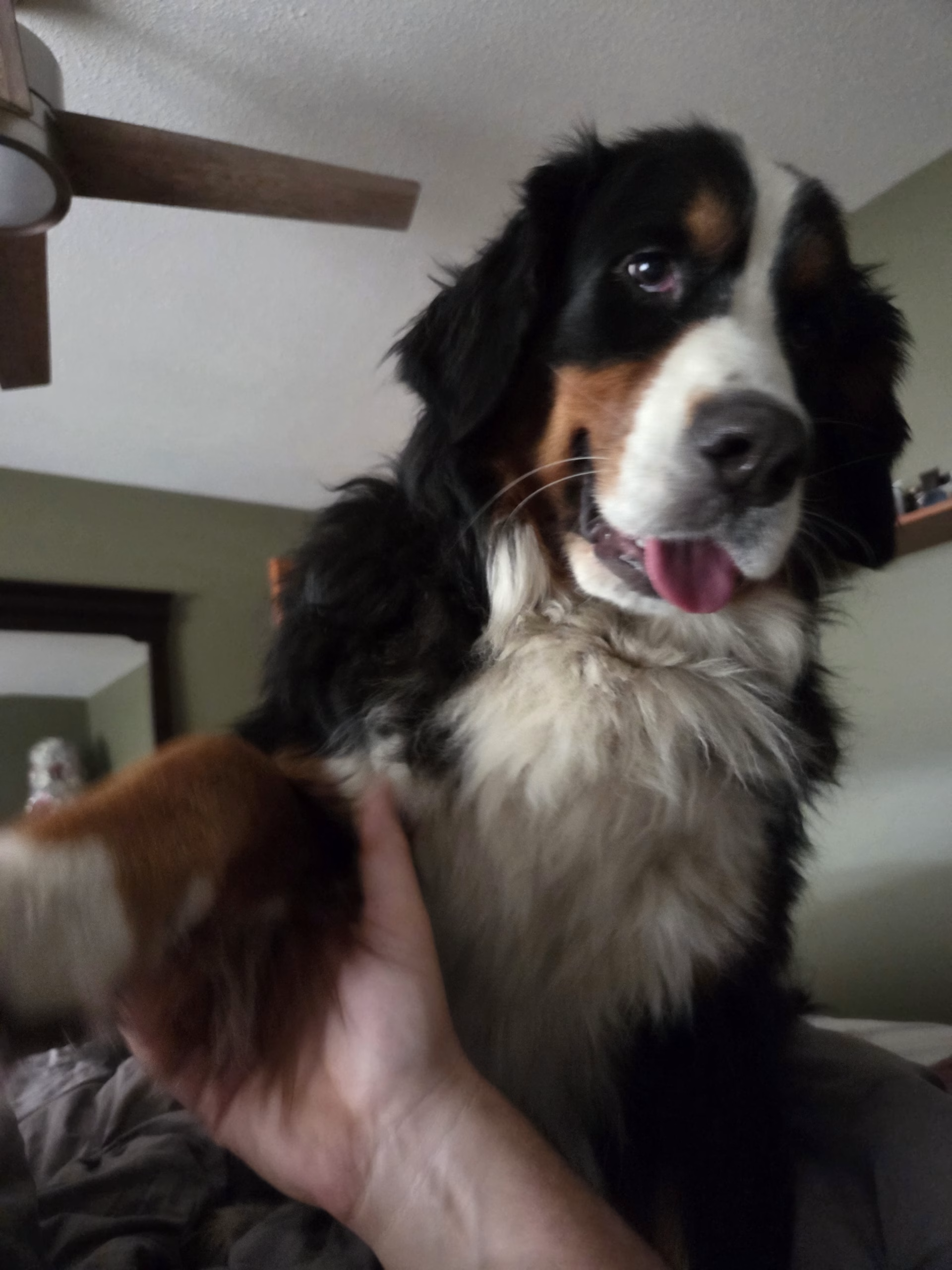
Most owners buy the wrong brush first, then buy three more. Here is what each type actually does on a double coat.
- Undercoat rake. Long, rounded, widely spaced teeth that pass through the guard coat and drag loose undercoat out from underneath. This is the workhorse for a Berner and the single most useful tool during a coat blow. It does not cut anything.
- Slicker brush. Fine angled wire pins on a flat head. Good for surface tangles, feathering and finishing. Much less effective at deep undercoat than a rake, and pressed too hard it scratches skin — let the tips do the work.
- De-shedding blade tools (the Furminator-style ones). These have an actual cutting edge. They pull undercoat efficiently, which is why they feel so satisfying, but they also cut guard hairs, and overuse thins and dulls the outer coat over time. Use sparingly, only on a dry mat-free coat, and never as your main brush.
- Metal greyhound comb. Not really a shedding tool — it is the check tool. If the comb passes cleanly to the skin, that area is genuinely mat-free. If it snags, you have not finished, whatever the surface looks like.
- High-velocity dryer. What groomers use, and the fastest way to clear a blowing coat. Blows loose undercoat out rather than pulling it. Loud, and worth introducing gradually to a young dog.
Two technique points that matter more than the tool. Do not work hard at a bone-dry coat — a light mist of water reduces static and breakage. And brush in sections down to the skin rather than skimming the top, because a Berner’s surface can look immaculate over a mat.
Where a Berner mats, specifically
Matting is not evenly distributed. On this breed it forms in predictable places, and those are the spots to check even in a week when you have not done a full groom:
- Behind and underneath the ears, where the hair is fine and constantly moving
- The ruff around the neck, particularly under a collar
- The armpits behind the front legs — friction plus fine hair, and the most commonly missed spot
- The feathering on the backs of the legs, front and rear
- The tail plume
- Between the toes, which also collects ice balls in winter and grass seed in summer
A mat that has tightened to the skin is not a brushing job. It needs to be cut out carefully or dealt with by a groomer, because pulling it stretches and tears skin that you cannot see under the coat.
Managing fur around the house
A few practical habits make a big difference: vacuum with a pet-rated vacuum a couple of times a week (daily during a blow), keep washable covers on furniture and the car seat, use a rubber pet-hair brush or damp rubber glove on upholstery, and run a robot vacuum on off days. Keeping a lint roller by the door saves a lot of last-minute panic.
Diet and skin health
A healthy coat sheds less excessively. Feed a complete, balanced diet appropriate for a large breed; omega-3 fatty acids (often from fish oil) can support skin and coat, but ask your veterinarian before adding supplements. Sudden heavy shedding, bald patches, redness, or itchy, flaky skin is different from normal seasonal shedding and is worth a vet visit, since it can point to allergies, parasites, or a thyroid issue.
Frequently asked questions
Do Bernese Mountain Dogs shed all year? Yes — moderate shedding year-round plus two heavier seasonal coat blows.
Are Berners hypoallergenic? No. They are heavy shedders and not a good fit for people with significant dog-dander allergies.
How long does a coat blow last? Usually two to four weeks. Daily brushing during that window shortens the misery considerably.
Related reading: best brush for Bernese Mountain Dog shedding · full Bernese grooming guide
As an Amazon Associate, this site earns from qualifying purchases.
Owner-written, not veterinary advice. This article is written by a Bernese Mountain Dog owner, not a veterinarian. It is general information gathered from veterinary and breed-club sources — not a diagnosis or a treatment plan. Every dog is different. If your dog is unwell or showing any sign described here, call your own vet. In an emergency, go straight in.

6 Comments
I wanted to thank you for this fantastic read!! I absolutely enjoyed
every bit of it. I’ve got you book-marked to check out new stuff you post…
Hi there i am kavin, its my first occasion to commenting anywhere, when i
read this article i thought i could also make comment due to this
sensible article.
It’s a pity you don’t have a donate button! I’d most certainly donate to this brilliant blog!
I suppose for now i’ll settle for book-marking and adding your RSS feed to my Google account.
I look forward to brand new updates and will talk about this website with my Facebook group.
Talk soon!
Do you have a spam issue on this site; I also am a blogger, and I was wanting to know your situation; many of us have developed some nice practices and we are looking to exchange solutions with other folks, be sure to shoot me an email if interested.
Wonderful beat ! I would like to apprentice
while you amend your web site, how could i subscribe for a
blog web site? The account helped me a acceptable deal.
I had been a little bit acquainted of this your broadcast provided bright clear idea
Greetings! Very helpful advice within this post! It is the little changes that will make the largest changes.
Thanks for sharing!