
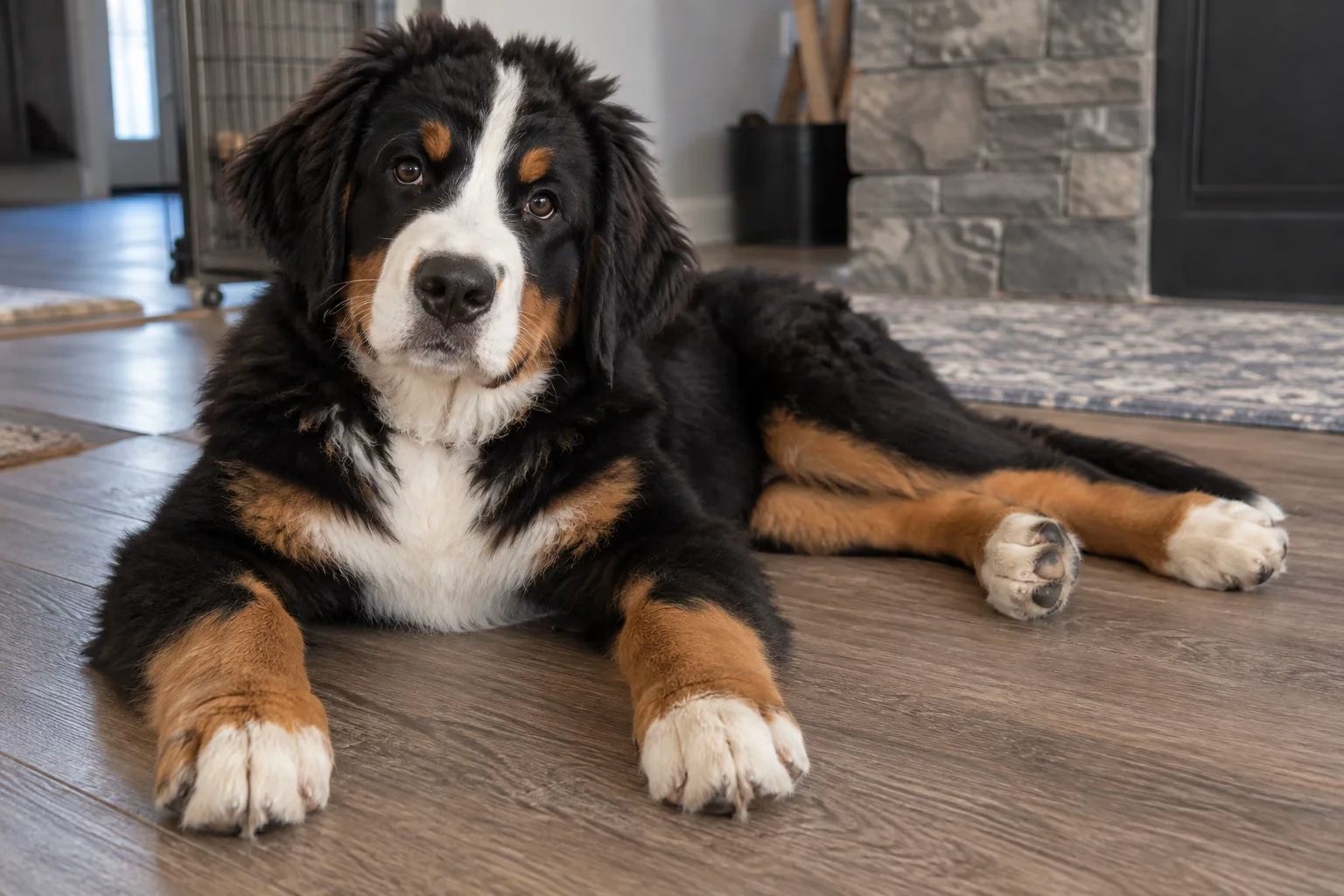
Most of the time, a limping large-breed puppy has either a minor soft-tissue strain from playing too hard, or panosteitis — often called growing pains. Both usually resolve. Panosteitis in particular is painful but self-limiting, and its prognosis is excellent.
But a Berner puppy is not a generic large-breed puppy, and there’s one thing worth understanding before you settle on the reassuring answer. Elbow dysplasia shows up at the same age, in the same legs, and this breed is more predisposed to it than any other breed studied. Telling the two apart is a job for your vet, and the behaviour of the limp over the next few weeks is one of the best clues you’ll get.
Start with whether it’s urgent.
This is owner education, not veterinary advice, and it doesn’t diagnose your puppy. A limping puppy is a vet visit. The sections below are about what to expect and what to watch.
Go to the vet today if
- Your puppy won’t put any weight on the leg
- There’s a fever, or the puppy is lethargic, depressed or off its food
- Joints or the ends of the long bones are swollen and warm, especially in more than one leg
- There was a fall, a collision or a trapped leg, or you suspect a fracture
- The puppy cries out when the leg is touched or moved
- There’s an open wound, or something embedded in a paw
Those point toward a fracture, a serious soft-tissue injury, an infection, or hypertrophic osteodystrophy — which is covered below and which does warrant prompt attention.
Do not give your puppy human painkillers. Ibuprofen, naproxen and acetaminophen are dangerous to dogs. If your puppy needs pain relief, it needs a veterinary-prescribed drug at a veterinary dose.
If it’s not urgent: the common causes
Soft-tissue strain
The most common explanation for a single limp after a boisterous day. A Berner puppy is heavy, uncoordinated and enthusiastic, which is a combination built for sprains.
Typically: one leg, after a known bout of hard play, improving over a few days of rest. Check the paw first — a thorn, a cut pad, a torn nail or a split between the toes causes more puppy limps than people expect.
Panosteitis
What it is. A self-limiting inflammatory condition of the long bones in young, rapidly growing, large-breed dogs. It affects the shaft of the bone — not the joint — and the cause is unknown.
Who gets it. Dogs typically between about 5 and 18 months, though it’s been seen as early as 2 months and occasionally later. Most sources report males more commonly affected — roughly four to one in one clinical review — although at least one veterinary source reports no sex predisposition. It’s rarely seen past about 20 months.
The breeds listed as most commonly affected are the German Shepherd, Great Dane, Golden and Labrador Retrievers, Rottweiler, Dobermann, Basset Hound and Saint Bernard. The Bernese Mountain Dog isn’t specifically named on those lists — but it’s squarely in the population the condition affects: large, heavy, and growing fast.
The hallmark: shifting-leg lameness. The limp moves. It may settle in one leg and then appear in another, because more than one bone can be affected at once or in sequence. Front legs are affected far more often than hind legs — about four to one — with the ulna, radius and humerus most commonly involved.
It comes and goes. Each episode can last a few days to a few weeks, and the gap between episodes is often around a month. Recurrent episodes are expected. The whole thing typically resolves once the dog reaches skeletal maturity.
Other signs can include lethargy, a reduced appetite and a low-grade fever during an episode.
How it’s diagnosed. The characteristic finding is pain when a vet presses firmly on the shaft of an affected long bone. Radiographs then show increased density inside the bone.
One important catch: X-rays can lag behind the symptoms. Radiographic changes may not appear for up to about ten days after lameness begins, and some vets repeat films a couple of weeks later to confirm. A normal first X-ray doesn’t rule panosteitis out — and nor does it rule anything else in.
Treatment. Pain relief during episodes — veterinary NSAIDs, sometimes opioids — plus restricted exercise. There’s nothing that shortens the condition itself; treatment manages the pain while it runs its course.
Prognosis. Excellent. Once it resolves, the bone returns to normal.
Hypertrophic osteodystrophy (HOD)
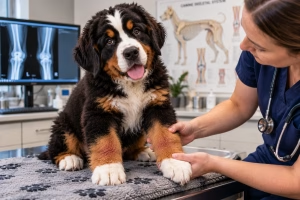
Less common, younger, and more systemically unwell.
HOD typically affects pups between about 2 and 8 months, at the flared ends of the long bones near the growth plates rather than the shaft. The picture is different from panosteitis:
- Warm, painful swelling near the joints, often of the lower front legs and hind legs, frequently on both sides
- High fever
- Refusal to walk, not just a limp
- A puppy that seems sick — lethargic, depressed, not eating
This is the one that belongs in the go-today category. A feverish puppy that won’t get up with swollen lower legs needs a vet promptly.
The one to take seriously in a Berner: elbow dysplasia
Here’s where the breed changes the picture.
Elbow dysplasia presents most often between 5 and 10 months. It favours the front legs. And the Bernese Mountain Dog carries the greatest breed predisposition to fragmented coronoid process — the main form of elbow dysplasia — of any breed studied.
So the age window and limbs overlap almost exactly with panosteitis. And the two aren’t mutually exclusive: a veterinary review notes that other developmental orthopedic diseases may be similar to panosteitis and, in some cases, occur at the same time. A puppy can have both.
The practical risk is this: panosteitis is common, benign, and exactly what a limping seven-month-old large-breed puppy is likely to be told it has. In most breeds that’s usually right and harmless if it isn’t. In a Berner, if the limp is really coming from an elbow, accepting “it’s just growing pains” and waiting it out means losing the window in which elbow disease is best managed.
Our elbow dysplasia article covers that condition in detail, including the finding that a dog can have significant elbow disease without ever limping.
Telling them apart
This is the table to bring to your vet appointment. None of it is diagnostic on its own — an exam and imaging are what decide it — but these are the patterns that point one way or the other.
| Panosteitis | Elbow dysplasia | HOD | Soft-tissue strain | |
|---|---|---|---|---|
| Typical age | ~5–18 months | ~5–10 months | ~2–8 months | Any |
| Which leg | Shifts between legs | Usually the same front leg, or both front | Often several legs, both sides | One leg |
| Where it hurts | Pressure on the bone shaft | Flexing or extending the elbow joint | Swollen area near the joint | Local to the injury |
| Pattern | Episodes, then improvement, then recurs | Persistent; often worse after exercise, stiff after rest | Acute and systemic | Improves over days with rest |
| Fever / unwell | Sometimes mild | Usually not | Often high | No |
| Outcome | Resolves by maturity | Lifelong joint management | Usually resolves; can be serious | Resolves |
The single most useful observation you can make is whether the limp moves. Shifting between legs points toward panosteitis. Staying stubbornly in the same front leg, week after week, is the pattern that should keep the elbow question open.
Questions worth asking your vet
If your Berner puppy is diagnosed with panosteitis:
- Were the elbows specifically examined — flexed, extended, checked for joint effusion?
- If radiographs were taken, did they include views of the elbow?
- If this doesn’t resolve or keeps recurring in the same leg, at what point should we image the elbows properly, or consider CT?
- Should we recheck in a few weeks regardless?
A vet who’s already thinking about elbows in a Berner will answer those immediately. If they haven’t, asking is entirely reasonable — this is a breed-specific concern and it’s one any vet will recognise once it’s raised.
Other causes worth knowing about
A vet working up a limping large-breed puppy will also have these in mind:
- Osteochondritis dissecans (OCD) — a cartilage defect, most commonly in the shoulder in large breeds. Note that in Berners, the common elbow form is the coronoid rather than OCD
- Ununited anconeal process — another component of elbow dysplasia
- Hip dysplasia — a hind-leg possibility. Our hip dysplasia article covers it
- Growth-plate injury — a knock to an open growth plate in a puppy can be more serious than the same knock to an adult
- Ligament injury
- Infection, including tick-borne disease, depending on where you live
What to do at home while you wait for the appointment
- Rest. Leash-only toilet breaks. No stairs, no jumping on and off furniture, no play with other dogs until it’s been assessed.
- Check the paw thoroughly first — pads, between the toes, nails.
- Watch and note which leg. Seriously: write it down each day, with the date. Whether the limp moves is the most useful single piece of information you can give your vet, and memory is unreliable after a week.
- Film it. Puppies often walk soundly in a vet’s consulting room from adrenaline. A thirty-second phone video of the limp at home is genuinely valuable.
- No human medication. Ever. Ibuprofen, naproxen and acetaminophen can cause serious harm.
Prevention: what you can actually influence
None of these conditions can be fully prevented — genetics and growth set the stage. What’s within your control is the rate of growth.
- Keep the puppy lean. Rapid growth is the common thread running through large-breed developmental bone and joint disease.
- Feed a large-breed puppy formulation and don’t supplement on top of it. Excessive dietary supplementation in young large-breed dogs should be avoided — particularly added calcium. Faster growth is not better growth in a giant breed. Our feeding guide and growth chart cover the details.
- Restrict high-impact activity until skeletal maturity, around two years — repetitive jumping, forced running, stairs by the dozen, hard stop-start play on slick floors.
FAQ
Why is my Bernese Mountain Dog puppy limping on and off? Intermittent lameness that comes and goes in a young large-breed puppy is often panosteitis, a self-limiting inflammation of the long bones sometimes called growing pains. Episodes can last days to weeks, with gaps of around a month between them. But in a Berner, a limp that stays in the same front leg rather than moving deserves a vet’s attention for elbow dysplasia.
What are growing pains in dogs? The common name for panosteitis — a painful but self-limiting inflammation of the shaft of the long bones in young, fast-growing large dogs, usually between about 5 and 18 months. It typically causes a shifting-leg lameness and resolves by skeletal maturity with an excellent prognosis.
Is panosteitis serious? It’s painful but not dangerous, and it resolves on its own, usually by the time the dog is skeletally mature. Treatment is pain relief during episodes and restricted exercise. The main risk is assuming a limp is panosteitis when it’s actually something that needs different management.
How can I tell panosteitis from elbow dysplasia? Only a vet can, with an exam and imaging. But the pattern helps: panosteitis tends to shift between legs, cycles through episodes, and hurts when pressure is applied to the bone shaft. Elbow dysplasia tends to stay in the same front leg, persists, and hurts when the elbow joint is flexed or extended. The two can occur at the same time, and Berners are the breed most predisposed to the main form of elbow dysplasia.
When should I take a limping puppy to the vet? Any limp lasting more than a day or two warrants a visit. Go the same day if the puppy won’t bear weight, has a fever, has warm swollen joints, cries out when the leg is touched, or had a fall or collision. Those can indicate a fracture, a serious injury, or hypertrophic osteodystrophy.
Can I give my puppy ibuprofen for a limp? No. Ibuprofen, naproxen and acetaminophen are dangerous to dogs. Pain relief for a puppy needs to be a veterinary-prescribed medication at a veterinary dose.
The X-ray was normal. Does that rule out panosteitis? No. Radiographic changes can lag behind the lameness by up to about ten days, and repeat films a couple of weeks later are sometimes needed to confirm the diagnosis. A normal first X-ray doesn’t rule panosteitis out.
What is hypertrophic osteodystrophy? A less common condition in younger large-breed pups, usually 2 to 8 months, affecting the ends of the long bones near the growth plates. It typically causes warm, painful swelling near the joints on both sides, a high fever, and reluctance to walk, and the puppy often seems unwell. It warrants prompt veterinary attention.
