
The breed standard for the Bernese Mountain Dog lists inverted or everted eyelids as serious faults — one of the few places where a standard flags something that is genuinely a surgical problem rather than a cosmetic one.
That tells you the breed has a history with it. Veterinary breed-predisposition references list the Berner for entropion and ectropion, and also for oversized palpebral fissures — an eyelid opening longer than it should be, which is the conformation that causes both.
Most Berners never have an eye problem. But eyes are one of the five health tests this breed’s parent club requires, and the exam is checking for real things.
This is owner education, not veterinary advice, and it doesn’t diagnose anything. Eyes are time-sensitive: see the emergency list below, and when in doubt, call.
See a vet today if
An eye is the one organ where waiting until Monday can cost vision permanently.
- Squinting, or holding the eye closed
- Obvious pain — pawing at the face, rubbing on furniture
- A sudden change in the appearance of the eye — cloudiness, redness, a visible film
- Discharge, particularly if yellow or green
- A visibly cloudy or blue-ish cornea that appeared quickly
- Any suspected injury, including a scratch from a branch or another animal
- Sudden apparent loss of vision — bumping into things, hesitating in familiar rooms
Don’t put human eye drops in a dog’s eye. Some contain steroids, which can be actively harmful if there’s a corneal ulcer — and a corneal ulcer is exactly what a squinting, painful eye often is.
The eyelid problems the standard warns about
These are the ones the breed standard names, and they’re conformational — a matter of how the eyelid is built rather than a disease that arrives later.
Entropion is the eyelid rolling inward, so that eyelashes and haired skin contact the surface of the eye. It’s painful and it abrades the cornea. Untreated it causes ulceration and scarring.
Ectropion is the eyelid turning outward, leaving the inner surface exposed. It’s less immediately painful but it dries the eye and lets debris in, which causes chronic irritation and recurrent conjunctivitis.
Macroblepharon — an eyelid opening that’s too long — is the thing that often produces both. The Bernese is listed among breeds predisposed to oversized palpebral fissures.
“Diamond eye”
Here’s the detail that explains why a single eyelid can be doing two contradictory things at once.
When the eyelid opening is too long and the lateral support is weak, the centre of the lower lid sags outward while the outer portions roll inward. The result is a distorted, angular eyelid margin — described in the literature as “diamond eye” or a pagoda conformation. In a UK study of conformational eyelid disorders, diamond eye was recorded in 9.60% of ectropion cases.
For an owner, the practical version is this: if your dog’s lower eyelid looks droopy in the middle but the corners look like they’re turning in, that’s a recognised pattern with a name, and it’s worth an ophthalmologist’s assessment rather than a watch-and-wait.
How common is this, really?
Honestly: less common than the breed standard’s attention to it might suggest.
A study of UK primary-care records found an annual prevalence of 0.33% for entropion and 0.04% for ectropion across dogs overall. Neither condition featured among the 70 most diagnosed disorders in dogs generally — which the authors noted implies that a few breeds carry extremely high predisposition while most carry very little.
The Bernese Mountain Dog was not among the highest-prevalence breeds in that study. Those were the Shar-Pei and Chow Chow for entropion, and the Neapolitan Mastiff for ectropion. The Berner appears on breed-predisposition reference lists, which is a different and weaker claim than appearing in prevalence data.
So: a recognised predisposition, not a likelihood. If your dog’s eyes are tight-fitting and comfortable, they’re almost certainly fine.
Treatment
Both are surgically correctable, and surgery is usually the answer when the condition is causing damage rather than merely looking unusual. Entropion in particular generally requires surgery, because every blink is abrading the cornea.
Mild cases are sometimes managed with lubricants and monitoring. A veterinary ophthalmologist is the right person to make that call, since the surgical techniques involved are precise and an over-correction causes its own problems.
The other conditions on the breed’s list
Distichiasis — extra eyelashes emerging from the eyelid margin where they shouldn’t. Some dogs are entirely unbothered; others have persistent irritation and need the hairs removed. Listed as a Berner predisposition.
Cataracts — opacity of the lens. Listed for this breed, including posterior and equatorial cortical forms, and cataracts can also develop secondary to retinal disease.
Progressive retinal atrophy (PRA) — inherited degeneration of the retina leading to gradual vision loss and eventually blindness. There’s no effective treatment; management is about adapting the dog’s environment. Dogs adjust to gradual vision loss remarkably well in familiar surroundings, which is both reassuring and a reason not to rearrange the furniture.
Retinal dysplasia and retinal detachment, persistent pupillary membranes, and optic nerve coloboma also appear on breed-predisposition lists for the Bernese. Most are found on an ophthalmologist’s exam rather than noticed by an owner, which is exactly what the CAER exam exists for.
Systemic histiocytosis. One veterinary ophthalmology breed-disorder reference lists this among the Bernese Mountain Dog’s ocular conditions. It belongs to the same histiocytic disease family as the breed’s defining cancer, and it can involve the eye. If your dog has an unexplained eye problem alongside signs elsewhere — skin lesions, weight loss, lethargy — mention the combination to your vet rather than treating the eye in isolation. Our histiocytic sarcoma article covers the broader disease.
Cloudy eyes in an older dog: cataract or not?
A very common worry, and usually the answer is reassuring.
Nuclear sclerosis is a normal age change. The lens becomes denser and takes on a bluish-grey, hazy appearance, typically from middle age onward. It affects vision minimally and needs no treatment. It looks alarming and isn’t.
A cataract is an actual opacity of the lens, appears white and opaque rather than hazy and translucent, blocks light, and does impair vision.
You can’t reliably tell them apart by looking, and guessing wrong in either direction is a problem. A vet can distinguish them in a routine exam, so it’s a question for your next appointment rather than an emergency — unless the change was sudden, in which case see the list at the top.
Our senior care guide covers what else changes in an older Berner.
The CAER exam and what it proves
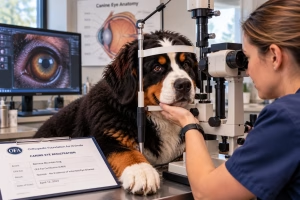
Eye certification is one of the five health tests the BMDCA requires for this breed. The exam is performed by a board-certified veterinary ophthalmologist, who examines for inherited and congenital eye disease and registers the result.
Two things worth knowing:
It’s a snapshot, not a guarantee. Eye exams can be performed at any age, and should be repeated annually. Several of the conditions above are late-onset — PRA and cataracts in particular. A clear exam on a two-year-old says nothing about that dog at six.
Check the date. If a breeder shows you an eye certification, look at when it was issued. A current certification on both parents is meaningful; a four-year-old one is history.
Our health testing article covers the full set of requirements and how to verify results yourself in the OFA and Berner-Garde databases.
It’s also worth knowing that ACVO shares its recorded data publicly while the European equivalent does not — so for a dog certified in North America, the result should be lookup-able.
Everyday eye care
Not much is required, and that’s the point.
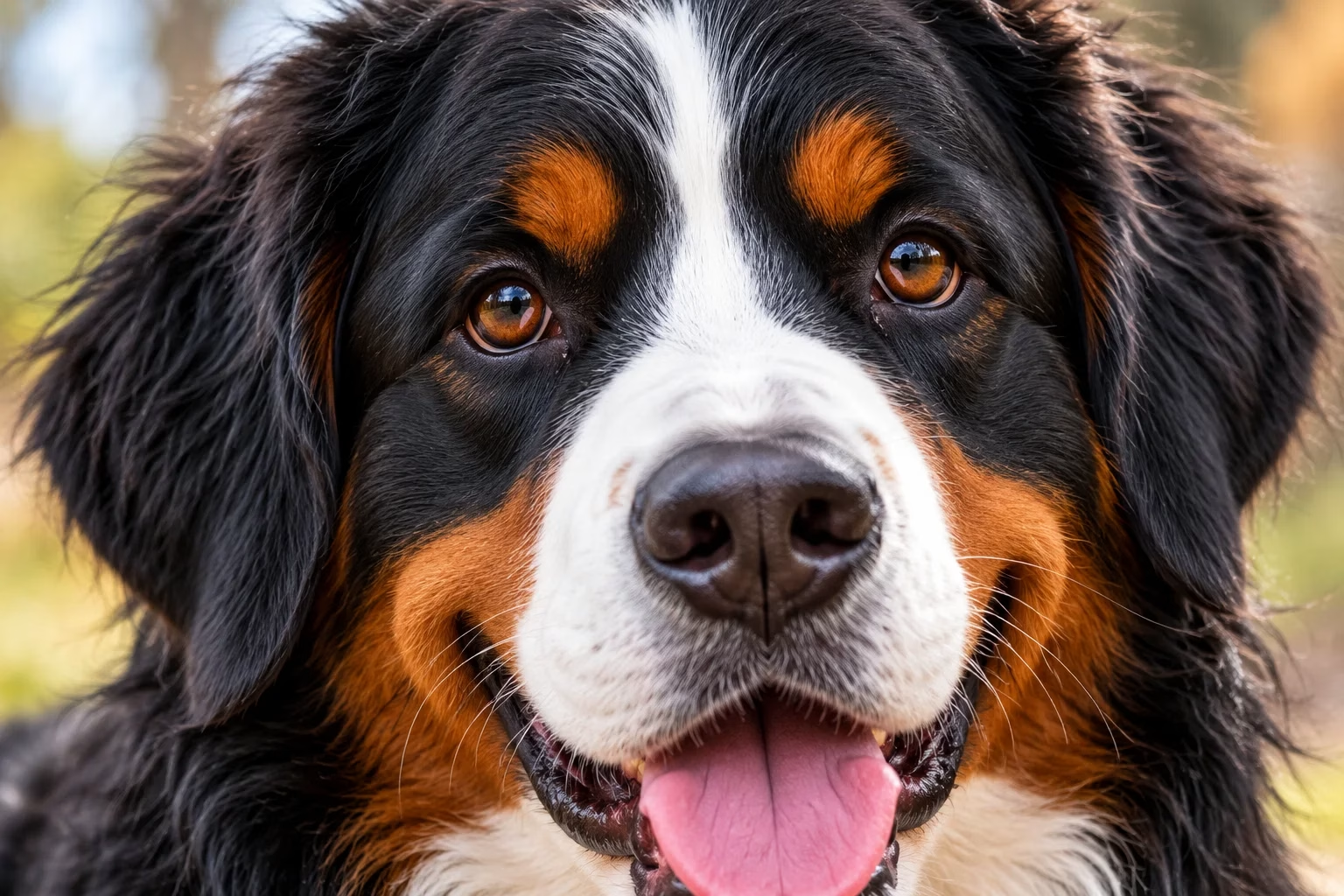
- Look at both eyes properly, weekly. They should be clear, bright, symmetrical, with tight-fitting lids and no discharge. On a dog with this much face hair, that means actually looking rather than glancing.
- Keep the hair around the eyes tidy. Hair contacting the cornea causes irritation, and a Berner carries a lot of it.
- Wipe away normal discharge with a damp cloth, working from the inner corner outward, using a separate area of cloth for each eye.
- Don’t medicate on your own initiative. The wrong drop in an ulcerated eye makes things considerably worse.
- Mention changes at the annual check, even small ones — a lid that sits differently, one eye that waters more than the other.
The buying question
If you’re choosing a puppy, this is a short conversation.
- Do both parents have current eye certifications, and what date were they issued?
- Have you had any entropion or ectropion in your lines?
- Is there PRA or inherited cataract in the pedigree?
- Can I look up the eye results myself?
A breeder who answers all four directly is operating the way the parent club intends — our breeder guide covers the wider conversation, and the standard’s own language on eyelids is a reasonable thing to raise.
FAQ
What is entropion in dogs? The eyelid rolling inward so that lashes and haired skin rub against the surface of the eye. It’s painful and abrades the cornea, and untreated it causes ulceration and scarring. It generally requires surgical correction. The Bernese breed standard names inverted eyelids as a serious fault.
What is ectropion? The eyelid turning outward, exposing the inner surface. It’s less immediately painful than entropion but dries the eye and allows debris in, causing chronic irritation and recurrent conjunctivitis. It’s also named as a serious fault in the breed standard.
What is “diamond eye”? A conformation where an overly long eyelid opening with weak lateral support causes the centre of the lower lid to sag outward while the outer portions roll inward — producing a distorted, angular eyelid margin. It was recorded in 9.60% of ectropion cases in a UK study of conformational eyelid disorders.
Are Bernese Mountain Dogs prone to eyelid problems? They appear on veterinary breed-predisposition lists for entropion, ectropion and oversized palpebral fissures, and the breed standard names inverted and everted eyelids as serious faults. But the Berner was not among the highest-prevalence breeds in UK primary-care data — those were the Shar-Pei and Chow Chow for entropion, and the Neapolitan Mastiff for ectropion. It’s a recognised predisposition rather than a likelihood.
My older Berner’s eyes look cloudy. Is it cataracts? Possibly, but more often it’s nuclear sclerosis — a normal age change where the lens becomes denser and takes on a bluish-grey haze. It affects vision minimally and needs no treatment. A cataract is an actual opacity, appears white and opaque rather than translucent, and does impair vision. You can’t reliably tell them apart by looking; a vet can, in a routine exam.
Do Bernese Mountain Dogs get progressive retinal atrophy? PRA appears on breed-predisposition lists for the Bernese. It’s an inherited degeneration of the retina causing gradual vision loss and eventually blindness, with no effective treatment available. Management focuses on adapting the dog’s environment — and dogs adjust remarkably well to gradual vision loss in familiar surroundings.
What does a CAER eye exam prove? That a board-certified veterinary ophthalmologist examined the dog for inherited and congenital eye disease on a particular date, and registered the result. It’s one of the five health tests the BMDCA requires. Crucially it’s a snapshot — exams should be repeated annually, because several of the relevant conditions are late-onset. Always check the date on a certification you’re shown.
When is a dog’s eye problem an emergency? Squinting, obvious pain, sudden cloudiness or redness, yellow or green discharge, a suspected injury, or sudden apparent vision loss all warrant a same-day visit. Eyes are time-sensitive and a day’s delay can cost vision. Never put human eye drops in a dog’s eye — some contain steroids, which can be harmful if there’s a corneal ulcer.
