


This article is for general Bernese Mountain Dog owner education only and is not veterinary advice. Bernese Mountain Dogs are prone to serious conditions including bloat/GDV, cancer, hip and elbow dysplasia, and heart issues. Always contact a licensed veterinarian for diagnosis, treatment, diet changes, supplements, or emergency symptoms. Supplements are not a substitute for diagnosis or treatment, are not a cure, and cannot guarantee any outcome. Talk to your vet before starting one — especially for puppies, dogs on medication, or dogs with a diagnosed joint condition. This article may contain affiliate links; see our affiliate disclosure.
The first time a Bernese takes a little longer to rise, hesitates before the stairs, or bunny-hops after a hard play session, most owners feel the same mix of concern and urgency. Joint supplements come up a lot for this breed because Berners carry real orthopedic risk. This guide is about how to choose one wisely — what the ingredients do, how to judge a formula for a giant breed, and, just as important, when a supplement is the wrong answer and your dog needs a vet instead.
Bernese Mountain Dogs are a giant breed with a build, growth pattern, and genetic background that make hip, elbow, and general joint wear a bigger issue than in many other breeds. That doesn’t mean every Berner needs a supplement, and it doesn’t mean supplements can fix structural disease. It means owners should know what these products realistically do, when they’re worth trying, and how to tell a thoughtful formula from marketing.
Support, not treatment
The most useful way to view joint supplements is as support, not treatment. If your Bernese has hip or elbow dysplasia, arthritis, a cruciate injury, or a painful gait change, a supplement may help comfort and function, but it is not a substitute for a veterinary diagnosis. Many owners lose time assuming a chew can solve limping that actually needs imaging, medication, rehab, or weight management.
When to see your vet instead of reaching for a supplement: sudden or worsening limping, yelping or pain when touched, a leg your dog won’t bear weight on, swelling, or a rapid change in mobility. These need a veterinary exam — a supplement should never delay a workup for pain or lameness.
Supplements tend to make the most sense in three situations: general support in large-breed adults with no obvious pain but long-term risk; early stiffness in middle-aged or senior dogs; and as one part of a broader plan for dogs already diagnosed with orthopedic issues. Be honest about results, too — some dogs show a clear difference, some improve slightly, and a few show no obvious change. Expect gradual, moderate benefit rather than an overnight turnaround, and no claims of “rebuilding” or “reversing” disease.
Ingredients that matter
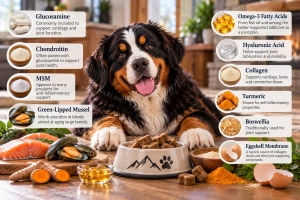
Glucosamine is the ingredient most people recognize; it’s a standard part of many formulas and is commonly included to support cartilage and joint function. Chondroitin is often paired with it. MSM appears in many products for anti-inflammatory support. Green-lipped mussel is worth attention in blends aimed at aging large breeds. Omega-3 fatty acids from fish oil are among the better-supported additions to a joint plan and deserve more attention than they often get in chewables. You may also see hyaluronic acid, collagen, turmeric, boswellia, or eggshell membrane — helpful in context, but a long trendy ingredient list isn’t automatically better than fewer ingredients at meaningful doses. For giant breeds, label transparency matters more than length. The evidence for these ingredients is mixed and individual response varies, so treat them as reasonable support rather than proven therapy.
What makes a supplement better for a Berner
Because these dogs are so large, dosing is a major issue. Some products are fine in principle but underdosed for a 90–115 lb dog unless you feed an impractical number of chews. Check the serving size for your dog’s actual weight before buying. Palatability matters too — soft chews are usually easiest for consistency, powders mix into wet food, and tablets are often least convenient. Favor clear dosing by weight, straightforward ingredient amounts, and solid manufacturing standards. Vague “proprietary blend” labels are a drawback.
Red flags
Be cautious of any product that claims to rebuild joints, reverse dysplasia, or replace veterinary care — those promises target owners searching during a stressful moment. Also watch for formulas with too little of the core ingredients but premium pricing for packaging, and for unnecessary fillers, artificial colors, or unclear sourcing. For a breed already prone to health issues, simpler and cleaner is the safer direction.
The basics matter more than the scoop
Even the best formula can’t compensate for lifestyle factors that keep stressing joints. If your Bernese is carrying extra weight, that’s usually the most powerful place to start — a leaner body reduces joint strain every day. Pair any supplement with good traction on floors, moderate exercise instead of weekend overexertion, an orthopedic bed, ramps where helpful, and prompt veterinary attention when something changes.
Choosing one without getting overwhelmed
Start with your goal. A healthy young adult may only need a basic, reputable glucosamine-chondroitin formula; an older or slowing dog may suit a broader formula with MSM, green-lipped mussel, or added omega-3 support. Check the serving size for your dog’s weight, ask your veterinarian whether the ingredients are appropriate (especially with prescription medication, a sensitive stomach, or upcoming surgery), and then give it a fair trial of several weeks rather than switching every few days. Note small changes: how quickly your dog rises, whether stairs seem easier, whether post-walk stiffness improves.
The bottom line
Realistic expectations are the point. The right product may help your dog move more comfortably, especially used early and consistently. It will not erase orthopedic disease, and it should never delay a workup for limping, pain, weakness, or sudden mobility changes. Look for transparent ingredients, practical dosing for giant breeds, and a formula matched to your dog’s stage of life — then support it with lean body weight, steady low-impact exercise, traction at home, and prompt veterinary care. For a breed as loving as the Bernese, joint care isn’t about chasing miracle products; it’s about keeping your gentle giant comfortable and steady for as long as possible.
Owner-written, not veterinary advice. This article is written by a Bernese Mountain Dog owner, not a veterinarian. It is general information gathered from veterinary and breed-club sources — not a diagnosis or a treatment plan. Every dog is different. If your dog is unwell or showing any sign described here, call your own vet. In an emergency, go straight in.
How we research this / Sources
- American Kennel Club — Glucosamine for Dogs: Uses, Side Effects, and Alternatives
- American Kennel Club — How to Manage the Symptoms of Canine Arthritis
- VCA Animal Hospitals — Arthritis (Osteoarthritis) in Dogs
- American Kennel Club — Bernese Mountain Dog breed information
Written by Todd Grasse, a Bernese Mountain Dog owner and founder of Bernese Mountain Lover. Todd writes from real owner experience with Scarlett, Reba, and Indy, combined with reputable veterinary and breed-health sources. This is general education, not veterinary advice.

1 Comment
ogndwmjrixqxkwdhfmrqtzgvrrnwqu