

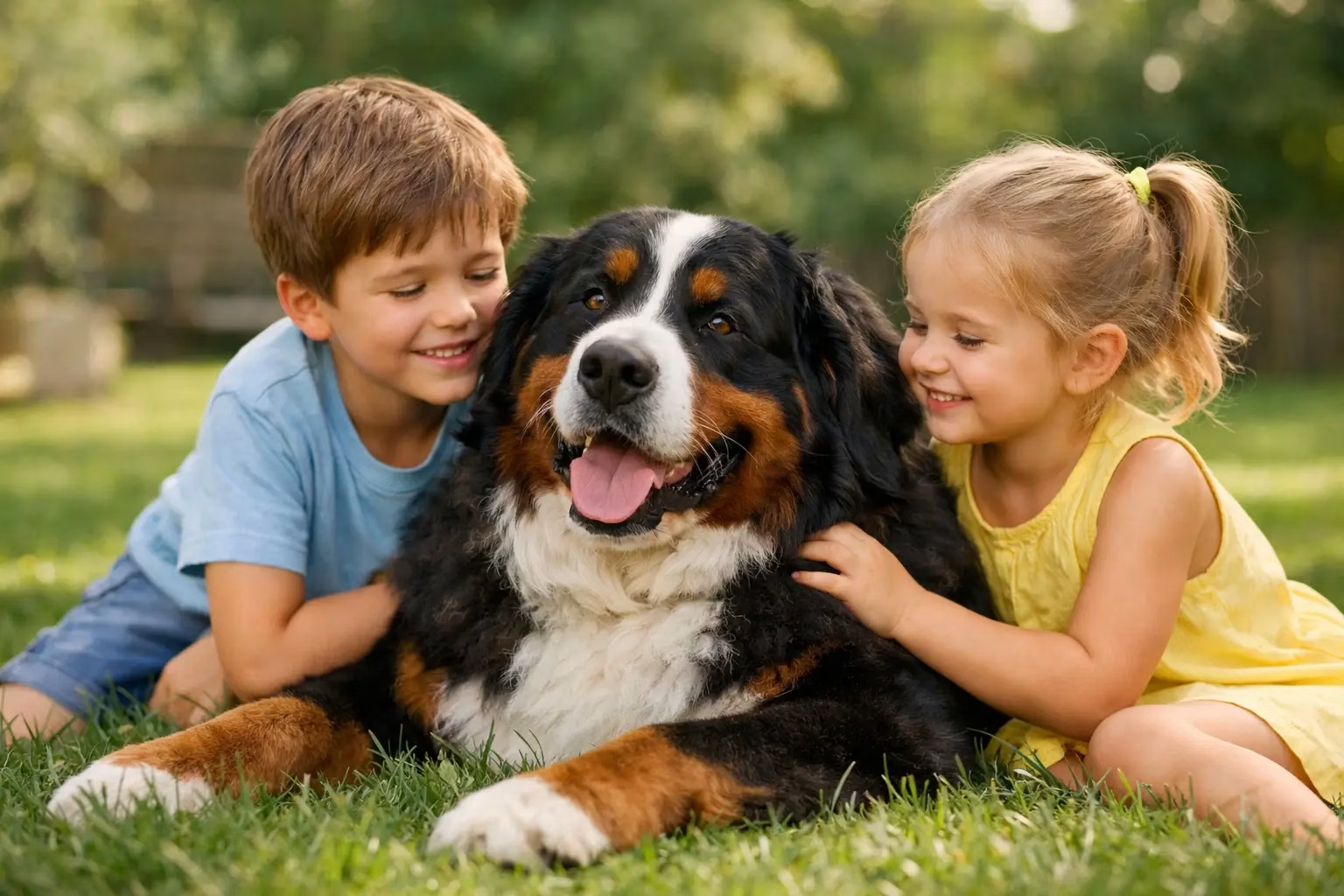
A Bernese leaning softly against a child on the couch looks like the picture of a perfect family dog. Often, that picture is real. Bernese mountain dog temperament with kids is one of the breed’s biggest strengths, but families do best when they understand both the sweetness and the limits that come with a giant, sensitive dog. My firsthand experience is that the Bernese in our lives can be little angels, protecting not only us but our children, and they are great with kids once trained well. I once went camping with Scarlett when she was 2. A group of campers pulled in nearby and were together with maybe 4-6 kids. I did not notice, but within the hour one of the young kids coaxed her from under my trailer and she went to play with the children. I must have been in the trailer setting things up at that time or something (as I rarely tied her up when camping – she was so good!) When I came out, I was shocked to find my dog lying on the ground a few feet away from the trailer, with four kids on top of her, petting her and giving her love!
Bernese Mountain Dogs are widely loved for being affectionate, steady, and people-oriented. Many are naturally gentle with children and seem to enjoy being included in everyday family life. They are not usually sharp, reactive dogs when well bred and properly socialized. That said, “good with kids” does not mean every Bernese is automatically safe in every home, with every age group, or under every kind of stress. Socialization can help, but we also need to be aware of the limits we put on our dogs.
What Bernese Mountain Dog temperament with kids is really like
At their best, Bernese are calm, tolerant, and deeply attached to their people. They tend to prefer closeness over chaos. In family homes, that often shows up as a dog who follows the kids from room to room, settles nearby during playtime, and wants to be part of the routine without constantly demanding attention.
This breed usually has a soft emotional style. Bernese often respond better to calm guidance than hard corrections, and many are sensitive to raised voices or rough handling. With that being said; it can take some time for our Bernese to accustom themselves when that sweet little baby turns 2 or 3 and can become more rowdy and demanding. Around children, that sensitivity can be a benefit because it often pairs with patience. A well-adjusted Berner may tolerate noise, movement, and a busy household better than some more intense working breeds. In my experience; they are great around kids, but yet both kids and their loving protecting dogs need to be trained at first on how to interact with each other. The dog may need to be trained to be calm and move slow around young children, as they can knock over and harm young children (especially the tails around young children). Young children may need to be taught to not hit dogs and to “play nice”. Both kids and dogs – They both need a bit of training together!
Still, temperament is never just about breed. Genetics, early socialization, health, and training all shape how a dog behaves around kids. A stable Bernese from health-tested, temperament-focused lines is very different from a poorly bred dog with fear issues or weak nerves.
Why families are drawn to Bernese Mountain Dogs
There is a reason so many families considering a large breed end up looking hard at Bernese Mountain Dogs. They are often loving without being hyper, watchful without being overly suspicious, and playful without being relentless. Many owners describe them as emotionally intuitive. They often seem to sense when a child needs comfort and when the house needs a calmer presence.
They also tend to form strong bonds across the whole household rather than attaching to only one person. For families, that matters. A dog that happily engages with parents and children alike usually fits family life more naturally. I have noticed that as well; as all of my dogs have really bonded with family and friends over the years.
But the family-friendly reputation can create false confidence. A Bernese may adore children and still knock over a toddler by turning too fast (or with the tail!!!). A puppy may be sweet and still mouth hands, grab clothing, or jump when excited. A sick, sore, or overtired dog may have less patience than usual. Good homes prepare for those realities instead of assuming gentleness solves everything.
The biggest strengths around children
One of the strongest traits in this breed is steadiness. Many Bernese do not come into a room looking to control it. They are often content to observe, rest nearby, and join in at a moderate pace. That lower-intensity style can be a very good match for children, especially compared with breeds that stay in constant motion.
Another strength is tolerance. Well-socialized Bernese often handle the normal unpredictability of family life reasonably well. The sound of toys, kids running down the hall, and changing daily rhythms may not bother them as much as it would a more sensitive or high-strung dog.
Affection is the other major advantage. Bernese are known for leaning, cuddling, and wanting close contact. For older children who know how to respect a dog’s space, that can create a truly beautiful bond.
Where problems can happen
The first issue is size. Adult Bernese Mountain Dogs commonly weigh well in the 80-120 pounds range. Even a gentle dog can accidentally bump, topple, or step on a small child. This is especially true during adolescence, when the dog is big but not fully coordinated.
The second issue is slow maturity. Bernese puppies and teenagers can be goofy, impulsive, and physically clumsy for longer than some people expect. Families imagining an instant calm giant are often surprised by the mouthy, jumpy stage. That phase is manageable, but it takes training and patience.
The third issue is sensitivity. Bernese are not usually suited to rough, chaotic handling. If children climb on the dog, pull fur, corner the dog, or interrupt rest constantly, even a sweet dog can become stressed. Stress does not always look dramatic. It may show up as licking lips, walking away, hiding, or avoiding the child before it ever becomes a growl. This happened with me once with Indy, at a get together with friends. I left to go inside and left Indy. I maybe was inside for a few minutes gathering things and came out to find some of my friends young kids all around her banging toys and things on her and generally playing not as gentle as she would have got at home. I could see it in her eyes that she was scared, standing straight (and hoping for my return); but yet she let the kids continue until I saw what was happening upon returning from inside. I asked the kids to slow down, Indy ran to me, and we all had a chat about playing nicer with dogs!
Bernese Mountain Dogs with toddlers
Toddlers are often the hardest age group for any large dog, and Bernese are no exception. The challenge is not that the breed dislikes small children. It is that toddlers are unsteady, grabby, loud, and unpredictable, while Bernese are huge and often physically unaware of their own impact.
A Bernese can be loving with a toddler and still be a risky match without constant adult oversight. Excited greetings, fast turns, swinging tails, and attempts to join the action can send a little one to the floor. For this age group, management matters as much as temperament. Gates, structured downtime, and very close supervision are what keep interactions safe. I always had trained dogs at this stage; but for anyone going through this or about to go through it I would definitely recommend offsetting new children and Berners by a few years – to give you some safety.
Bernese Mountain Dogs with school-age kids
This is often the sweet spot. School-age children can usually learn respectful dog handling, follow household rules, and participate in training. Bernese often thrive when kids are old enough to be calm, consistent, and involved. They also love being talked too, and school-age kids are great at that!
At this stage, the relationship can become especially rewarding. Many Bernese love walking with older children, lying beside them during movie time, and joining family routines. A child who understands how to give the dog space during meals, rest, and stressful moments can help build a bond based on trust rather than constant correction.
How to set a Bernese up for success in a family home
Start with breeder or rescue selection. This matters more than many people want to admit. Look for stable, social dogs with a track record of good family temperaments. Fearful or highly anxious lines are a poor fit for homes with children. Rescue dogs with problems may or may not be the best fit. I did not have the best luck with Reba, as unfortunately she was abused a bit before I adopted her. If going the adoption route; I would spend a lot of time with the dog priorhand to make sure no problems may exist.
Socialization should be thoughtful, not overwhelming. A Bernese puppy needs positive exposure to kids of different ages, normal household noise, handling, movement, and routine disruptions. The goal is confidence, not flooding the puppy with every possible experience. If possible, train the dog the first 1-2 years before you are training the kids! Training both a new born baby and a puppy Bernese at the same time is how dogs end up in the pound.
Training should focus on the family basics early. Sit for greetings, no jumping, polite leash walking, leave it, drop it, place, and comfort with handling all make daily life with kids easier. Because Bernese are sensitive, calm consistency works better than heavy-handed methods. During the puppy phase it is incredibly important for you to TOUCH your dog all over. Eyes, ears, teeth tail, legs, belly, chest, etc. Not only does this prepare the dog for your children (or future children), but it really pays off well down the road at the vet clinic, as they have to look as their eyes, ears, tongue, etc.
Just as important, train the children. Kids should never climb on the dog, hug tightly, disturb meals, take toys away, or approach when the dog is sleeping. Many bite incidents happen because adults teach dogs what to do but never teach children how to behave around dogs.
Watch the dog in front of you
Breed tendencies are helpful, but individual dogs matter more. Some Bernese are naturally social and patient with children. Others are more reserved and prefer quieter interactions. Neither is wrong. Problems usually start when a family tries to force a dog into a role that does not fit its temperament.
Pay attention to body language. A Bernese that turns away, yawns repeatedly, tucks the tail, licks lips, stiffens, or keeps leaving the room is communicating. Respecting those signals protects both the dog and the child. Always be sure that the dog has a “safe space” to go to that the kids can not bombard them – as everyone needs a break at times from kids (even Berners, sometimes!)
Health also affects behavior. This breed is prone to painful orthopedic issues, and a dog with discomfort may have less tolerance for being touched or crowded. If a normally patient Bernese becomes irritable, avoid assuming it is a training problem. Pain should be considered early.
Is a Bernese the right family dog for you?
For many households, yes. Bernese Mountain Dogs can be wonderful with children when they are well bred, well trained, and carefully supervised. They often bring a rare mix of warmth, loyalty, and calm presence that families fall in love with quickly.
But they are not low-maintenance family décor. They are giant dogs with grooming needs, health risks, short lifespans, and a real need for structure. If your home is extremely chaotic, if adults cannot actively supervise dog-child interactions, or if you want a dog that can tolerate anything a child does, this may not be the right breed.
Families who do best with Bernese usually see them clearly. They love the breed for its gentle heart, but they also respect its size, sensitivity, and physical vulnerability. That balance is what turns a hopeful match into a safe and lasting one.
If you are considering bringing one home, picture the daily rhythm honestly, not just the dream photo. A Bernese can be an extraordinary companion for children, especially when the adults in the house are just as gentle, steady, and dependable as the dog they hope to raise.
Written by Todd Grasse, founder of BerneseMountainLover.com and Bernese Mountain Dog owner, drawing on first-hand experience with the breed.
