
ⓘ Affiliate Disclosure: This post contains affiliate links. As an Amazon Associate, we earn from qualifying purchases at no extra cost to you. Read our full disclosure.
The right toys keep a Bernese Mountain Dog physically active and mentally engaged — and the wrong ones can be a choking or blockage risk for a dog this size. Berners are powerful but generally gentle players, so the goal is durable, appropriately large toys that match how your individual dog plays. Here’s how to choose, by type and by safety.
Size and safety come first
Whatever the toy, it has to be too big to swallow or lodge in the throat of a 70–115 lb dog. Avoid balls and toys that can fit fully in the mouth. Check toys regularly and throw out anything cracked, splitting, or chewed down to a swallowable size. Supervise play with any new toy until you know how your dog handles it, and match toughness to your dog — some Berners are gentle, others are determined destroyers.
Toy types that suit Berners
- Tough chew toys. Durable rubber chews (like the classic Kong) stand up to big jaws and can be stuffed with food for longer engagement. For dedicated chewers, see our best chew toys roundup.
- Food-dispensing and puzzle toys. Excellent for mental work on rainy or hot days when outdoor time is limited. A stuffed, frozen Kong or a treat puzzle can occupy a Berner for a good while.
- Plush toys. Many Berners love a soft toy to carry around. Fine for gentle dogs, but supervise — a strong chewer can shred plush and swallow stuffing or squeakers.
- Tug and rope toys. Good for interactive play and light dental benefit. Use heavy-duty rope sized for a large dog, and toss it if it starts to fray badly (swallowed strands can cause blockages).
- Fetch toys. Large rubber bumpers or oversized balls (bigger than the mouth) work for dogs that like to retrieve, though not every Berner is a natural fetcher.
Sizing a toy so it cannot become an emergency
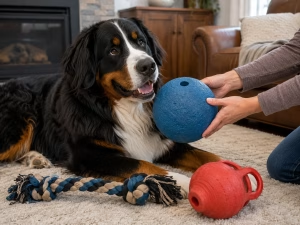
The mistake almost every large-dog owner makes at least once is buying a toy sized for a dog rather than for this dog.
The rule that matters: if a toy or ball can fit entirely behind the molars, it is too small. A Bernese has a mouth big enough to get a standard tennis ball past its back teeth, and a ball lodged at the back of the throat is an airway obstruction that gives you seconds, not minutes. Buy the oversized ball. It costs a dollar more.
Two related points on tennis balls specifically. The felt covering is mildly abrasive and, over years of hard chewing and fetching, contributes to worn tooth enamel — fine as an occasional fetch toy, poor as a daily chew. And a ball a Berner has crushed flat is more dangerous than a round one, because a flattened ball travels further back before it re-expands.
Chew hardness: the thumbnail rule
Bernese Mountain Dogs are strong chewers without generally being obsessive destroyers, which means the greater risk for this breed is not swallowing pieces but fracturing a tooth — usually the upper carnassial, the large slicing tooth at the back.
The rule of thumb used widely in veterinary dentistry: if you cannot make a dent in it with your thumbnail, or you would not want it hitting your kneecap, it is too hard to chew on. That rules out most of the popular category:
- Antlers and hooves
- Real bones, cooked or raw — cooked bones also splinter
- Hard nylon bones of the unbending sort
- Ice cubes as a routine chew
A fractured carnassial is not a wait-and-see problem. It exposes the pulp, it hurts, and it usually ends in extraction or a root canal under general anaesthetic — on a dog whose anaesthetic risk is already higher for being large.
What to supervise, and what to leave down
Worth splitting your toy box in two.
Supervised only: rope toys, anything with stuffing or a squeaker, and rawhide. Rope is the one people underestimate — swallowed strands can form a linear foreign body, where the fibre catches at one end and the intestine concertinas along it. That is major surgery, and it does not always show up on a first X-ray. Squeakers and stuffing are straightforward obstruction risks, and rawhide swells after it is swallowed.
Safe to leave down: solid rubber toys of the right size, food-stuffable rubber toys, and durable rubber chews with some give in them. These are also the ones that do enrichment work rather than just occupying the mouth — a frozen stuffed rubber toy will hold a bored Berner far longer than anything squeaky.
Whatever you leave down, retire it once it starts coming apart. The point at which a toy becomes interesting to destroy is the point at which it becomes worth swallowing.
What to avoid
Skip toys small enough to swallow, brittle plastics that splinter, and anything that breaks into sharp pieces. Be cautious with very hard chews (some antlers, hard nylon, real bones) that can crack large-breed teeth — the rule of thumb is if you can’t make a slight dent with a thumbnail, it may be too hard. Always remove and replace destroyed toys promptly.
Matching toys to enrichment
Toys are part of a Berner’s overall mental and physical enrichment, not a replacement for walks and time with you. Rotating a few toys keeps them interesting, and pairing a puzzle toy with a calm afternoon is a great way to settle a dog that has energy to burn but can’t get outside.
Related reading: Bernese exercise needs · activities and enrichment ideas
As an Amazon Associate, this site earns from qualifying purchases.
