
Bernese Mountain Dogs were bred as Swiss farm dogs that pulled carts and worked alongside their people, so many of them genuinely enjoy having a job. Formal dog sports give a Berner structured exercise, mental work, and time bonding with you. None of this is required — plenty of Berners are happy with walks and play — but for a dog that wants more, these activities suit the breed well.
From my own experience: mine aren’t formal competition dogs — most of our “sport” is a solid daily walk and some play. But you can absolutely see the working-dog wiring in them: they’re happiest when they’ve got something to do and someone to do it with, and a Berner with a bit of a job to focus on tends to be calmer and more content at home. If your Berner seems restless, adding a little structure like this often helps more than just piling on more exercise.
Carting and drafting
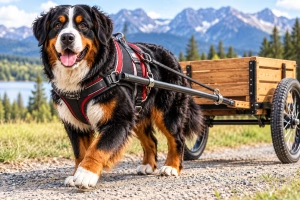
This is the breed’s heritage sport. Berners can be trained to pull a cart or wagon, and clubs offer drafting tests that reward control and teamwork over raw power. It’s a wonderful fit for the breed, but start only with a fully grown dog (to protect developing joints), proper fitted equipment, and gradual conditioning. Many owners find carting is the activity their Berner is most enthusiastic about.
Rally and obedience
Berners are intelligent and eager to please, which makes them well suited to rally (a course of signposted obedience stations) and traditional obedience. These sports are low-impact, great for the dog’s mind, and build a strong working relationship — a good choice if you want structure without heavy physical demands.
Tracking and nose work
Scent sports let a dog use its nose to find hidden articles or follow a trail. They’re low-impact and joint-friendly, work for dogs of almost any age or fitness level, and are mentally tiring in the best way. A great option for a Berner that can’t do high-impact activity.
Therapy and visiting work
The gentle, steady Bernese temperament makes many of them excellent therapy dogs. With the right temperament and certification, a Berner can do meaningful visiting work at hospitals, schools, and care homes — a calm “job” that plays to the breed’s strengths.
Other options to explore
Some Berners also enjoy beginner agility (kept low and slow to protect joints — avoid high jumps and hard landings), canine conditioning/fitness work, and weight-pull events run by clubs. Whatever you choose, fit the sport to your individual dog.
Impact load: which sports suit this build and which do not
A Bernese is a heavy, slow-maturing, orthopaedically vulnerable breed. That does not rule out sport — it rules out a specific kind of sport, and it is worth being clear about which.
Low impact, well suited. Tracking and nose work, rally, obedience, therapy visiting, carting and drafting once mature, and long steady walks on forgiving ground. These load the dog’s brain and its strength rather than hammering its joints.
High impact, approach with care. Competitive agility at full jump height, flyball, repeated hard turns on grass, and anything involving jumping in and out of a vehicle repeatedly. None of it is forbidden for a mature, sound, lean Berner, but the risk-to-benefit ratio is worse than it is for a 40-pound dog, and it should follow a veterinary conversation rather than precede one.
Genuinely unsuitable. Distance running as a training partner, and any sustained sport in summer heat. On the second point the evidence is unambiguous: in a study of UK veterinary records, dogs over 50 kg had 3.42 times the odds of heat-related illness compared with small dogs, and 74.2% of heat-related illness events were brought on by exercise rather than by hot cars. A heavy double-coated dog working hard on a warm day is the exact profile that gets into trouble.
Carting and drafting: what it actually involves
This is the breed’s heritage sport and the one most Berner owners are curious about, so it is worth setting expectations.
Drafting is pulling a cart or wagon in a purpose-built harness, and it is a strength discipline rather than a speed one. A drafting harness is not a walking harness — it spreads load across the chest and shoulders and is fitted to the individual dog, and using the wrong harness is how dogs get sore.
Start age is the thing people rush. A Bernese takes roughly two years to reach skeletal maturity, and load-bearing work belongs on the far side of that. Training the behaviour can start much earlier — wearing the harness, accepting something behind them, steady starts and stops, backing up on cue — all with no weight in the cart at all. That separation is the whole trick: teach everything, load nothing, until the dog is grown.
The Bernese Mountain Dog Club of America runs formal draft tests, which give the work a structure and a goal if you want one. Plenty of owners never enter anything and just do it for the enjoyment of giving a working breed a job.
Signs you are asking too much
A Berner will generally keep going for you past the point it should stop, which is exactly why the handler has to make the call rather than the dog.
- Slowing or dropping behind on the return leg of a route it managed comfortably before
- Lying down at the end of a session and being reluctant to get up
- Stiffness the following morning, or a shortened stride
- Sitting or lying down mid-activity, which in this breed usually means finished rather than disobedient
- Heavy panting that does not settle within a few minutes of stopping in shade
Stiffness the day after is the one to take seriously. It is easy to write off as a good workout, and in a breed with this much orthopaedic risk it is worth a conversation with a vet rather than a shrug.
Keep it safe for a large breed
Two rules apply across every sport: wait until growth plates close before any high-impact or pulling work (generally 18–24 months — ask your vet), and never train or compete in the heat. Warm up, build conditioning gradually, keep your dog at a healthy weight, and stop if you see limping or reluctance.
Related reading: everyday activities and enrichment · exercise needs by age
