
Bernese Mountain Dogs are intelligent, eager to please, and sensitive — a combination that makes them rewarding to train as long as you’re consistent and positive. Because they grow so large, early manners aren’t optional: it’s far easier to teach good habits to a puppy than to undo them in a 100-pound adult. Here are the essentials, practical tips, and the mistakes that trip owners up most.
From my own experience: the biggest shift for me was leaning on positivity instead of negativity — getting mad at a puppy never once helped. When one of mine grabbed something they shouldn’t, like chewing on the wrong thing, I’d aim a firm “bad” at the item rather than at the dog, then redirect them to something they were allowed to have. Keeping the correction off the puppy and the praise on the good choices is what actually built good habits for us.
Start early and keep it positive
Begin training the day your puppy comes home, and build on it through adolescence. Berners respond best to reward-based methods — treats, praise, and play — and poorly to harsh corrections, which can make a sensitive dog anxious or shut-down. Keep sessions short (5–10 minutes), upbeat, and frequent.
The essentials to teach
- Name and attention — the foundation for everything else.
- House training — consistent schedule, supervision, and rewarding outdoor potty.
- Crate training — a safe den that also helps with house training and calm alone-time.
- Basic cues — sit, down, stay, come, and leave it.
- Loose-leash walking — critical for a strong dog; see our leash and loose-leash guide.
- Handling and grooming tolerance — so vet and grooming visits are easy.
Practical tips that work with the breed
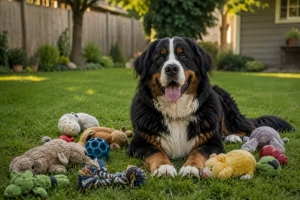
Use high-value rewards, be consistent across everyone in the household, and train before meals when your dog is motivated. End each session on a success. Pair training with daily exercise and enrichment — a Berner that has had a walk and some mental work learns far better than a restless one. And socialize alongside training; a confident, well-socialized dog is much easier to teach.
The three things that matter most in a giant breed
Plenty of training advice applies to any dog. These three are the ones where getting it wrong with a Bernese specifically costs you later, because the dog ends up weighing more than some of the people handling it.
1. Loose-lead walking, taught before the dog is strong enough to win
A pulling 20-pound puppy is an annoyance. A pulling 100-pound adult is a genuine safety problem — for you, for the dog’s neck and shoulders, and for anyone the dog decides to greet enthusiastically. The window where you get to teach this cheaply is roughly four to nine months, before the dog has the mass to simply out-pull you.
The core mechanic is unglamorous and it works: the lead going tight means forward motion stops, and slack means it resumes. Every time, by everyone in the household. A Berner is smart enough to learn this quickly and smart enough to notice if one person in the house lets pulling work.
2. Handling and cooperative care
This is the most under-taught skill in large breeds and the one your veterinarian will thank you for. Practise, from puppyhood, in short cheerful sessions: paws held and each toe touched, nails handled with clippers present before they are used, ears looked into, lips lifted and teeth examined, and the dog standing still to be gone over.
A 25-pound puppy that objects to nail trims is a minor inconvenience. A 100-pound adult that objects means sedation for routine care, which is more cost, more risk and a dog that finds the vet frightening for the rest of its life.
3. Bite inhibition, early
Berner puppies mouth like any puppy, and it is genuinely harmless at twelve weeks. The problem is that the same behaviour scaled up to adult jaw size is not harmless at all, and by then it is a habit rather than a phase. Teach it during the mouthy stage: play stops the instant teeth meet skin, and resumes when the mouth is soft. Redirect to a toy rather than punishing the dog for having a mouth.
Training around the growth plates
Bernese Mountain Dogs take roughly two years to reach skeletal maturity, and that constrains what you can train and when.
Obedience, socialisation, handling, tricks, scent work and loose-lead walking can all start immediately — none of them load the joints. What waits is repetitive high-impact work: agility jumping at full height, long-distance running on hard surfaces, repeated jumping in and out of a vehicle, and heavy drafting or carting.
Carting is the classic Bernese activity and worth doing, but it is a mature-dog sport. Talk to your veterinarian about when your individual dog is ready rather than working to a fixed number, and expect that answer to be later than it would be for a mid-sized breed.
The practical version for the first two years: teach everything, load nothing.
A realistic timeline
Rough guide for a well-socialised puppy in a consistent household. Individual dogs vary considerably, and adolescence undoes things temporarily in almost every dog around eight to fourteen months.
- 8–16 weeks. Name, house-training, crate as a good place, handling, sit and down, first recalls in the house, puppy class.
- 4–6 months. Loose-lead walking in earnest, stay building duration, recall away from mild distraction, settle on a mat.
- 6–12 months. Proofing everything in harder environments. Expect regression — adolescence is not the dog forgetting, it is the dog testing.
- 12–24 months. Reliability under distraction, and gradual introduction of physical work as the joints allow.
Common training mistakes to avoid
- Starting too late. Waiting until problems appear makes everything harder. Begin in puppyhood.
- Inconsistency. Different rules from different people confuse the dog. Agree on cues and rules as a household.
- Harsh corrections. Punishment-heavy methods damage trust with a sensitive breed and can worsen fear-based behavior.
- Skipping socialization. Obedience without socialization still leaves a dog that can be fearful or reactive.
- Too-long sessions. Long, repetitive drills lose a dog’s attention; short and frequent wins.
- Accidentally rewarding bad habits. Giving attention for jumping or barking teaches the dog to repeat it.
- Not proofing behaviors. A “sit” that only works in the kitchen isn’t finished — practice in new places and around distractions.
When to get help
A reputable puppy class or positive-reinforcement trainer is a great investment, especially for first-time large-breed owners. For anxiety, reactivity, or any aggression, work with a qualified trainer or veterinary behaviorist.
Related reading: how to train a Bernese puppy (step by step) · socialization · behavior problems
